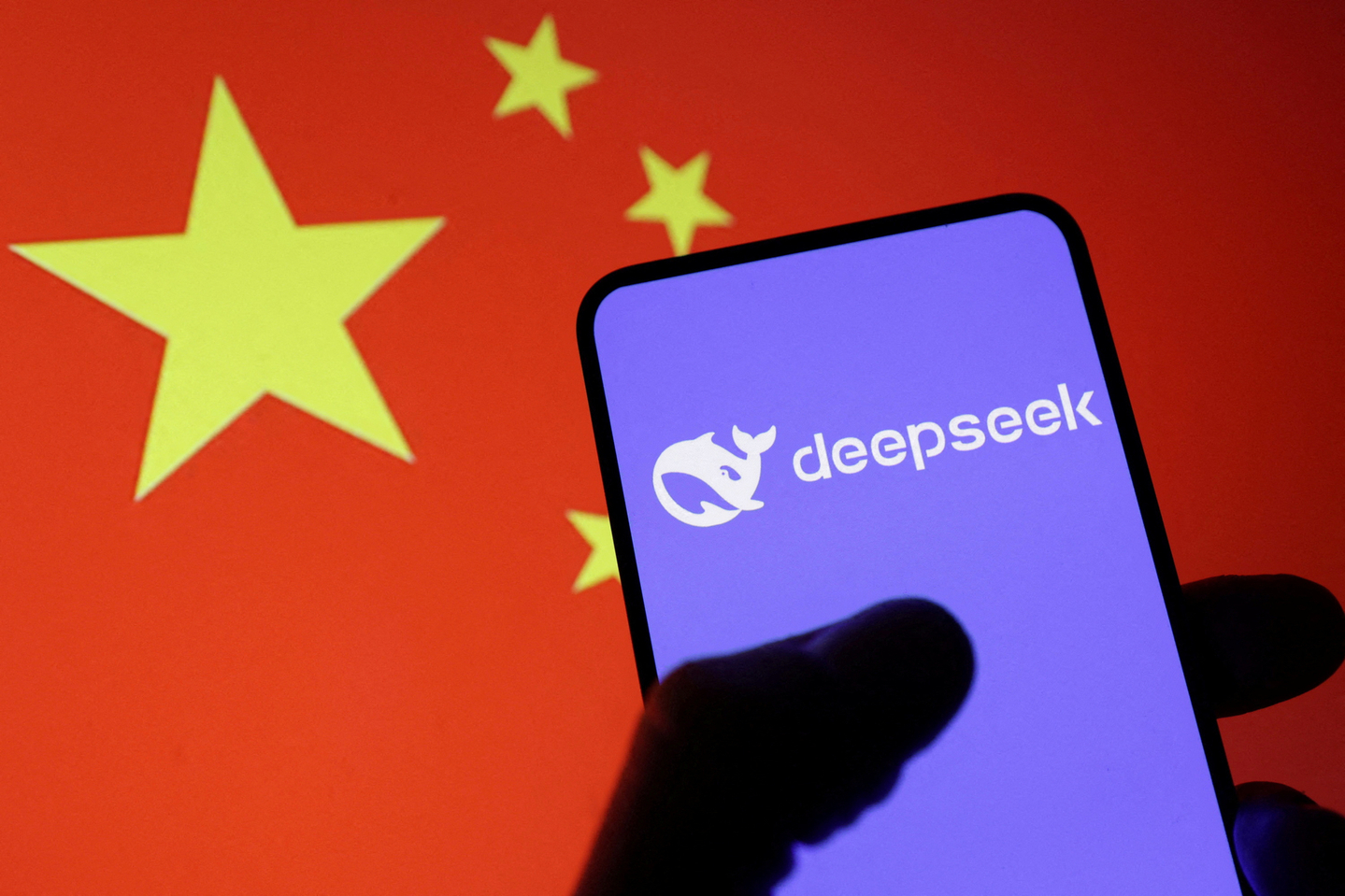
The Deepseek logo and a Chinese flag are seen in this illustration taken Jan. 29. [REUTERS/YONHAP]
Korea JoongAng Daily, December 3, 2025
The Chinese government is developing AI systems in the languages of China’s ethnic minorities — including Korean — to expand state surveillance and control, an Australian think tank warned.
The Australian Strategic Policy Institute (ASPI) said in a report published Monday that Beijing is developing large language model (LLM)-based public opinion analysis systems for Korean, Uyghur, Tibetan and Mongolian. The goal, it said, is to increase the state’s ability to monitor and control communications in those languages across text, video and audio.
ASPI said Chinese-developed models could be exported to countries participating in China’s Belt and Road Initiative (BRI), and added that these tools could ultimately affect Korean-language users outside China.
The report, titled “The party’s AI: How China’s new AI systems are reshaping human rights,” points to a government-backed laboratory at Minzu University of China as a key driver of the effort. China’s Ministry of Education established the National Key Laboratory of Ethnic Language Intelligent Analysis and Security Governance at the university, ASPI said.
The lab’s website states it was set up to “maintain national stability and ethnic unity.” Its main research areas include developing LLMs for Korean, Uyghur, Tibetan and Mongolian to build public opinion analysis and online security systems for minority communities.
Researchers collect internet data from regions inhabited by ethnic minority groups, extracting meaning from text, audio, video and even emojis posted by users. Using this, the lab aims to build what it calls “internet public opinion monitoring and sentiment analysis technology,” and claims to have developed large-scale knowledge databases in more than 10 minority languages.
![A member of the People's Liberation Army gesticulates while standing guard at the gate of the Old City of Kashgar, Xinjiang Uyghur Autonomous Region, China, Aug. 9. [EPA/YONHAP]](https://koreajoongangdaily.joins.com/data/photo/2025/12/03/de5d4010-d600-4aab-8a02-8250213ef269.jpg)
A member of the People's Liberation Army gesticulates while standing guard at the gate of the Old City of Kashgar, Xinjiang Uyghur Autonomous Region, China, Aug. 9. [EPA/YONHAP]
China has sizable minority populations including 1.7 million ethnic Koreans, 12 million Uyghurs, 6 million Tibetans and 6 million Mongolians. Minority languages have long represented a blind spot for Chinese state surveillance, the ASPI report noted.
Because these languages are spoken by relatively small populations compared to China’s 1.4 billion people, commercial AI models — including DeepSeek — have limited capabilities in minority languages, ASPI wrote.
China has therefore moved to build its own censorship systems. Efforts intensified after the National Ethnic Affairs Commission’s translation bureau developed intelligent voice translation software for seven languages — including Korean — between 2019 and 2020.
ASPI also suggested that China’s AI censorship tools may be deployed abroad. Another stated objective of the MUC laboratory is to “serve the Belt and Road Initiative,” and it collects online information from BRI countries to conduct public opinion monitoring research. The Australian think tank observed that “the lab doesn’t seem to distinguish between ethnic minority regions inside of China and populations speaking those languages in BRI countries.”
In 2022, the Chinese Association for Artificial Intelligence (CAAI) proposed applying LLM-based monitoring systems in BRI countries to maintain stability.
![A man walks outside the Tencent headquarters in Nanshan district of Shenzhen, Guangdong province, China, Sept. 2, 2022. [REUTERS/YONHAP]](https://koreajoongangdaily.joins.com/data/photo/2025/12/03/a603fd8e-35c1-44db-baf1-8c5f2db08be3.jpg)
A man walks outside the Tencent headquarters in Nanshan district of Shenzhen, Guangdong province, China, Sept. 2, 2022. [REUTERS/YONHAP]
The Chinese Communist Party has increasingly incorporated AI into its internet censorship system, known as the Great Firewall.
China’s tech giants — Tencent, Baidu and ByteDance — are also developing AI censorship tools. The report said these companies effectively act as “deputy sheriffs.” Tencent, which operates the messaging app WeChat, has expanded monitoring from public posts to private chats, assigning users risk scores. Baidu sells its AI censorship tools to other firms.
AI’s growing role has extended censorship to images as well. When ASPI researchers tested 200 sensitive images — including content related to the Tiananmen Square crackdown, Hong Kong protests and Uyghur and Tibetan demonstrations — Chinese AI systems either refused to respond or offered critical commentary.
Researchers also asked China’s Ernie model by Baidu to generate a satirical meme depicting President Xi Jinping as Winnie the Pooh. The chatbot immediately terminated the conversation, the report said.
To identify political context or sensitive expressions that AI systems fail to detect, human moderators are still needed. Companies are therefore strengthening censorship through hybrid systems that combine AI and human labor, the report said. Chinese tech firms are also recruiting workers proficient in minority languages and foreign languages to support these systems.
This article was originally written in Korean and translated by a bilingual reporter with the help of generative AI tools. It was then edited by a native English-speaking editor. All AI-assisted translations are reviewed and refined by our newsroom.