By Taha Kılınç
Saturday, December 20, 2025
Every civilization brings forth its own type of human being. Within this framework, Islam also has a specific human archetype and model. If you look closely at Muslims who have left a mark on history and paved a path for others to follow, you will observe certain common characteristics. Alongside fundamental virtues such as diligence, patience, altruism, and idealism, these are personalities capable of placing jihad beside knowledge, and the sword and weapon beside the pen when necessary. The "Islamic person" is a mature and evolved character—a resilient type of human capable of charting their course according to the flow of events and continuing their struggle without turning back, under any condition or circumstance.
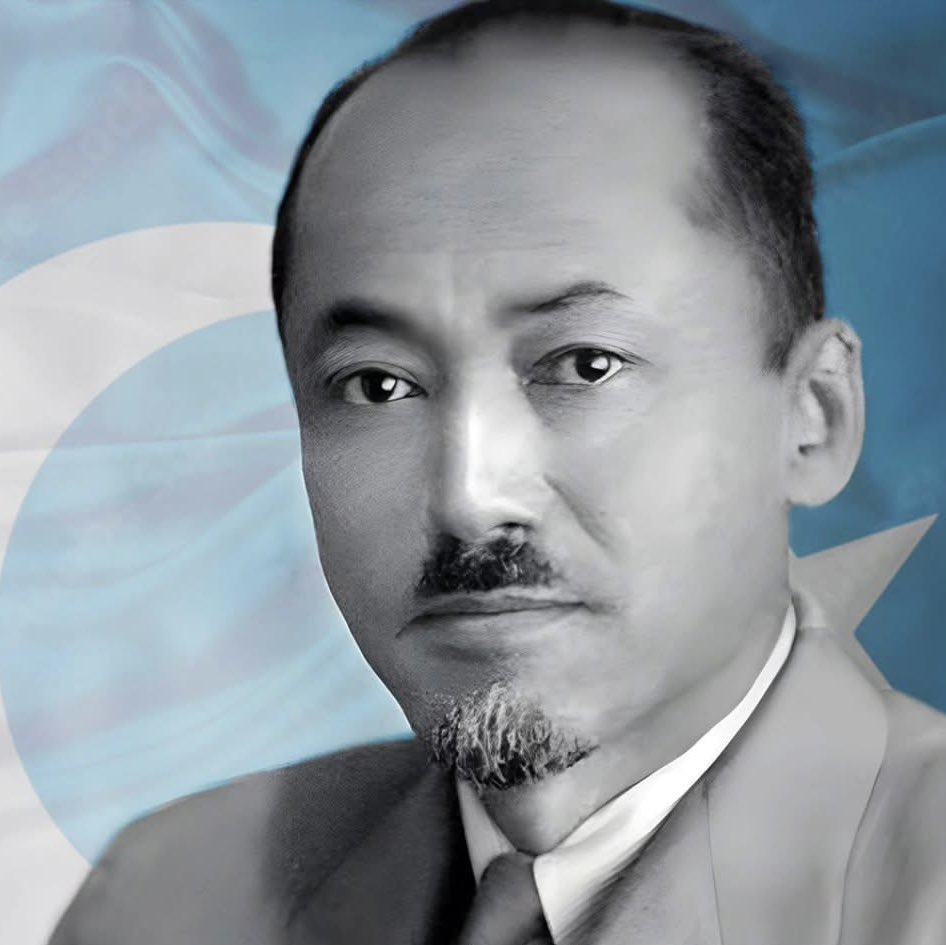
In our recent history, it is possible to encounter such figures everywhere in the Islamic geography. However, I focus more on the voices rising from crisis regions. This is because the example they set serves as an epic of patience and resistance that transcends ages. If one were to ask, "Like whom?", one of the first examples that comes to my mind is Muhammad Amin Bughra (1901-1965).
Born in the city of Hotan in East Turkistan as the son of a distinguished family whose roots trace back to the famous Sufi Khoja Ubaydullah Ahrar (d. 1490) buried in Samarkand, Muhammed Emin Buğra received a solid Islamic education under his uncle's supervision, as his father passed away when he was young. From his youth, Buğra had fully realized the reality of the situation in East Turkistan under Chinese oppression. During a six-month tour of the country he embarked on in 1931, he visited all the cities of East Turkistan and observed the condition of the people; he held long consultations with the scholar and politician Sabit Damolla (1883-1941) in Ghulja. Buğra and Damolla agreed on the necessity of waging an active struggle against China. The first uprisings, which began in Karakash county under the leadership of the "National Revolution Organization" founded by Buğra in 1932, spread to the entirety of Hotan in a short time. Within a month (April 1933), the "Khotan Islamic Government" was established.
Leading a very intense life until 1949, when he was forced to leave East Turkistan for good, Muhammed Emin Buğra spent the period between 1934 and 1943 in exile in India and Afghanistan. His work titled "History of East Turkistan", which he completed during his residence in Kabul, remains a masterpiece and a serious reference source that has yet to be surpassed today.
After settling in Ankara in 1951 following his migration, and succeeding in settling 1,850 East Turkistani refugees in Turkey as a result of negotiations with the Adnan Menderes government, Muhammed Emin Buğra now had a new global mission: to represent the East Turkistan cause in the diplomatic arena across various circles of the Islamic world, from Delhi to Cairo, from Lahore to Jerusalem, and from Mecca to Rawalpindi. This process was so fruitful that today it is possible to find people all over the Arab world who know Muhammed Emin Buğra and have witnessed his struggle.
Living a dynamic and fruitful life of 64 years, Muhammed Emin Buğra passed away on June 14, 1965, in Ankara, far from the homeland he loved dearly and always missed. Today, his grave in the Cebeci Asri Cemetery awaits visitors as a symbol of the fighting spirit of an Islamic person.
My reason for commemorating Muhammed Emin Buğra is the "International Muhammed Emin Buğra Symposium in Memory of the 60th Anniversary of His Passing," held last Wednesday (December 17) hosted by the Silk Road Studies Institute at Istanbul Sabahattin Zaim University, with contributions from the Farabi Education and Culture Association, Buğra Academy, the Union of East Turkistan Scholars, the Digital Memory Association, and Taklamakan Publishing. The symposium, held at the Abdullah Tivnikli Hall on the university's Halkalı campus, had two particularly striking aspects: the number of young academics and researchers was very high, and papers were presented in four different languages: Turkish, Arabic, English, and Uyghur. Thus, Muhammed Emin Buğra was commemorated and remembered with a program of this scale for the first time in Turkey's academic circles.
I was also invited to the symposium, but I had three separate speeches on East Turkistan in different parts of Istanbul on the same day. Therefore, we made a sort of "division of labor" with our Uyghur friends: while they spoke about the cause at the university, I spoke about the same cause at schools simultaneously.
On this occasion, may the noble soul of the Islamic persona, Muhammed Emin Buğra, be happy and blessed.
https://www.yenisafak.com/yazarlar/taha-kilinc/bir-islam-insani-4780131