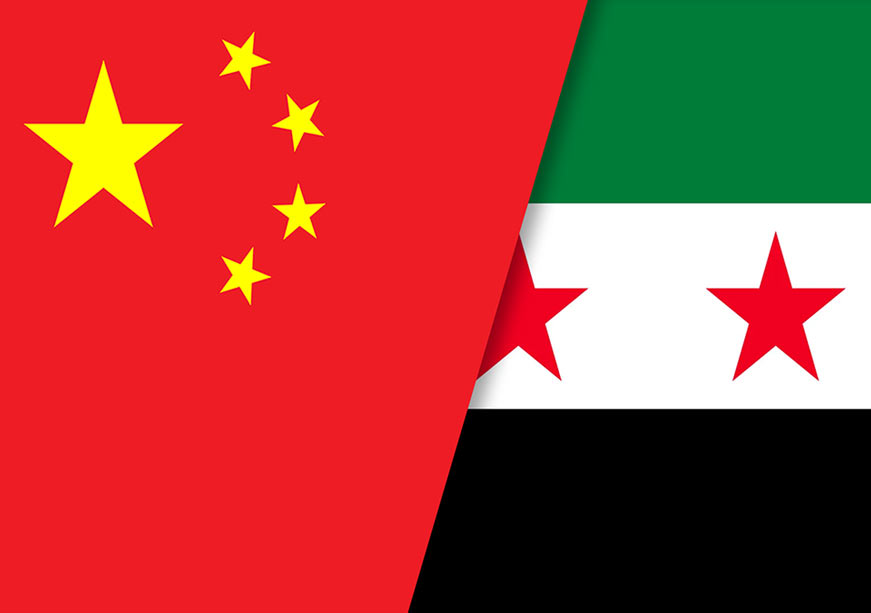
China is leveraging Syria’s post-Assad transition to press Damascus into repatriating Uyghur fighters
Author : Ayjaz Wani
Expert Speak Raisina Debates
ORF, Jan 17, 2026
For the first time since the fall of the Assad regime, Syrian Foreign Minister Asaad al-Shaibani visited China in November 2025 and met his Chinese Foreign Minister counterpart, Wang Yi, in Beijing. The meeting focused on strengthening bilateral relations and expanding cooperation, with the main agenda beingthe repatriation of Uyghur fighters from Syria. Media reports on the discussions indicated that Damascus agreed to send 400 Uyghur fighters back to Beijing, causing significant concerns about their safety. Although the Syrian government has denied reports of deportation, al-Shaibani strongly endorsed the one-China principle during the meeting. He alignedwith China’s security concerns, including combating terrorism in all its forms, and stated that no entity perceived to jeopardise China’s national security will be permitted to operate from Syrian territory.
Media reports on the discussions indicated that Damascus agreed to send 400 Uyghur fighters back to Beijing, causing significant concerns about their safety.
Notably, al-Shaibani’s overt expression of sympathy with China on its concerns followed Beijing’s abstention from the United Nations Security Council (UNSC) vote on a resolution to lift sanctions on Syrian President Ahmed al-Sharaa, citing t counterterrorism concerns, particularly regarding foreign fighters such as Uyghurs. Fu Cong, China’s Permanent Representative to the United Nations, reiteratedthat Syria should fulfil its commitments to prevent terror attacks and tackle the threat from foreign terrorists, including members of the East Turkistan Islamic Movement (ETIM) and Turkistan Islamic Party (TIP). It is also notable that in 2020, the United States (US) removed ETIM from its list of terror organisations after two decades and defended this decision, stating that for over 10 years, “there has been no credible evidence that ETIM continues to exist.”
The Uyghur Presence in Syria’s Post-Assad Power Shift
In December 2024, Hay’at Tahrir al-Sham (HTS) under Al-Sharaa, and opposition fighters overthrew Bashar al-Assad’s family regime, which had been in power for 53 years. Many of these fighters come from diverse ethnic backgrounds, including Uyghurs from the northwestern province of Xinjiang. Most of these Uyghurs, viewed by the Chinese authorities as a security threat, left Xinjiang in several waves, driven by China’s state repression, economic marginalisation, and human rights violations. The arbitrary detentions following the 2009 ethnic riots in Xinjiang forced many Uyghurs to travel to Türkiye with their families to live in exile. Consequently, as many of them faced socio-economic problems in Türkiye, the war-torn Syrian province of Idlib became a haven for them.
Furthermore, in exile, Uyghurs became the targets for radical ideologies and were recruited by extremist groups in the Af-Pak region and the Middle East. By early 2015, 700 Uyghur families had reached Idlib province, and roughly 1,500 Uyghurs had joined local jihadist groups, including the Islamic State and al-Qaeda. It is estimated that approximately 4,000 to 5,000 Uyghur fighters are fighting alongside various militant groups in Syria. The new government established under Syrian President Ahmed al-Sharaa began integrating foreign fighters, including Uyghurs, into the administration, with the majority integrated into the Syrian Ministry of Defence. The new Syrian government established the 84th Division, composed largelyof Uyghur fighters, and by December 2024 had promoted six foreign fighters—including Abdulaziz Dawud Hudaberdi, a Uyghur known as Zahid—to the rank of brigadier general.
Beijing’s Diplomatic Strategy toward Syria
The Uyghur fighters and their families view Syria as their home due to safety concerns relative toother Muslim countries. Beijing has leveraged its economic strength to establish extradition treaties with 81 countries worldwide, including Pakistan, Afghanistan, and Central Asian nations. Since 2017, Beijing has compelled Muslim countries to detain 682 Uyghurs, including those inTürkiye, even without formal extradition treaties. Beijing has also successfully used counterterrorism rhetoric to secure assistance from Interpol, sending 5,530 warnings, threats, and arrest requests. Since the previous Assad regime also fought against Uyghur militants, Beijing has consistently backed the al-Assad governmentand criticised the Arab Spring protests. To shield the al-Assad family from sanctions and arms embargoes, China exercised its veto power at the United Nations eight times, which further strained its relations with the new government led by Ahmed al-Sharaa. In addition, the presence of Uyghurs has constrained Beijing’s diplomatic support and economic aid to the Al-Sharaa government relative to Western powers, emerging as a growing strategic challenge for Chinese leadership.
Since 2017, Beijing has compelled Muslim countries to detain 682 Uyghurs, including those inTürkiye, even without formal extradition treaties.
Nevertheless, Syria’s new government requires financial assistance from other countries, such as China, for reconstruction after years of conflict, as well as diplomatic support to enhance its international standing and end its isolation. To realign relations with global powers, President al-Sharaa visited Russia and the United States, meeting their leaders to discuss sanction relief. He also met French President Emmanuel Macron to seek economic aid for post-war reconstruction. In 2025, the new government achieved significant progress, with most international sanctions lifted or relaxed by the United Nations, the United States, the United Kingdom, and the European Union. In contrast to Western engagement with HTS and its leaders, the Uyghur fighters continue to be designated terrorists, even though Washington has not formally objected totheir participation in the Syrian defence forces.
The Syrian Foreign Minister al-Shaibani’s remarks in Beijing display a significant departure from Damascus’s earlier approach tothe Uyghurs. President al-Sharaa’s government has integrated them into Syria’s post-conflict security calculus, acknowledging their military value and deep social roots. However, by openly endorsing China’s concerns and promising to prevent them from operating on Syrian soil, al-Shaibani has reinforced Beijing’s narrative.
As China extends its influence over Syria, Damascus’s evolving stance on the Uyghurs will remain a critical indicator of how regional alignments are being reshaped in the shadow of major-power competition.
Given China’s financial and diplomatic influence over international organisations, it may seek to repatriate Uyghurs from Syria and detain them in camps similar to those in Xinjiang. The coming months will determine whether al-Shaibani’s statements represent merely a rhetorical effort to ease China’s anxieties or a complete shift in its stance on Uyghurs, including considering their mass repatriation. As China deepens its engagement with Syria, the latter’s evolving stance on the Uyghurs will determine how regional alignments will shape in the shadow of major-power competition.
The period ahead will determine whether Shaibani’s statements represent merely rhetorical accommodation or an early signal of more substantive concessions, including pressured repatriations. As China extends its influence over Syria, Damascus’s evolving stance on the Uyghurs will remain a critical indicator of how regional alignments are being reshaped in the shadow of major-power competition.
Ayjaz Wani is a Fellow with the Strategic Studies Programme at the Observer Research Foundation.