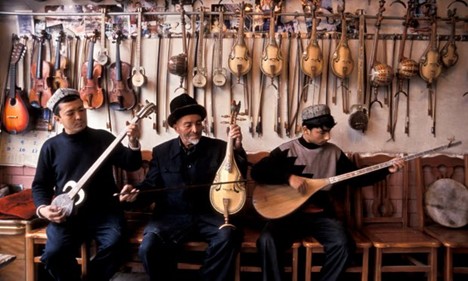
Traditional Uyghur musicians in a shop in Kashgar city. Photo Credit: The Guardian
January 19, 2026
Songs are never just songs.
Across the world, music entertains and comforts, but it also carries history, belief, and identity. It teaches children language and values. It celebrates weddings and new life, marks funerals and loss, and keeps community bonds alive. In difficult times, music helps people endure. It can regulate mood, strengthen memory, and remind us who we are.
That is why the reported banning and restriction of Uyghur songs by Communist China in East Turkistan (aka Xinjiang Uyghur Autonomous Region) is so alarming. When Chinese authorities label Uyghur music “problematic,” the target is not merely sound, it is culture itself.
Reports indicate that Uyghur songs are being flagged for having religious meaning, for “distorting Uyghur history,” for “inciting separatism,” or for promoting “discontent” with the society. But these categories are so broad that, in practice, almost any Uyghur song could become a target. If a song mentions faith, homeland, traditional values, or collective memory, it can be reinterpreted as political and “problematic”.
For Uyghurs, music is not optional. It is a foundation of cultural life, sustained across centuries. Uyghur songs and musical traditions preserve language, poetry, storytelling, humor, and social customs. They are not only performed on stages; they live in homes, community gatherings, and education. Music is one of the strongest ways a culture is passed from one generation to the next, especially when other spaces shrink.
This recalls the “Cultural Revolution”, when many Uyghur songs were banned or altered to align with Chinese communist ideology. Today, few could imagine that Uyghurs are once again living through one of the darkest periods in human history. Yet, Uyghurs, Kazakhs, and other Turkic peoples live in a region where the reality resembles a renewed “Cultural Revolution”, where traditions must be “corrected” or disappear. The fear today is that Uyghurs, Kazakhs, and other Turkic peoples are once again being pushed into a controlled cultural reality, where traditions must be reshaped or erased.
These are the results of Chinese official policies, including a statement reportedly announced on August 10, 2017: “Break their lineage, break their roots, break their connections, and break their origins. Completely shovel up the roots of ‘two-faced people,’ dig them out, and vow to fight these two-faced people until the end.” Human rights researchers, journalists, and advocacy groups have documented mass detention, pervasive surveillance, pressure on religious practice, and policies that reach deeply into family life and education. Dozens of governments have used the term “genocide,” while the United Nations has raised concerns that the scale and nature of abuses may amount to crimes against humanity.
This is not only about politics. It is about a nation’s right to exist as itself.
Since 2017, Uyghur writers, scholars, teachers, artists, comedians, singers, religious figures, and professionals have been among those detained or imprisoned. Cultural leaders are often targeted first because they protect memory. When poets, professors, and performers are silenced, a community loses more than individuals; it loses transmitters of heritage.
As part of its massive internment campaign, the Chinese authorities sent millions of Uyghurs, Kazakhs, and other Turkic Muslims to prisons, placed more than 3 million Uyghurs, Kazakhs, and other Turkic people in concentration camps, and separated more than 1 million Uyghur children from their language environment through education systems in boarding schools that prioritize assimilation. When language is weakened, songs change. When songs change, memory changes. That is how cultural destruction works: slowly, steadily, and often in full view
Today, the world’s attention is devoured by an endless churn of crises: wars, elections, disasters, economic shocks. But while the headlines reset, something far more enduring is unfolding in plain sight. China is systematically dismantling Uyghur language and culture, suppressing faith, and forcing distinct peoples toward a single, state-approved identity: Han, communist, and compliant. This is not history. It is happening now, under our watch. And cultural erasure rarely arrives with the drama of a single day. It advances quietly through pressure, surveillance, punishment, and the slow narrowing of what is permitted. It looks like fewer songs sung without fear. Fewer holidays celebrated without being policed. Fewer children taught the words that carry their ancestors’ lives. Until, one day, a people can still be counted, but can no longer speak themselves into being.
If the world only pays attention to what explodes, it will miss what is being suffocated. Music is often called a universal language. That is true, and it is precisely why banning a people’s songs matters. When a state decides which histories may be sung and which emotions are permissible, it is not about regulating art, It is about regulating identity. A song can be a portable homeland, something people carry when everything else is taken. If Uyghur songs are being criminalized, it is because they preserve belonging.
And no government should have the power to outlaw belonging.