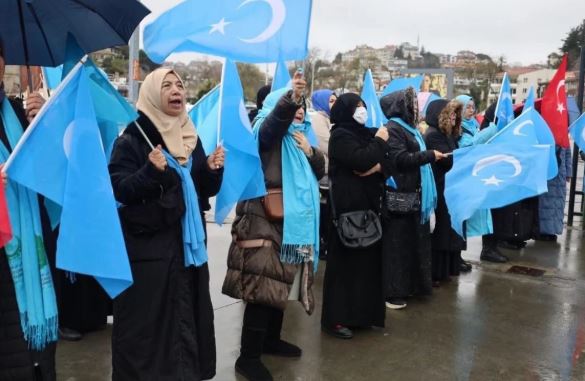
Uyghur women protest the loss of their loved ones in the Uyghur homeland, in Istanbul, May 2023. Protests used to be a weekly event attended by hundreds, but threats and intimidation via the Chinese state towards their relatives in Xinjiang have caused numbers to dwindle.
The government’s increasing proximity to Beijing makes the country no longer safe for the thousands of Uyghurs who live there.
Türkiye, a trusted friend and refuge for Uyghurs fleeing Chinese persecution for decades, is no longer a safe haven, following spates of arbitrary arrests, threats of deportation, and false allegations of terrorism.
The duplicity has been exposed in “Protected No More, Uyghurs in Türkiye,” a scathing report by Yalkun Uluyol of Human Rights Watch (HRW), whose conclusions that Uyghurs without Turkish citizenship are no longer guaranteed safety continue to be confirmed by regular waves of round ups including those of women and children.
Abduweli Ayup, exiled Uyghur academic, blew the whistle over the detention by Istanbul’s counter terrorism police of 31 Uyghurs who were detained amid a mass corral of suspected ISIS militants before New Year. The Uyghurs, most of whom were employed and had lived without incident in Türkiye for more than ten years were rounded up on 24-25 December 2025, but as mysteriously as they were detained have been released without charge after human rights outcries on their behalf.

A Uyghur mother and her one-month-old baby were snatched during the same episode with other family members. While three of her other children were allowed to go home over concerns for their health, Müeyesser Ali and her infant Enes Abdullah were transferred to the Izmir Deportation Centre, awaiting they feared, a forcible return to China.
Müeyesser and her child were released after a week after persistent legal challenges and public pressure. No charges were made or reasons given for the arrest.
Türkiye’s love affair with its Muslim cousins has waxed and waned over the years. Having thrown wide its doors to large groups of Uyghurs seeking asylum since the early 1960s, closer ties with the Superpower in recent years, particularly since 2022, have soured the relationship.

Previous preferential treatment giving them long term residence permits and a pathway to Turkish citizenship has been seriously eroded. Some Uyghurs applying for citizenship despite several years of trouble-free residence are bafflingly rejected citing risks to national security and leaving them in a dangerous stateless limbo.
Türkiye has from time to time challenged Beijing’s treatment of Uyghurs. In 2019, Türkiye’s Ministry of Foreign Affairs issued a statement raising concerns over detention camps in the Uyghur region branding the camps as “a great cause of shame for humanity.”
In 2020 Türkiye urged China to respect and guarantee the cultural and religious identity of Uyghurs at the UN General Assembly’s Third Committee. and on 21 October 2021 President Erdoğan signed a joint UN regional statement with 43 countries on 21 October 2021 concerned about the human rights situation in Xinjiang urging unfettered access to the region to investigate the alleged abuses.
On 8 September 2022 Türkiye released a statement following the UN OHCHR’s report on the region expressing concern and requesting a visit to the Xinjiang region.
But fast forward to August 2024 amid increasing rapprochement with Beijing, a Turkish media delegation to the Uyghur region returned with glowing reports of “smiling faces, hospitality and peaceful and happy lives.” contradicting Western media reports they had heard. The accolades have continued.
Many of the estimated 50,000 exiled Uyghurs who have sought asylum from persecution in the Uyghur heartland of North West China, particularly those who have been refused permanent citizenship and passports in Türkiye, now live increasingly in fear of being returned to face imprisonment, torture and the wrath of Beijing. Those who fled during the recent wave of arrests and internment in so-called “re-education camps” in their homeland in 2016, feel especially vulnerable.
“Protected No More” has unearthed secretive, so-called “restriction codes,” ordered, say some, by the Chinese state, that have blotted the immigration records of selected Uyghurs designating them a “public security threat” and enabling authorities to round up and detain them at will. With no obvious rhyme or reason for these classifications they are a mystery not only to those detained but also the arresting officers. These codes are almost impossible to appeal, according to the report.
Idris Hasan’s case has been well publicized by “Bitter Winter” for his multiple arrests on terrorism charges, long unexplained periods of detention in Türkiye over seven years, and an ill-fated escape to Morocco where he was yet again pursued by Beijing, imprisoned for three years and threatened with rendition to China. “We had absolutely no idea where he was sometimes or why he had been picked up,” his wife Zeynure told Bitter Winter. “The G87 code on his files (flagging up threats to public security) followed him everywhere and we had no idea how he got it, or how to get rid of it.”

Individuals who have been branded in this way are easy game for arrest and detention, even deportation. As in Hasan’s case a simple visit to a police station for a visa extension could and did for him, result in arrest, disappearance, and on two occasions, his detention for six months with multiple threats of deportation to China.
According to HRW sources, a steady trickle of Uyghurs have been held in deportation centres between 2018-2025, citing “over 100 Uyghurs held by Turkish authorities in 2024 alone.”
The HRW investigation uncovered “inhumane and degrading conditions” for some Uyghurs where they were coerced into signing voluntary return forms, putting them at risk of removal to third countries with extradition agreements with China.
Many are simply detained and then released, but according to one Turkish official interviewed, the use of restriction codes creates “debilitating uncertainty for Uyghurs” that “pushes people’s lives toward a complete unknown.”
“The Turkish government claims it has never directly deported Uyghurs to China,” reported HRW, but there is at least one reported incident in May 2018, “when Turkish authorities reportedly deported at least three Uyghurs directly to China.”
In March 2025 Turkish courts approved the extradition to China of Mahemuti Anayeti and Aierken Abuduwaili, two Uyghurs who fled China years ago, based on the claim that “there is no serious, concrete material evidence that they will be subjected to persecution if extradited to their country.” This was in direct violation of Law No. 6458 on Foreigners and International Protection, the UN Convention on Civil and Political Rights, the UN Convention Against Torture, and the Geneva Convention.
Indirect refoulement to China has also been reported: in June 2019, Turkish authorities deported a Uyghur woman Zinnetgul Tursun and her two toddler daughters, Hilal Shehinur and Banu Abdullah to Tajikistan, after which Tajik authorities reportedly returned them to China. Her sister in Türkiye said Zinnetgul has not been heard from since.
“In 2017, the Turkish government signed an extradition agreement with China, but the Turkish Parliament has yet to ratify it. The extradition agreement, if enacted, will pose a significant and additional threat to Uyghurs in Türkiye,” said the report.

The Chinese government also coerces Uyghurs in Türkiye to collaborate with state proxies, including Chinese consulates and embassies, by putting pressure on their families back home to ask them to provide information about fellow Uyghurs.
Many Uyghurs whilst mourning for their homeland and their families whom they have little chance of ever seeing again, have as far as possible made new lives for themselves in Türkiye, some for more than a decade. Their children are settled in school, many have bought their own homes, acquired the new language, and embarked on new careers. Many however have begun to realise they are not as safe as they once thought and for many the shock of discovering they could be persona non grata and even marked as terrorists at the behest of the Chinese state, is a time-bomb waiting to explode.
Exiled academic and rights activist Abduweli Ayup, speaking to “Bitter Winter,” spoke out against the uneasy limbo Uyghurs now face in their adopted homeland and demanded protection, not harassment for Uyghurs. “They should not be targeted because of their ethnicity or charged with terrorism and endangering public security,” he said. “Türkiye should respect its own laws and not target Uyghurs collectively as the Chinese government has done. It should protect them and not terrorize them.”

Elaine Pearson, Asia Director at Human Rights Watch, said the current climate had triggered fear among Uyghurs, many hesitating to leave their homes in case of arrest. Some were undertaking perilous journeys looking for safe havens. She was unflinching in her demands. “The Turkish government should respect the principle of non-refoulement, immediately stop all deportations of Uyghurs to third countries, and recognize Uyghurs as refugees on a prima facie basis.”
“Other governments should halt transferring Uyghurs to Türkiye, as it can no longer be considered a safe third country for Uyghurs, and should consider resettling Uyghur refugees from Türkiye.”
Ruth Ingram is a researcher who has written extensively for the Central Asia-Caucasus publication, Institute of War and Peace Reporting, the Guardian Weekly newspaper, The Diplomat, and other publications.