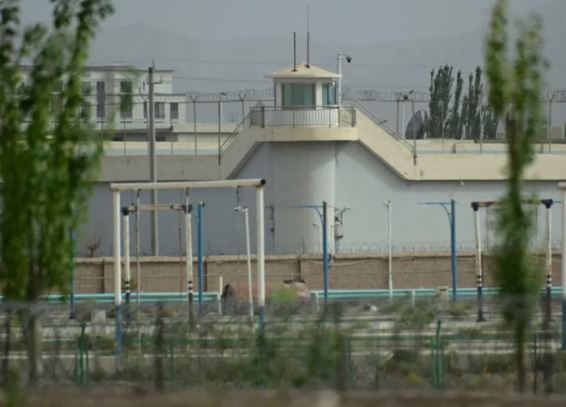
FEATURED IMAGE: This picture taken on July 19, 2023 shows a watchtower of an alleged detention facility in Artux in Kizilsu Prefecture in China's northwestern Xinjiang region. China stands accused of incarcerating more than 1 million Uyghurs and other Muslim minorities in a network of detention facilities across Xinjiang, a region in northwestern China that is shrouded in secrecy and under extreme surveillance. (Photo by PEDRO PARDO/AFP via Getty Images)
Countering the spread of forced labor in global trade has long been an American priority, and the United States has among the strongest laws in the world to address it. However, as of 2024, the U.S. Department of Labor still identified 204 goods from 82 countries as being made by child and forced labor. Confronting this persistent challenge should be a priority for the Trump administration, as it supports several of its major national security, economic, and religious freedom goals.
Nowhere is the problem of forced labor more pernicious than in China. The Chinese government’s horrifying, systematic abuse of the Uyghur people bears all the hallmarks of genocide. Uyghur people are subjected to arbitrary incarceration, forced labor, family separation, and forced sterilization. Millions have been forced into re-education and work camps, subject to torture and other atrocities. Frustratingly, the United States and other Western nations have some measure of complicity in these horrors because this exploited labor, at a massive scale, is ending up in Western supply chains.
Forced labor is not just a moral crisis — it’s also an economic security challenge that disadvantages American businesses. State-imposed forced labor is unlawful and destructive. It spurs a race to the bottom, allowing China to flood global markets with artificially cheap goods that undercut American business, even while tightening Chinese control over minerals vital to aerospace, defense, consumer products, and other household technologies that Americans and others around the world use every day.
Last year, my organization, Global Rights Compliance, released a major report that traced the provenance of four critical minerals from the Xinjiang Uyghur Autonomous Region of China. By examining global trade with the region, we linked Uyghur forced labor to a vast range of products, including coffee mugs, electric vehicles, power tools, spacecraft components, and even household and commercial paint. These minerals, mined in Xinjiang, are also critical to AI technologies.
Despite the fact that the 2021 Uyghur Forced Labor Prevention Act (UFLPA) prevents the importation into the U.S. of goods mined, produced, or manufactured wholly or in part in Xinjiang, we found dozens of U.S. and international companies utilizing mineral-based products manufactured in the region. It’s highly likely that some of these products are making their way into American homes.
Trump Administration Goals
Countering these destructive practices supports key goals that the Trump administration has laid out in its recently released National Security Strategy, including its ambition to protect Americans from “predatory trade practices, drug and human trafficking” while utilizing “soft power” to exercise influence in the world. While the strategy is primarily focused the effects on American workers and consumers, its emphasis on global standard-setting creates space for broader impact: applying these tools to counter state-imposed forced labor against Uyghur people would reinforce U.S. credibility, strengthen supply chain security, and ensure that American technology and standards drive the world forward without relying on coercion.
The Trump administration also has prioritized protecting religious freedom “for all people worldwide,” stating that it is a “foreign policy priority of the United States.” The Uyghur people are primarily Muslim, and it is their religious identity that is one of the many reasons the Chinese state targets them for persecution. Challenging the oppression of the Uyghur people is an important way the United States can advance its stated goal of religious freedom.
The United States has long established a globally recognized standard for preventing and curtailing forced labor. Through the UFLPA and longstanding import bans on goods made with forced labor, the United States made it clear that freedom and the rule of law are non-negotiable. Enforcement of the UFLPA has decreased in the past year, yet implementation of this global standard-setting law should be prioritized because it advances a core pillar of U.S. — and now the Trump administration’s — strategy: economic security. As the administration works to rebalance trade and secure access to critical minerals and strategic materials, it must confront the reality that many of these inputs, particularly critical minerals, are sourced from the Uyghur region of China and produced by people who are not free.
A ‘Strategic Differentiator’
American standards can be a strategic differentiator. By confronting the spread of artificially cheap, forced-labor-tainted goods, the administration can help raise global norms, constrain China’s exploitative economic model, and incentivize companies to diversify away from China. Such actions will strengthen U.S. supply chain independence and help protect Uyghur communities from further abuse. Such values, translated into enforceable labor standards and upheld by American businesses, make the United States more competitive, not less.
There are several concrete ways that the Trump administration can advance this approach. The administration’s Pax Silica initiative to “secure supply chains in the AI era” should embed forced labor standards as a core safeguard, ensuring U.S. innovation is not underwritten by exploitation. The federal government can also use its purchasing power to drive change. As the world’s largest buyer of goods and services, the U.S. government can set clear expectations that any company doing business with it must ensure its supply chains are free from forced labor. By enforcing existing strong procurement standards, taxpayer dollars can be used to push companies to divest from forced labor, including goods linked to regions such as Xinjiang. Given the scale of U.S. federal procurement, refusing to purchase goods linked to Xinjiang would cut off a significant source of Chinese government revenue generated from the exploitation of Uyghur labor, helping the United States and American businesses in their broader economic competition with China.
Continued investment in supporting allied governments is also critical, as demonstrated by the U.S. Department of Labor’s recent investments, under this administration, in Indonesia and the Democratic Republic of the Congo to strengthen forced labor protections in critical mineral supply chains. These investments raise standards for workers in those countries, while also protecting American consumers from buying goods made with forced labor. Finally, administration’s push to incorporate forced labor prohibitions into bilateral trade agreements reinforces U.S. leadership and sets enforceable expectations abroad.
Utilizing these tools would make it clearer than ever that countering forced labor is central, not ancillary, to U.S. priorities. To help make Americans safer, stronger, and more prosperous, as Secretary of State Marco Rubio put it, the Trump administration can deploy economic leverage, diplomatic influence, and the U.S. government’s procurement power to confront and stop the spread of forced labor. Pressing to end such practices in Xinjiang is a good place to start.