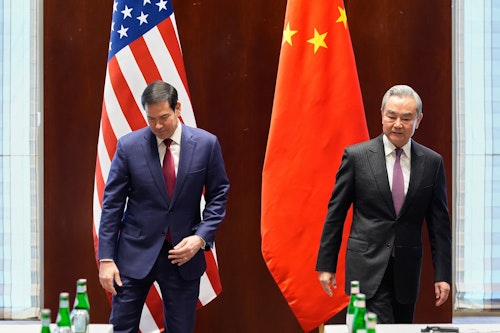
Turkistan Times, 14 Feb. 2026, Munich: The halls of the Munich Security Conference (MSC) recently became the stage for a profound geopolitical tug-of-war. U.S. Secretary of State Marco Rubio and Chinese Foreign Minister Wang Yi presented diametrically opposed visions for a "new world." Rubio’s rhetoric—notably emotional yet grounded in a "hawkish" realism—attempted to bridge the growing rift between Washington and Brussels.
However, this effort faced a stark reality: European leaders are increasingly chartng their own course. German Chancellor Friedrich Merz, opening the conference, declared that the "rules-based order no longer exists" and urged Europe to find its own "firmness and willpower." This sentiment was bolstered by Ursula von der Leyen, who called for a "new European independence" to protect the bloc's economy and democracy, while Foreign Policy Chief Kaja Kallas outlined a strategy to address "all dimensions of European security" in this hostile era. Even as Emmanuel Macron continues to push for "strategic autonomy," the silence surrounding the Uyghur crisis—once a cornerstone of Rubio's moral crusade—loomed large, signaling a shift where human rights in East Turkistan (referred to by Beijing as China's Xinjiang) are increasingly weighed against the cold demands of state interest.
The Rebirth of National Interest: Rubio’s Civilizational Appeal
Marco Rubio’s address was marked by an uncharacteristic depth, leaning heavily on the "common purpose" that saw the West prevail over Soviet Communism. Yet, his message carried a sharp warning: the era of "borderless" globalism is dead. Rubio argued that the "delusion" of replacing nationhood with commerce alone has cost the West dearly. By stating that the U.S. and Europe "belong together" due to roots planted long before 1776, Rubio attempted to reassure an anxious Europe that the Trump administration remains committed to the alliance, albeit one that must be "rebuilt" on the foundations of national interest rather than vague globalist rules.
This "rebuilding" comes as Kaja Kallas warns of a "more hostile geopolitical era." Kallas recently emphasized that the EU’s new strategy must address "all dimensions of European security," a sentiment echoed by President Macron, who has long championed "strategic autonomy." For leaders like Macron and Germany's Friedrich Merz, the perception of the U.S. as a potential "wrecking ball" to the old rules-based order necessitates a Europe that can stand on its own feet.
The Great Pivot: "Governor" Carney and the Commonwealth Middle Path
While Rubio spoke of civilizational unity, the reality on the ground suggests a more pragmatic, fragmented approach. In a striking shift, several of America’s staunchest allies have recently sought to stabilize—and even deepen—their ties with Beijing. In the last few months alone, Emmanuel Macron and UK Prime Minister Keir Starmer have made high-profile visits to China. They were joined by Canadian Prime Minister Mark Carney, who recently signed a landmark strategic partnership with President Xi Jinping.
Carney’s deal—which trades access for Chinese Electric Vehicles (EVs) for reduced tariffs on Canadian canola—triggered a firestorm in Washington. President Trump responded with a 100% tariff threat on Canadian goods, famously referring to Canada as a "51st state" and Carney as "Governor Carney," warning that China would "eat Canada alive." Despite this, Carney remains defiant, asserting that Canada must react to "the world as it is," a sentiment shared by Friedrich Merz as he prepares for his own Beijing mission.
Realism vs. Rhetoric: The Evolving Stance on East Turkistan
Perhaps the most significant shift in Munich was the calculated tone regarding human rights, particularly concerning the Uyghur people. Historically, the U.S. position has been one of staunch condemnation; in January 2021, the U.S. State Department officially determined that China was committing "genocide" against Uyghur Muslims and other ethnic minorities. Marco Rubio himself was the architect of this pressure during his time in the Senate, playing a pivotal role in passing the Uyghur Human Rights Policy Act and the Uyghur Forced Labor Prevention Act.
However, the recent Rubio-Wang sideline meeting was characterized by a pivot toward managing "geopolitical malpractice." The previous focus on the crisis in East Turkistan appears to have been tempered by the necessity of managing competition between the world’s two largest powers. While the legal determinations of the State Department remain on the books, the current diplomatic priority has shifted toward establishing "red lines" and "stable tracks."
This transition raises a haunting rhetoric: Has the plight of East Turkistan moved from a central pillar of Western moral authority to a secondary concern of "state interest"? As the U.S. and China prepare for a landmark presidential summit, the once-burning moral outrage seems to have entered a phase of strategic silence, leaving the future of human rights in the region hanging in a delicate, realist balance.