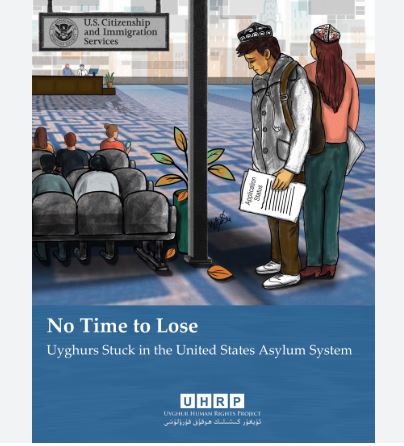
Turkistan Times, 26 February 2026, Istanbul: The plight of Uyghurs trapped for years in the political asylum system in the United States is becoming increasingly critical. As indicated in a report prepared by Dr. Henryk Szadziewski for the Uyghur Human Rights Project (UHRP), currently 500 to 1,000 Uyghurs are stranded in the limbo of the US immigration system, with some anxiously awaiting the processing of their cases for over eight years. This prolonged waiting period not only deals a heavy blow to asylum seekers physically and mentally but also exhausts them economically due to limited income. This report details the key findings and the tragic fate faced by Uyghurs during their asylum journey in the US.
These Uyghurs seeking asylum in the US are essentially people who fled with their lives from the systematic persecution and genocide in East Turkistan. Since 2016, the situation in East Turkistan has deteriorated further, with the Chinese government's actions reaching the level of genocide and crimes against humanity. Asylum seekers chose the US as a haven precisely to escape such horrific danger. Based on January 2022 estimates, approximately 800 Uyghurs remain in an indefinite backlog. According to the Northern Virginia-based Uyghur American Association (UAA), since each case represents a family, these unresolved cases actually concern the life-and-death struggle of 500 to 1,000 individuals.
Most of these asylum seekers are the elite of society who received higher education and held stable professions in their homeland. Among them are experienced entrepreneurs, representatives of international companies, university professors, and researchers, many of whom graduated from prestigious institutions like Beijing University or Xinjiang University (East Turkistan University). Although they achieved great success through their own efforts despite state-sponsored discrimination, the Chinese government viewed their professional achievements as a hidden threat and targeted them for suppression. Some asylum seekers have revealed that they were detained and brutally tortured with electric batons merely for possessing religious books, despite having violated no laws.
The journey from East Turkistan to the US is also fraught with dangerous trials. While some Uyghurs arrived directly in the US before the passport confiscation policy in 2016, others reached the US via countries like the United Arab Emirates, Japan, and Turkey. In these third countries, too, Uyghurs became targets of China's transnational repression policy; for instance, requests for police protection were rejected in Japan, while in Turkey, they faced police warnings to avoid damaging relations with China. Therefore, Uyghurs viewed the US as the only safe haven beyond the reach of China's long arm and strove to reach it.
The difficulties in entering the US also forced asylum seekers to pay a heavy price. While most arrived with business or tourist visas and sought asylum, others set foot in the US after traversing dangerous routes via the Mexican border. For example, an asylum seeker named Yusuf was imprisoned for four months in an immigration detention center after crossing the border and was released only after paying a $10,000 bond and on the condition of wearing an electronic tracking device on his ankle. Such cold treatment dealt a severe blow to their initial hopes for freedom.
Upon arriving in the US, these Uyghurs faced America's complex and slow-moving bureaucratic system. Under US law, asylum seekers must apply within one year, and the asylum office was supposed to conclude the case within 180 days. However, due to policy changes in recent years and the massive backlog of cases in the system, these regulations have remained only on paper.
In particular, the "Last In, First Out" (LIFO) policy implemented during the Trump administration in 2018 dealt the heaviest blow to Uyghur asylum seekers. Although the aim of this policy was to deter frivolous applications, the cases of Uyghurs who had been waiting for many years were pushed to the very back of the line. Consequently, the waiting time for many who applied from 2015 onwards has exceeded seven years, which is an unacceptable victimization for people who had already fled from terrifying camps and prisons.
Although the Biden administration aimed to reform the system in 2022 and reduce the process to six months, the previously backlogged cases have not yet been resolved. For instance, an asylum seeker named Alimjan applied in 2015 and could only get a court date after waiting for eight years. Alimjan expressed his frustration, saying, "This system is broken; we also have the right to start our lives normally." Another asylum seeker, Aynur, had her court date set only after a nine-year wait.
Such endless uncertainty is devastating the mental and physical health of Uyghur asylum seekers. Coupled with the loss of contact with relatives in East Turkistan due to the limbo in the asylum system, they have developed severe mental stress, depression, and "survivor's guilt." Due to China's policy of detaining those who communicate with people abroad, they suffer day and night thinking that their family members are being punished because of their arrival in the US.
Examples in the report demonstrate the depth of this tragedy. Asylum seeker Hoshur states that he suffers from insomnia thinking that his five siblings were detained in camps and their lives ruined because he sought asylum. Alimjan heard the news of his parents' death from strangers, and his inability to verify this news further exacerbated his pain.
Depression, forgetfulness, and chronic insomnia have been observed in most Uyghur asylum seekers. One asylum seeker describes his despair: "Whenever I sleep, I dream that I have become a US citizen." Although they need psychological support, expensive health insurance and psychological treatment seem like a luxury for these people trying to survive on minimum wage.
Economic hardships and the pressure of periodic document renewal also strain asylum seekers. Since their political asylum status has not been approved, they spend thousands of dollars every year just to renew their work permits. For example, Murat and his wife spent over $7,000 in seven years just for work permits. Sometimes, delays in permits have left them at risk of unemployment and homelessness.
The Chinese government's use of passports as a weapon to intensify transnational repression has further complicated the situation. Consulates refuse to renew Uyghurs' passports, forcing them to return to China. Consequently, many Uyghurs have been left stateless, suffering the mental anguish of living without a passport and restrictions on their freedom of movement. US authorities dragging out cases using these administrative obstacles as an excuse draws strong resentment from the people.
The most disheartening point is that immigration officers do not sufficiently understand the genocide situation Uyghurs face. According to asylum seekers, officers sometimes fail to distinguish between Uyghurs and ordinary Chinese citizens. An asylum seeker named Ahmet posed a strong question: "If the US government recognizes our situation as genocide, why doesn't the immigration office feel this urgency?"
Against these unjust delays, the Uyghur community in the US is making continuous efforts. UHRP and UAA have called on authorities to expedite these cases by writing letters and testifying in Congress. At the same time, asylum seekers have held peaceful demonstrations multiple times in front of the immigration office in Arlington to make their voices heard. However, due to these demonstrations, some asylum seekers have faced remote telephone and electronic threats from Chinese police.
Therefore, the central theme of this report is that Uyghur asylum seekers no longer have time to wait. These people, living under pressure from China, only desire to achieve their personal safety and the opportunity to speak freely on behalf of the victims of persecution in their homeland. As one asylum seeker said: "We are contributing to the US and want to contribute more; we are not in need of charity." They are merely waiting for a fair chance to start their lives from scratch.
Many asylum seekers imagine a beautiful future after their applications are approved. Their greatest wish is to completely escape China's persecution and start a new, safe life. People like Murat, Aynur, and Abdullah have expressed their desires to find better jobs, educate their children, and serve this country that protects them. As Adil said: "I don't have a big dream; it would be enough just to live like a normal human being."
Nury Turkel, Chair of the US Commission on International Religious Freedom, addressed this issue, emphasizing that the clearest and simplest help the US can provide is to grant asylum to Uyghurs backlogged in the system. He pointed out that the US government has the power to alleviate the suffering of these people.
The report offers numerous concrete recommendations to the US Congress and administrative branches. Congress is asked to direct the immigration office to process applications of genocide survivors as a priority, allocate additional funds, and pass the "Asylum Seeker Work Authorization Act."
Regarding US administrative branches, the White House "Atrocity Prevention Task Force" is called upon to pay attention to this issue. Furthermore, the immigration office is asked to specially train all its officers on China's crimes against Uyghurs and create a facilitated interview schedule for Uyghurs.
Finally, it is indicated that the Department of Justice should update materials to ensure judges rely on accurate information, and the Department of Homeland Security should strengthen communication with the Uyghur community. It is also recommended that civil society and charitable organizations cooperate in providing psychological support and legal counseling to Uyghurs.
In conclusion, the experiences of Uyghur asylum seekers in the US are not merely an immigration issue but the continuation of a humanitarian crisis. These people, who fled with their lives from genocide, should not become victims of bureaucratic obstacles on the soil of the US, a symbol of freedom. They have not yet lost hope of adding strength to US society and creating a bright future. Therefore, it is an urgent duty for the US government to fulfill this historical responsibility and resolve Uyghur asylum cases immediately.
You can view the full English version of the report here.