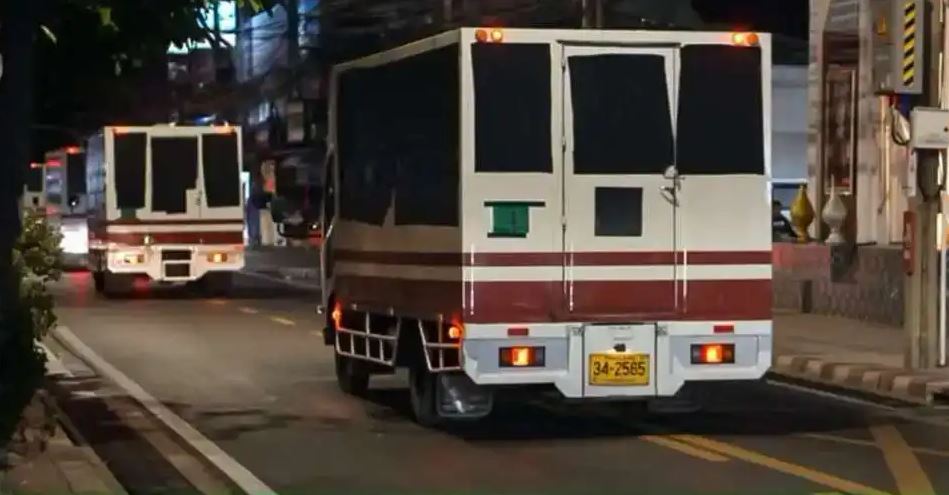
Thai immigration department trucks carrying 40 ethnic Uyghurs, with their windows covered with black cloth, leave the main immigration detention center in Bangkok on Feb. 27, 2025. A year later, all 40 have vanished, said Human Rights Watch (HRW) on the first anniversary of their deportation. (Photo: Natthaphon Meksophon via BenarNews / Radio Free Asia)
One year after forced repatriation, answers are demanded
Thailand sparked an international incident last year when it bowed to years of Chinese pressure and deported 40 Muslim Uyghurs — who had been granted asylum in Canada and the United States — in the dead of night.
Accusations of human rights abuses amid fears for their safety followed as US Secretary of State Marco Rubio warned Thailand, as a longstanding signature ally, that “we are alarmed by this action” after an attempt to secretly fly them out of the country was botched.
Activists and journalists tracked the blacked-out vans to the airport and the flight, condemned by Rubio “in the strongest possible terms.”
Bangkok and Beijing responded with reassurances to allay any fears, but 12 months later, all 40 have vanished.
“Their fates remain unknown,” Human Rights Watch (HRW) said on the first anniversary of their deportation. “Both the Thai and Chinese governments portrayed the returns as family reunifications, but their family members abroad have heard nothing from the men since their deportation.”
Thailand promised regular visits to Xinjiang to ensure their well-being. The first in March was considered a stage-managed affair for an international audience. The last was in June, shortly before Prime Minister Paetongtarn Shinawatra was ousted from power.
Neither independent observers, United Nations experts, nor the UNHCR — which determines refugee status and was repeatedly denied access by Thailand before their deportation — have been granted access to the men.
"Bangkok and others should press Beijing to allow unfettered access to the 40 men to monitor their conditions and well-being. They shouldn’t be forgotten,” New York-based HRW said, adding a refusal by China to report on their fate amounted to forced disappearances under international law.
“Uyghurs who leave China without state approval are, if returned, viewed with intense suspicion and subject to arbitrary detention, interrogation, torture, and other cruel treatment. The Thai government knew the risks facing the deported men.”
China has also rebuffed Vatican concerns about the Uyghurs. Six years ago, Pope Francis wrote in his book, Let Us Dream: The Path to A Better Future: “I think often of persecuted peoples: the Rohingya, the poor Uyghurs, the Yazidi.”
Beijing said papal concerns were groundless.
It’s a plight that has been extensively detailed by independent media, including UCA News, and was the subject of a Uyghur Peoples' Tribunal in London in 2021. It found China had committed a genocide against the Uyghurs, which Beijing dismissed as “sheer fiction.”
A year later, a report by the UN Office of the High Commissioner for Human Rights concluded that serious human rights violations in the Uyghur region of China "may constitute international crimes, in particular crimes against humanity.”
Phil Robertson, director of Asia Human Rights and Labour Advocates, said the 40 were separated from their families, incarcerated in immigration detention for over a decade, denied rights to legal counsel and the ability to seek asylum before being carted away in the middle of the night.
“The Thai government still has blood on their hands from their heartless, rights-abusing forced return of the Uyghurs to China to face detention, torture, forced labor, and worse,” he said. “It’s basically impossible to fully state how completely wronged these men were by the Thai state.”
There are also broader international concerns. HRW said Uyghurs have been arbitrarily detained and deported after China’s request or pressure from Egypt, Cambodia, Malaysia, Morocco, Saudi Arabia, Tajikistan, and Turkey, once a safe haven for the ethnic Turkic Uyghurs.