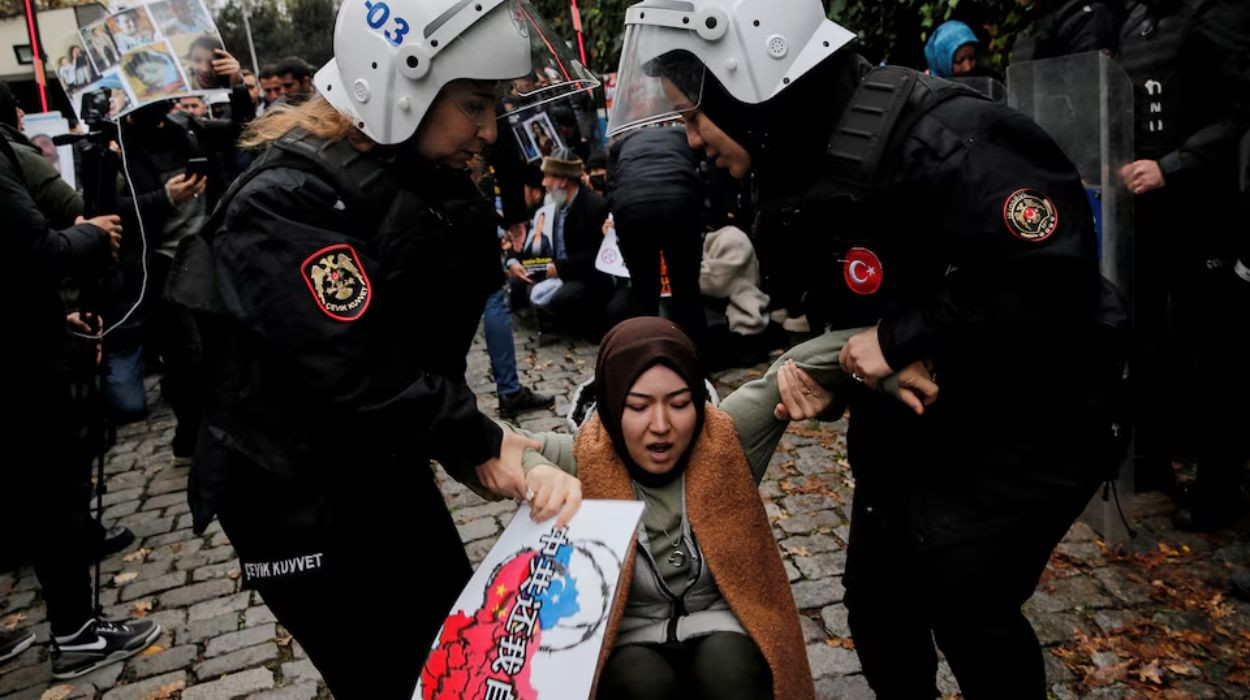
Global Alarm Rises Over Uyghur Arrests in China's Holy Month Siege. Intensified crackdowns on Uyghur Muslims in China's Xinjiang (East Turkistan-Ed.) region during Ramadan have triggered widespread international concern, highlighting a pattern of religious suppression and mass arrests.
These measures, enforced as part of broader state policy, transform the holy month into a period of heightened surveillance and coercion, raising urgent questions about human rights violations on a massive scale. Reports from advocacy groups detail thousands detained for basic religious observances, underscoring the systematic nature of Beijing's approach to Uyghur communities.
Historical Context of Xinjiang Policies
Since 2017, China's state policy in Xinjiang has involved the construction of vast internment camps, with estimates indicating over 1 million Uyghurs and other Muslim minorities detained in facilities officially termed
"vocational training centers."
These camps emerged in response to sporadic violence in the region, but critics argue they serve as instruments of cultural assimilation rather than security. The state policy expanded to include pervasive surveillance systems, covering up to 80% of the Uyghur population through facial recognition, AI-driven monitoring, and police checkpoints.
During religious periods like Ramadan, these controls intensify, with authorities banning fasting, seizing prayer materials, and deploying drones over mosques. This escalation aligns with a long-term state policy aimed at curbing what Beijing describes as extremism, though independent analyses reveal a deeper intent to erode Islamic practices.
By 2026, the infrastructure of control includes repurposed or demolished religious sites, with approximately 16,000 mosques affected since the policy's inception, representing a profound assault on Uyghur architectural and spiritual heritage.
The state policy extends to family separations, forced labor programs, and mandatory
"patriotic education"
sessions that prioritize loyalty to the Communist Party. Birth rates in Uyghur-majority areas have plummeted by around 60% since 2017, attributed to coerced sterilizations and intra-family detentions.
These elements collectively paint a picture of demographic engineering, where human rights to family, faith, and autonomy are systematically curtailed under the guise of national stability.
Ramadan 2026: The Holy Month Siege Unfolds
Ramadan in 2026 has witnessed a familiar yet alarming surge in enforcement, with reports of over 500 arrests in Hotan alone for "illegal religious activities" such as private fasting or gatherings. Checkpoints proliferate around mosques, and residents face random inspections for halal food or religious texts, creating an atmosphere of constant dread. This "Holy Month Siege" weaponizes the spiritual significance of Ramadan, turning reflection and abstinence into punishable offenses.
Surveillance spikes during this period, with detention rates increasing by 20-30% in targeted zones, according to leaked police data. Uyghurs report being coerced into public meals to demonstrate non-observance, while children are separated for state-run indoctrination.
The state policy here reveals its precision: by targeting the holiest month, authorities amplify psychological pressure, fostering compliance through fear. Satellite imagery confirms expanded camp capacities ahead of Ramadan, suggesting premeditated escalation.
These actions do not occur in isolation but build on years of infrastructure development, including AI systems that flag religious attire or behaviors. The result is a community under siege, where even silent prayer risks arrest, embodying a state policy that views religious expression as a threat to unity. Human rights advocates have long documented these patterns, emphasizing how they erode communal bonds during times meant for unity.
Scale and Statistics of Suppression
Quantitative evidence underscores the enormity of the crackdown. UN assessments peg the total detained since 2017 at over 1 million, with Ramadan periods marking consistent upticks in processing through camps.
In Xinjiang, surveillance apparatuses monitor 80% of Uyghurs daily, generating petabytes of data for predictive policing. Mosque demolitions stand at 16,000, a 65% reduction that has gutted religious life, per cross-verified satellite analyses.
Forced labor implicates hundreds of thousands, with Uyghurs transferred to factories across China, feeding global supply chains in cotton, electronics, and solar panels. Economic indicators show stunted growth in Uyghur areas, contrasted by Han Chinese influx, signaling assimilationist goals. Health data reveals elevated suicide rates and trauma-linked disorders, with human rights reports citing torture in detention facilities.
Detention spikes during Ramadan—such as Hotan's 500+ cases in 2025—illustrate localized intensity, often for trivial violations. These figures, drawn from survivor testimonies and defected official documents, confirm a state policy of preemptive control, where religious observance equates to subversion. The cumulative toll includes cultural losses: traditional dances, languages, and cuisine fade as generations are reprogrammed.
Mechanisms of Control and Surveillance
China's state policy relies on cutting-edge technology for enforcement. Integrated Joint Operations Platforms aggregate data from cameras, apps, and informants, assigning "extremism" scores to individuals. During Ramadan, algorithms prioritize mosque vicinities, triggering drone patrols and rapid arrests. This tech-driven approach ensures minimal resistance, with compliance rates nearing 100% in monitored zones.
Physical infrastructure complements digital oversight: ringed checkpoints, razor-wire perimeters around villages, and re-education compounds dot the landscape. Forced attendance at propaganda classes during fasting hours reinforces secular ideology, portraying Islam as incompatible with modernity. Human rights concerns peak here, as detainees endure sleep deprivation, beatings, and ideological bombardment tailored to religious holidays.
The policy's efficiency stems from centralized command, with regional leaders incentivized by promotion quotas for "stability maintenance." Leaked directives reveal quotas for detentions, tying career advancement to suppression metrics. This bureaucratic machinery sustains the siege, making Ramadan a litmus test for loyalty.
Impacts on Uyghur Identity and Society
The Holy Month Siege strikes at the core of Uyghur identity, severing ties to Islam that define communal life. Fasting bans and prayer prohibitions fragment families, with children reciting party oaths instead of Quranic verses. Cultural erasure accelerates: historical texts are burned, attire policed, and holidays commandeered for state events.
Societal ripple effects include eroded trust, underground faith practices, and mass emigration attempts. Women face heightened scrutiny, with sterilizations linked to human rights abuses under family planning edicts. Economic disempowerment follows, as Uyghurs are sidelined from local commerce in favor of state enterprises.
Long-term, this state policy risks radicalizing youth through despair, contradicting Beijing's security rationale. Exile communities preserve heritage digitally, but domestic isolation threatens extinction. The holy month's desecration symbolizes broader existential peril, where survival demands cultural suicide.
Global Response and Geopolitical Ramifications
International alarm has prompted sanctions, trade bans, and diplomatic isolation efforts. Western parliaments debate genocide recognition, tying aid to transparency demands. Economic decoupling targets Xinjiang products, with audits costing firms billions yet exposing complicity.
China counters with deflection, framing critiques as interference while leveraging Belt and Road ties for silence from Muslim states. This divide pits human rights universality against sovereignty claims, fueling US-China tensions. Forums like the UN Human Rights Council see stalled resolutions, hampered by vetoes.
Corporate responses vary: some divest, others comply with audits. Advocacy amplifies via leaks like the Xinjiang Police Files, sustaining pressure. Yet enforcement gaps persist, as global interdependence tempers resolve.
Challenges to Accountability and Reform
Beijing's opacity blocks verification, denying access to independent observers. Domestic propaganda portrays camps as successes, citing terrorism declines—though analysts attribute this to suppression, not deradicalization. State policy evolves subtly, shifting from overt camps to "community correction" centers.
Human rights pathways remain fraught: tribunals gather evidence, but prosecutions elude. Exile testimonies fuel campaigns, yet fatigue sets in amid competing crises. Sustainable change demands unified economic leverage, transcending rhetoric.
The Uyghur plight endures, with Ramadan arrests epitomizing resilient defiance against erasure. Global vigilance must evolve into concrete mechanisms, challenging the state policy at its roots.