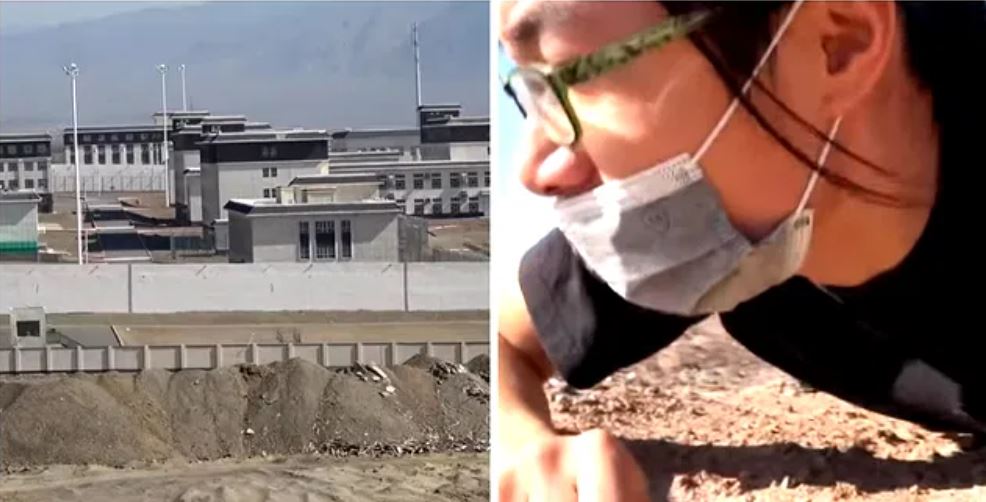
Chinese citizen Guan Heng was granted political asylum in the United States at the beginning of this year. He had faced severe persecution by Beijing authorities after producing a documentary in 2020 that filmed several detention camps where Uyghurs were held in East Turkestan.
Novastan, Editorial Staff, March 23, 2026
Guan Heng risked his life while filming the documentary about the detention camps in East Turkestan in 2020. After fleeing to the U.S. to seek asylum, he faced the risk of being deported to Uganda last August under the responsibility of U.S. Immigration and Customs Enforcement (ICE).
It is estimated that between 2017 and 2019, at least one million Uyghurs were detained for "preventive" purposes without any charges or trials in more than 380 detention camps, most of which are located in East Turkestan. These camps are referred to as "re-education centers" and are part of a widespread "anti-terrorism" campaign. Beijing authorities launched this campaign following terrorist attacks in 2013 and 2014 attributed to the East Turkestan Islamic Movement and the Turkistan Islamic Party (TIP). The first of these attacks occurred on October 28, 2013, in Beijing's Tiananmen Square, resulting in five deaths.
Whistleblower on the Uyghur Issue
In 2021, Guan Heng published a 20-minute video on his YouTube channel showing 18 detention sites where Uyghurs were held in East Turkestan. These locations were identified from maps jointly determined by Buzzfeed and the Australian Strategic Policy Institute (ASPI) through satellite imagery.
The footage, taken from inside a car or with a camera hidden in a backpack, shows camps surrounded by roadside watchtowers and barbed wire. One of these buildings bears the inscription "Reform through labor, reform through culture."
As Guan Heng explained, being a Chinese citizen allowed him to approach these sites, where entry was prohibited for foreign media, without raising suspicion. The video reached many Chinese internet users. However, Guan Heng soon became a target of persecution, and his identity, residence, and professional information were exposed online. His family members in Hainan province, except for his mother living in Taiwan, were interrogated by the authorities.
Between Chinese Oppression and the United States
In 2021, Guan Heng fled China and reached Florida via Hong Kong, Ecuador, and the Bahamas, entering the United States. Although he applied for political asylum, his request was accepted after he was detained by ICE officers near Albany, New York, last August.
In December, following public pressure, ICE abandoned the plan to deport Guan Heng to Uganda. Such a deportation would have exposed him to the risk of transnational repression by Beijing authorities. This policy of pressure by the Chinese government continues today against voices advocating for the Uyghur cause both inside and outside China.
The Camps as a Symbol of the Uyghur Genocide
Although a 2022 report by the UN High Commissioner for Human Rights mentioned the closure of some camps, Human Rights Watch (HRW) revealed in mid-2022 that nearly 500,000 people were still being held in camps, and crimes of torture and forced sterilization were continuing.
This repression has extended to cultural and religious activities, aiming at the systematic eradication of the Uyghur identity. Since 2017, authorities have demolished or destroyed one-third of the region's 15,500 mosques under the guise of the "Sinicization of religion" policy. Several countries, including the United States, describe Beijing's policies as "genocide" according to the 1948 Convention.
Chinese Government's Suppression of Media Workers
China is currently the country with the highest number of imprisoned media workers in the world, with at least 121 journalists in detention. In the 2025 World Press Freedom Index by Reporters Without Borders, China ranked 178th out of 180 countries.
Although "freedom of speech and the press" is guaranteed in the Chinese Constitution, Beijing authorities force dissidents into silence with charges of "espionage," "attempting to subvert state power," or "terrorism." The World Uyghur Congress, led by Rebiya Kadeer, is accused of being a "terrorist organization," and moderate intellectuals like Ilham Tohti were sentenced to life imprisonment in 2014 for "separatism."