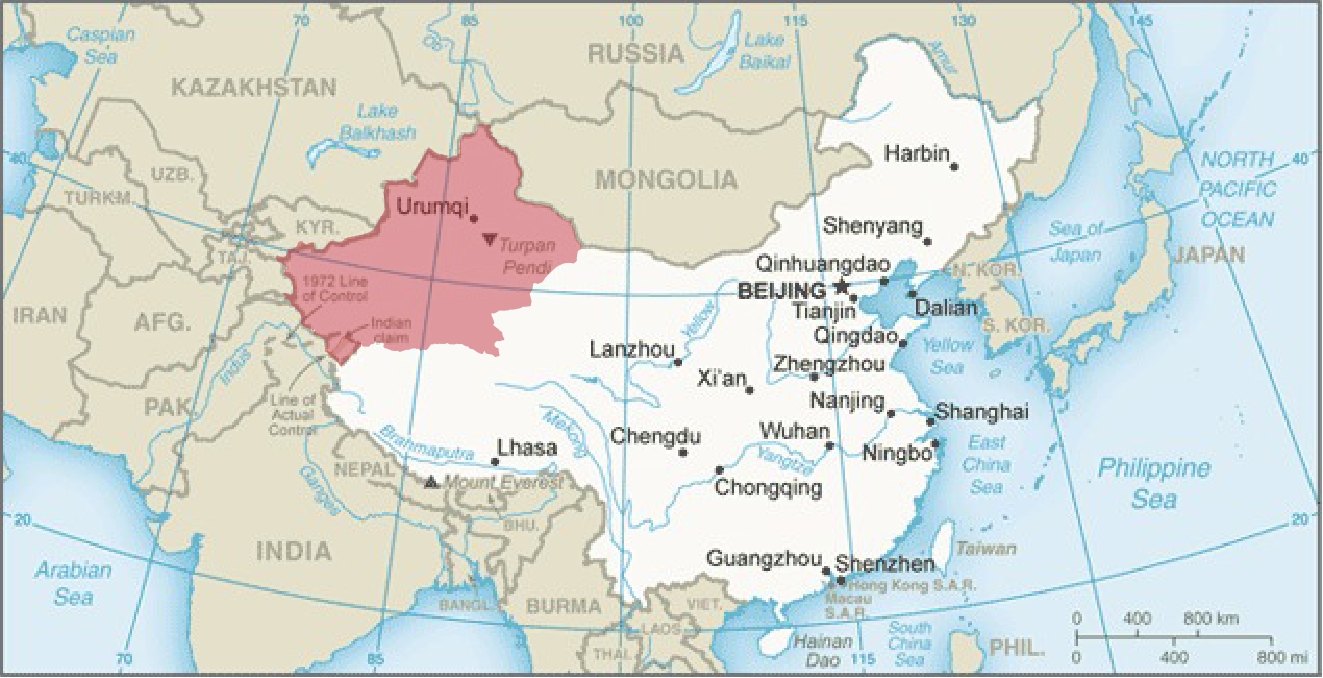
Turkistan Times, 26 March 2026, KASHGAR — In a move that observers describe as a calculated step toward demographic engineering, the Chinese government has officially announced the establishment of a new administrative unit in Kashgar Prefecture. On March 26, 2026, authorities confirmed the creation of Senling County (岑岭县), carved out of the historically significant and predominantly Uyghur-populated Kargilik (Yecheng) County.
According to official reports from the Xinjiang Uyghur Autonomous Region government, the establishment of Senling was approved by the CCP Central Committee and the State Council. The new county’s administrative center has been named "Xinhua Town" (meaning "New China"), a symbolic designation that replaces indigenous identity with state-sanctioned Mandarin nomenclature.
Targeting the Heart of Uyghur Majority Regions
The selection of Kargilik for this administrative fragmentation is highly strategic. For decades, Kargilik has remained one of the most densely populated Uyghur regions in East Turkistan, serving as a vital center of intellectual and cultural life. Historical data highlights the stark demographic reality that Beijing seeks to alter:
-
In 1997: Uyghurs made up 93% of the population, while Han Chinese accounted for only 6%.
-
In 2015: Out of 519,962 residents, 490,417 were Uyghur, maintaining a massive majority.
-
In 2018: Despite years of "stability maintenance" policies, Uyghurs still comprised 91% of the county’s population.
By partitioning these high-density areas into smaller, newly named units like Senling—which currently has a small local population of roughly 5,500—the Chinese government creates a vacuum designed to be filled by state-sponsored Han Chinese migration. Whether in Hotan, Kashgar, or Kargilik, the pattern remains consistent: breaking down Uyghur strongholds to facilitate the settlement of outsiders.
A Pattern of Administrative Erasure
This is not an isolated incident but part of a broader, systemic campaign. In late 2024, the State Council approved the creation of He’an and Hekang counties in the Hotan Prefecture. These actions demonstrate that while the state continues its campaign of mass internment, high-tech surveillance, and cultural assimilation, it is simultaneously using "administrative re-zoning" to erase the geographic and historical traces of the Uyghur people.
Kargilik is the land of revered religious scholars like Abdulhakim Han Mahdum and many other influential thinkers. By redrawing the map and imposing names like Senling, Beijing aims to sever the connection between the Uyghur people and their ancestral lands. Experts warn that these new administrative boundaries are the "legal" infrastructure for the final stages of cultural genocide—replacing an indigenous majority with a controlled, loyalist population under the guise of "urban development."