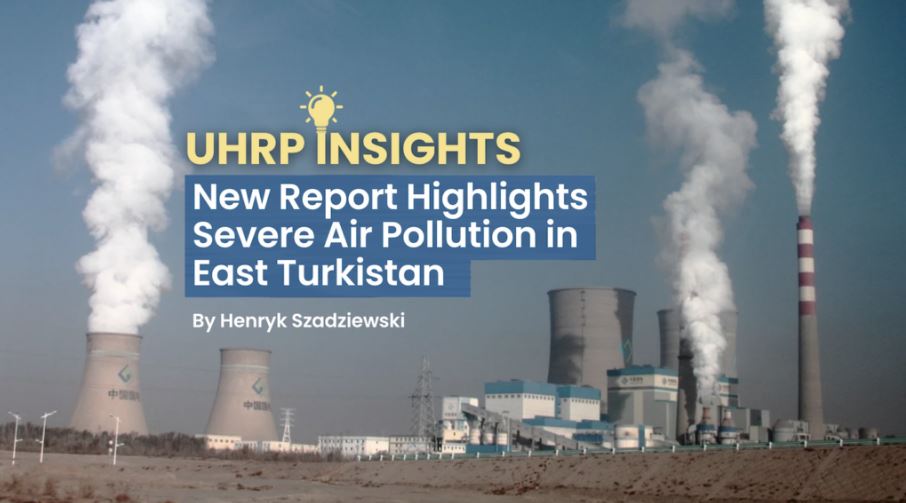
A UHRP Insights column by Dr. Henryk Szadziewski, Director of Research
April 9, 2026, UHRP
Chinese state media often portrays East Turkistan (also known as the Uyghur Region) as a land of pristine environments, highlighting snow-capped mountains and alpine lakes to attract tourists seeking respite from the congestion of eastern China’s cities. This narrative of an unspoiled wilderness presents the region as environmentally untouched and idyllic. However, recent data on urban centers in the region sharply contradicts this image.
Findings from IQAir’s 2025 World Air Quality Report show that cities in East Turkistan occupy the top six positions among the 15 most air polluted cities in East Asia. These cities are Khotan, Kashgar, Kizilsu, Aksu, Beshölük (Wujiaqu), and Turpan. Notably, Khotan, in the south of the region, ranks as the second most air polluted city globally.
| City | East Asia Rank | Global Rank | PM2.5 (μg/m³) |
| Khotan | 1 | 2 | 109.6 |
| Kashgar | 2 | 14 | 84.0 |
| Kizilsu | 3 | 19 | 79.7 |
| Aksu | 4 | 22 | 74.9 |
| Beshölük | 5 | 70 | 52.0 |
| Turpan | 6 | 114 | 45.6 |
Table 1: Air quality rankings of cities in East Turkistan and PM2.5 concentrations in 2025 (PM2.5 concentrations are reported in micrograms per cubic meter, or μg/m³, and as annual averages. Real-time data available at the World Air Quality Index).
As Table 1 illustrates, while all six cities rank within the top 15 in East Asia, five fall within the top 100 globally for worst air pollution. These cities exhibit dangerously high levels of PM2.5, the key indicator used by IQAir to measure air quality.
PM2.5 refers to fine particulate matter, airborne particles measuring 2.5 micrometers or smaller, that can penetrate the lungs and even enter the bloodstream. These particles originate from both natural sources, such as dust and wildfires, and human activities, including vehicle emissions, industrial processes, and fossil fuel combustion.
Exposure to PM2.5 is associated with serious health risks, including respiratory illness, cardiovascular disease, and premature death. According to the World Health Organization (WHO), annual average PM2.5 concentrations should not exceed 5 µg/m³ (5 micrograms per cubic meter), and 24-hour exposure should not surpass 15 µg/m³ (15 micrograms per cubic meter) more than three to four days per year.
Residents of Khotan are exposed to PM2.5 levels nearly 22 times higher than WHO’s annual average guidelines. Kashgar’s levels are approximately 17 times higher, with similarly extreme exposure observed across other cities in the region.
The pattern of high exposure to PM2.5 levels is not new. Analysis of IQAir data from 2018 to 2025 shows that Khotan has ranked as the most air polluted city in East Asia for every year documented, with Kashgar ranking second for eight continuous years. Other cities in East Turkistan, such as Aksu and Shihezi, appear in East Asia’s top air polluted cities in more than half of the years under review (see Table 2).
| City | Number of times in East Asia’s Top 15 |
| Khotan | 8 |
| Kashgar | 8 |
| Aksu | 5 |
| Shihezi | 5 |
| Kizilsu | 4 |
| Turpan | 3 |
| Beshölük | 3 |
| Sanji (Changi) | 1 |
Table 2: Frequency with which cities in East Turkistan appeared among the 15 most air polluted cities in East Asia, 2018–2025 (eight-year period).
The persistence of cities in East Turkistan in these rankings underscores a long-term trend of severe air pollution. In recent years, air pollution levels in cities such as Kizilsu, Aksu, and Beshölük have risen significantly (see Figure 1), joining Khotan and Kashgar as among the most affected. In contrast, China’s national average PM2.5 level in 2025 was 29.6 µg/m³, ranking 20th out of 143 countries and territories, substantially lower than levels observed in the worst affected cities of East Turkistan.

Figure 1: Annual average PM2.5 concentrations in cities in East Turkistan (2018-2025), reported in micrograms per cubic meter.
Historical data further highlights the structural nature of the air pollution problem in the Uyghur Region. A 2011 report by the Wilson Center noted that as early as 2007, Ürümchi ranked among China’s most air polluted cities, largely due to heavy reliance on coal. High coal consumption combined with expanding coal-fired power generation and limited pollution controls, contributed to sustained poor air quality, particularly during winter months. Additional sources, including mining, industrial activity, vehicle emissions, and underground coal fires, further exacerbated environmental and health risks.
By 2016, the Uyghur Region had become one of the most air polluted areas in China, with PM2.5 concentrations far exceeding safe standards and six of the country’s ten most air polluted cities located there. This deterioration was linked to multiple factors, including industrial relocation from eastern China, increased coal use for heating, and natural conditions such as sandstorms.
More recent research indicates that industrial relocation remains a central driver of worsening air quality. A 2025 report by the Centre for Research on Energy and Clean Air (CREA) found that the Uyghur Region is now the most air polluted region in China, with PM2.5 levels rising year-on-year to approximately 70 µg/m³, far exceeding both national averages and WHO standards. The report also attributes worsening air quality to the westward shift of heavy industry and energy-intensive production, which has increased emissions faster than local environmental controls can mitigate. In cities such as Ürümchi, ranking 63rd in China with a PM2.5 concentration of 37 (μg/m³) in 2025, rising air pollution levels are primarily linked to human activity rather than meteorological factors, potentially reversing mitigation efforts in place since the early 2010s.
The westward transfer of heavy industry reflects a broader structural shift in China’s economy. As noted in a Dialogue Earth analysis, based on CREA’s report, steel production and coal-to-chemicals are increasingly relocating to the resource-rich Uyghur Region. National development policies, combined with abundant coal reserves and rising investment in coal-based industries, have positioned the Uyghur Region as a major hub for high-emission production.
The expansion of coal-to-chemical industries is particularly significant. A November 2025 article by Peter Irwin and the author highlights how the region has become a focal point for new coal-to-chemical projects, which convert coal into fuels and industrial products but generate substantial air pollution and carbon emissions. This development effectively shifts environmental burdens from eastern China to the west, intensifying local air pollution.
Air pollution affects entire populations, but its impacts are not evenly distributed. According to the 2020 census, Uyghurs constitute approximately 45 percent of the regional population, with other minoritized peoples, such as Kazakh, Mongols, and Kyrgyz, approximately 13 percent and Han approximately 42 percent. However, Uyghur communities are concentrated in heavily air polluted cities such as Khotan, Kashgar, Kizilsu, and Aksu, the site of a Sinopec chemical plant, among others. In March 2026, work started on what will become the world’s biggest coal-to-ethylene glycol facility in Turpan Prefecture, another majority Uyghur area.
While some level of air pollution in these areas is linked to natural factors, particularly dust and sandstorms common to the region’s arid climate, the growing concentration of industrial activity has significantly intensified already fragile environmental conditions. As industrial production shifts westward under the framework of economic development and “poverty alleviation,” these communities bear a disproportionate share of the resulting environmental and health burdens.
While China has reported overall national improvements in air quality, conditions in Uyghur Region cities will continue to deteriorate in spite of state media reports of mitigation. This divergence underscores a broader pattern that environmental harm is increasingly concentrated in regions with high dependence on extractive industries, abusive labor conditions, and limited avenues for public participation or dissent, leaving local populations to once again absorb the costs of China’s relentless drive for economic growth.