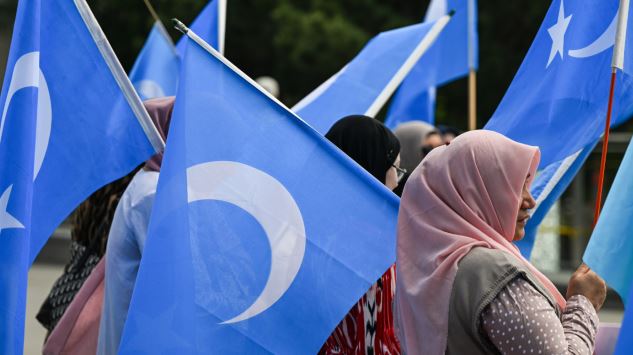
Members of the Uyghur diaspora gather at Violet King Henry Plaza, in front of the Alberta Legislature, during the “Remembering the 2009 Urumqi Massacre” protest-commemoration event, on July 5, 2025, in Edmonton, Alberta, Canada. (Photo by Artur Widak/NurPhoto via Getty Images)
by Samir Goswami and Nyrola Elimä, opinion contributors
The Hill - 04/11/26
The new plan is explicitly designed to expand and entrench a state-imposed forced labor system targeting Uyghurs and other ethnic minorities in Xinjiang, badly exploiting these workers as an engine of economic growth.
China’s continued exploitation of Uyghur people is central to its ambition to dominate global critical mineral markets. With access to cheap energy and coerced labor in Xinjiang, this creates a structural advantage that U.S. companies cannot fairly compete with. When President Trump meets with Xi Jinping in May, he should take advantage of the vital opportunity to raise these concerns directly.
Our organization analyzed the policy documents released at this year’s two sessions, the annual gathering where China’s leadership sets its national agenda. We found alarming strategic dependencies quietly accumulating inside the Western technology and defense industries — all built on terrible abuses.
The new plan’s overriding priority is to position China at the “forefront of global science and technology,” by eliminating critical technological dependencies and ensuring that its development trajectory cannot be disrupted by external pressure or supply chain coercion. The success of these goals depends on securing reliable access to raw materials at scale. The Xinjiang Uyghur Autonomous Region is central to that.
For example, Xinjiang holds 83.5 percent of China’s beryllium reserves, a material with no substitute in semiconductor manufacturing. China controls 99 percent of global lithium iron phosphate battery production, much of it anchored in Xinjiang’s mineral wealth.
The Chinese Communist Party also exploits Xinjiang’s abundant coal reserves to provide subsidized energy that enables mineral processing. Industrial electricity in Xinjiang costs approximately 2.7 cents per kilowatt-hour. In the U.S., it’s roughly 7.5 cents, and 22 cents in the European Union. Since energy accounts for 40 to 60 percent of processing costs for materials like titanium, magnesium and lithium, this gap creates a structural competitive advantage that Western producers simply cannot match on their own terms.
Xinjiang’s advantage in minerals doesn’t just come from subsidized energy: It comes from how those resources are processed from systemic reliance on state-imposed forced labor programs. China’s economic plans depend heavily on forced labor. That’s why the government intends to expand them, make them more deeply embedded in the system and use more advanced technology to enforce them.
China is using artificial intelligence to monitor and profile Uyghur workers, classifying them in real time and directing them into forced labor. Non-compliance is not an option. Refusal can be viewed by the government as sympathizing with “extremist” ideologies, which could lead to incarceration.
At this year’s two sessions, the Chinese government also passed the Ethnic Unity and Progress Law. This is a sweeping piece of legislation that establishes Mandarin-first policies across all official and educational settings and standardizes teaching materials to promote a single Chinese identity. The law turns the stated goal of “ethnic unity” into a legal requirement across society. It limits what people can say and see, while increasing surveillance and tightening government control.
This isn’t mere rhetoric — when policies are set in five-year plans, local governments move quickly to carry them out. On the same day the new five-year plan was released, the Xinjiang Production and Construction Corps and 18 state owned companies signed 92 agreements across energy, critical minerals, computing and manufacturing. These developments point to a broader push to scale up Xinjiang’s role across the full industrial chain.
By the time critical minerals from Xinjiang reach global markets, their price already reflects the hidden inputs of electricity generated under coerced conditions and labor extracted through state compulsion. Producers who don’t benefit from either cannot compete on price. And once electricity enters China’s national grid, it loses its origin, meaning products manufactured far from Xinjiang can still carry the hidden subsidy of forced labor while appearing fully compliant with regulators and buyers.
When Trump heads to China next month, he can make clear that the U.S. will only compete on the basis of free and fair trade and will not tolerate efforts to manipulate critical mineral markets through systemic forced labor.
The administration has already begun taking important steps in this direction, calling on key trading partners to demonstrate how they are preventing goods made with forced labor from entering their markets and, in turn, indirectly entering the U.S. The administration should also follow through to ensure these commitments from partners are credible and effective.
The U.S. also has an opportunity to respond by more systematically enforcing the Uyghur Forced Labor Prevention Act — a law passed in 2021 to prohibit the importing of any products linked to forced labor from Xinjiang. Most importantly, we must continue to support Uyghur, Kazakh and other Turkic communities in the face of China’s ongoing repression and genocide.
China is taking a whole-of-government approach to dominate critical mineral markets by using forced labor. The U.S. must act vigorously to counter this threat.
Samir Goswami is director of Forced Labor Programs at Global Rights Compliance, an international law foundation advancing accountability and justice, and a former deputy assistant administrator at USAID. Nyrola Elimä is a researcher with expertise in supply chain tracing, forced labor and transnational repression.