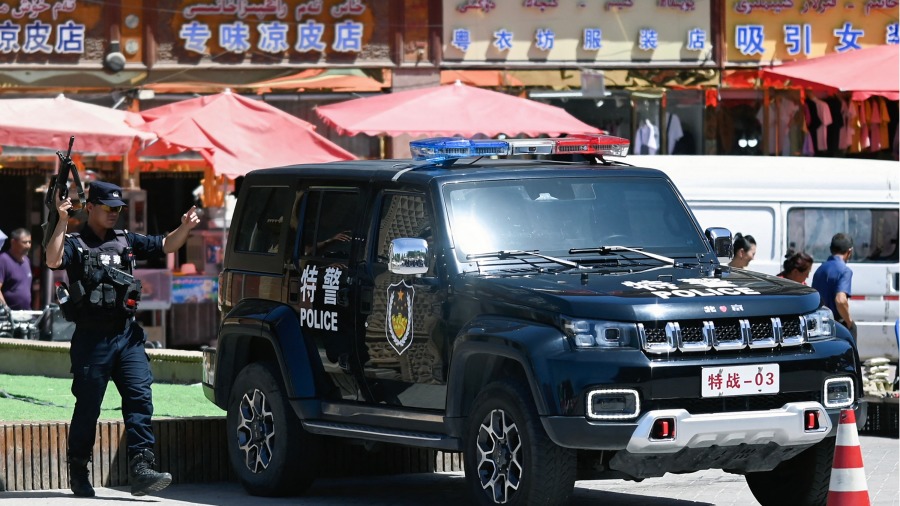
A Xinjiang police officer named Zhang Yabo successfully escaped to Germany and recently publicly revealed the brutal reality of persecution and detention inside Xinjiang’s camps. He also exposed how the Chinese authorities tightly monitor the local population in Xinjiang and fabricate charges against people based on absurd reasons.
Xinjiang police officer Zhang Yabo escapes to Germany, details revealed
On April 16, 2026, Der Spiegel reported that a Xinjiang police officer named Zhang Yabo traveled to Germany as part of a tour group in August 2025, during which he deliberately separated from the group and successfully broke away while at Neuschwanstein Castle.
At the time, Zhang Yabo carried a discreet gray backpack containing a laptop. On its hard drive were documents from his time serving as a police officer in Xinjiang—evidence of the persecution of Uyghurs by the Chinese authorities.
According to the report, Zhang Yabo walked at the very back of the tour group. He had repeatedly rehearsed this moment of escape in his mind—during hotel stays, on buses, and even in bathrooms. In reality, “when the tour group was walking up a mountain road, I deliberately stayed at the end of the group. At a turn in the path, I stopped and, when no one was paying attention, turned back and left. I then took transport via the town of Füssen to Munich.”
He later arrived at the headquarters of the World Uyghur Congress (WUC) in the Schwabing district of Munich and applied for asylum in Germany. The WUC issued a picture of Zhang Yabo and a statement on Friday urging the international community to consider his testimony as evidence of CCP’s persecution against Ughurs.

This photo taken on May 31, 2019 shows watchtowers on a high-security facility near what is believed to be a re-education camp where mostly Muslim ethnic minorities are detained, on the outskirts of Hotan, in China’s northwestern Xinjiang region. As many as one million ethnic Uighurs and other mostly Muslim minorities are believed to be held in a network of internment camps in Xinjiang, but China has not given any figures and describes the facilities as “vocational education centres” aimed at steering people away from extremism. (Image: GREG BAKER/AFP via Getty Images)
Zhang Yabo’s personal experience in Xinjiang prisons
As for why Zhang Yabo took such a risky decision to flee China, it relates to his professional background. According to reports, Zhang Yabo worked for nine years in northwestern Xinjiang as a prison guard and police officer. Information stored on the hard drive of the computer he carried indicates that he was born on October 15, 1986, in Henan Province. Starting in 2009, he worked as an elementary school teacher in Xinjiang. In 2014, he became a prison guard in Xinjiang, and later served as a police officer in a village in the region.
Zhang Yabo provided Der Spiegel with photos of his police ID and images of himself wearing a black uniform in front of a prison in Xinjiang to verify his identity.
The Chinese authorities in Xinjiang have established a system consisting of internment camps, digital surveillance, and political indoctrination, primarily targeting Uyghurs.
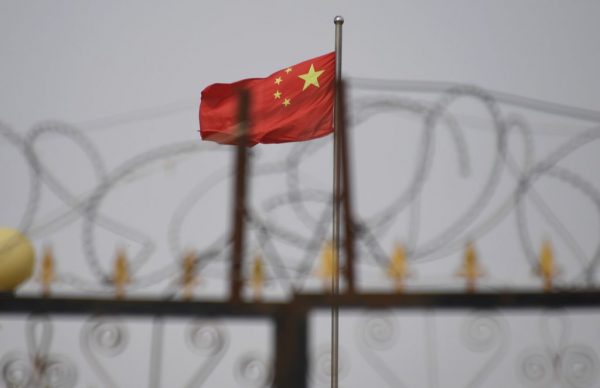
Since 2017, outside reports have revealed that numerous internment camps were built in the region. These facilities are surrounded by barbed wire fences, watchtowers, and barricades designed to prevent detainees from escaping. According to reports, these camps have at times held hundreds of thousands, and possibly close to one million people.
Although the Chinese authorities tightly restrict information about the camps, Zhang Yabo confirmed that detainees who show disobedience inside the camps are subjected to torture under accusations of being “so-called extremists.”
Zhang Yabo’s main duty while working in the prison was to escort detainees under investigation to designated locations for interrogation. These detainees were primarily Uyghurs from Xinjiang.
Zhang described conditions inside the facility, including cases where some police officers beat prisoners with batons so forcefully that the wooden batons broke. He also stated: “One guard repeatedly kicked a young man in the testicles; that person later died.”
Unlike other guards, Zhang said he only observed the beatings and did not personally participate. However, witnessing the suffering of detainees caused him psychological trauma. He said: “I can still hear those screams. I have nightmares about them.”
The alleged harsh treatment in the camps also led to deaths among detainees, while the authorities, according to Zhang, showed no regard for humane treatment. He recalled an incident in which he was responsible for guarding a prisoner whose arms were handcuffed for several hours until the person urinated on himself. He said such punishments occurred frequently in the prison.
Zhang further claimed that deaths occurred almost weekly in the prison, and that there was virtually no medical care provided to inmates.

Strict surveillance of Uyghur residents by Xinjiang police
By 2016, Zhang Yabo was transferred to a village in Xinjiang as a police officer. The village had about 1,700 residents. Zhang created personal files for so-called “suspects,” recording their names, contacts, religious activities, and even blood test results.
He was also required to ensure that no Uyghur residents went to mosques to pray and was responsible for searching their mobile phones, immediately reporting any suspicious findings to higher authorities.
Zhang also had to monitor messages in village committee chat groups, including information such as which villagers were ill and which Uyghur residents did not attend mandatory “Chinese language classes.” He was required to compile and report this fragmented information to the higher-level public security bureau every week.
According to the report, the CCP’s real-time surveillance of Xinjiang residents reached an extreme and intolerable level, and was also tied to incentives for police officers.
Zhang said that anyone could be taken away at any time. For example, if a villager went out to exercise, that person could be considered suspicious. The threshold for being labeled suspicious was also extremely low—“a song, a poem, or a prayer could be enough evidence for arrest.”
In addition, there were quotas for reporting suspects to higher authorities. Police officers who reported a sufficient number of “suspects” could receive time off; otherwise, they were required to work overtime. Some officers therefore fabricated cases deliberately—for example, if they saw villagers playing basketball, they would claim they were “maintaining physical fitness for violent activities” and record them as potential terrorists.
The classification of Uyghur villagers by the Chinese authorities was also described as highly absurd.
Zhang Yabo provided Der Spiegel with an internal “instruction” document issued in August 2022, which outlined how to handle so-called mentally ill individuals. According to the document, village-level administrative departments were required to conduct “screening and risk assessments” of villagers with mental illness.
As for who was considered mentally ill, Zhang gave examples claiming that so-called mentally ill individuals included unmarried people, alcohol drinkers, and homeless individuals who did not obey village directives. Although this may sound absurd, those classified in this way were subject to serious consequences.
The Chinese authorities were also said to be attempting to undermine the “purity” of Uyghur lineage through forced marriages, combined with financial incentives. Zhang confirmed that if a Uyghur person married a Han Chinese person, the couple would receive money from the government. Some of his colleagues reportedly received between 5,000 and 10,000 RMB through such arrangements.
Zhang Yabo resigns and escapes
The oppressive nature of the job placed significant psychological pressure on Zhang Yabo.
In September 2023, Zhang resigned for “family and health reasons” and later worked for a period as a barber in Guangzhou, where he also came into contact with Christianity. He decided to escape China and disclose internationally what he had personally experienced and witnessed regarding crimes in Xinjiang’s internment system, as well as how the authorities control police to closely monitor the local population.
He therefore spent 35,600 RMB to join a European tour group. This required bribing Chinese officials to obtain exit permission, and upon resignation he signed a so-called confidentiality agreement, pledging to remain silent about “state secrets he had obtained.”
Before Zhang Yabo fled, he divorced his wife and sold all the furniture and household appliances in his home.
Zhang Yabo has now successfully escaped to Germany, where he has applied for asylum.
The World Uyghur Congress asked Zhang Yabo why he chose to flee and speak out. Zhang said: “I am a Christian, and after I die I must give an account to Jesus.” He also presented proof of his baptism and said: “If one day I am asked what I did about the injustices there, I at least hope I can say: I told the truth.”
Like other dissidents who bravely speak out internationally to expose alleged abuses by the Chinese authorities, Zhang Yabo’s family and friends in China have also reportedly been threatened by the authorities.
Police allegedly detained Zhang Yabo’s father overnight and threatened his mother with imprisonment, forcing her to call him and beg him to return to China. Police also took one of his friends in for questioning.
Dr. Adrian Zenz, senior fellow at the Victims of Communism Memorial Foundation, said Zhang Yabo’s testimony is one of the most detailed operational eyewitness accounts obtained so far from inside Xinjiang’s security system.