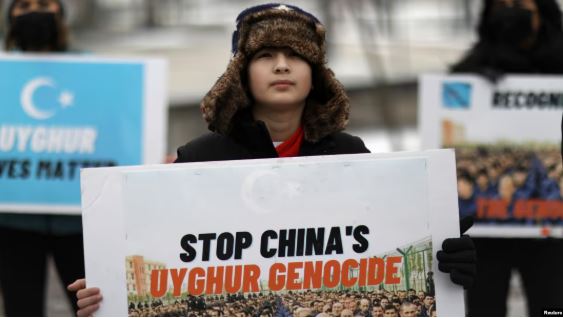
Material Photo: A 12-year-old protester participates in a rally in front of the Canadian Embassy in Washington, D.C., calling on Canada and other nations to designate China’s treatment of Uygurs and Muslim minorities as "genocide." (February 19, 2021)
The Commission on International Religious Freedom holds a global hearing on anti-Muslim hatred.
Lin Feng | Voice of America | May 5, 2026
A U.S. government commission responsible for monitoring international religious freedom held a hearing on Tuesday (May 5) to investigate the rising trend of attacks targeting Muslims on a global scale. During the meeting, a Uygur activist warned that the forced labor system mandated by the Chinese government has permeated global supply chains for daily consumer goods, asserting that religious belief is being used by Beijing authorities as a pretext for the systematic persecution of its own people.
Hosted by the United States Commission on International Religious Freedom (USCIRF), the virtual hearing was titled "Rising Anti-Muslim Hatred: FoRB Violations Against Muslims Abroad." Witnesses from Europe, Pakistan, and the overseas Uygur community were invited to collectively review the threats facing the religious freedom of Muslims worldwide.
Daughter of Prominent Uygur Intellectual Calls the U.S. to Action
One of the witnesses was Jewher Ilham, who currently serves as the Forced Labor Project Coordinator at the Worker Rights Consortium. Her father, the renowned Uygur economist Ilham Tohti, was sentenced to life imprisonment by Chinese authorities in 2014 on charges of "separatism" and remains in prison to this day.
Jewher recounted the moment of separation from her father to the commission: "I was 18 years old at the time." While she and her father were at the Beijing Capital International Airport, Chinese authorities detained her father just before they could board the plane. "That was the last time I saw him."
According to Jewher, it was only after arriving in the United States that she held the Holy Quran for the first time and entered a mosque—a fact that reflects the religious restrictions Uygurs face in Xinjiang (East Turkestan) within China.
In her testimony, she stated: "China is an officially atheist state; members of the Communist Party are not allowed to believe in any religion or engage in religious activities. The authorities fear that religious belief could become an alternative to Communism, thereby shaking the people's loyalty to the government."
"Sinicization of Religion" and Comprehensive Surveillance
Jewher detailed how, since Chinese leader Xi Jinping took power in 2013, the Chinese authorities have aggressively implemented the so-called "Sinicization of Religion" policy. This policy mandates that all religious groups bring their faith practices within the framework of Chinese culture and Communist Party ideology.
Authorities have banned religious education for young children; new regulations prohibit unregistered religious groups from distributing religious content online. In the region locals call "East Turkestan"—officially the "Xinjiang Uygur Autonomous Region"—it was reported that local authorities stopped conservatively dressed women on the street and forcibly cut their dresses to make them shorter. Traditional village and street names have been replaced with politically charged names like "Unity Bazaar" or "Red Flag Road."
Following Xi Jinping’s visit to Xinjiang in 2014, the Chinese government launched a massive crackdown, leading to the arbitrary detention of an estimated 1.8 million Uygurs, Kazakhs, Kyrgyz, and other Turkic peoples.
Jewher stated: "While the authorities announced to the world that these measures were to eliminate 'extremist' ideology among these peoples, in reality, it is to weaken and destroy their culture and suppress the religious activities of Muslims."
Forced Labor Deeply Embedded in Global Supply Chains
Jewher informed the commission members that this persecution has created a massive state-run forced labor system, which has now permeated at least 17 industries in the global supply chain.
She pointed out that one in five cotton garments in the global market originates from Xinjiang; furthermore, 10% of the world’s PVC construction materials, nearly 10% of aluminum, and 35% of the polysilicon used in solar panel production are produced in this region.
According to her, Uygurs transferred to factories in places like Shanghai, Nanjing, and Beijing begin work at 5:00 AM every day and work for 10 consecutive hours. They are housed in overcrowded dormitories under 24-hour surveillance, where praying and wearing headscarves are strictly prohibited. They attend mandatory political education classes every week; those who refuse to comply face the threat of being sent to "re-education camps."
Based on research data cited by Jewher, at least 3.17 million people have been forced to leave their homes in Xinjiang and move to other regions through the government’s labor transfer project.
"Recently revealed whistleblower testimony shows that living conditions there are even worse than in Chinese prisons," she said. The entire system is dominated by a "pervasive invention of fear."
Urging the U.S. to Take Political Action
Jewher urged the commission and the U.S. government to take practical measures, including expanding the sanctions list of the Uyghur Forced Labor Prevention Act (UFLPA). Under this law, imports from Xinjiang are completely prohibited unless it can be proven that they do not contain forced labor.
She stated that civil organizations have waited over a year for the sanctions list to be updated, and that continuing to expand this list is necessary to send a clear signal to importers that the U.S. government will not diminish its law enforcement efforts.
She also called on Washington to strengthen coordination with other countries that have implemented or are considering restrictions on forced labor products, to prevent goods rejected by the U.S. from flowing into other markets.
"The clothes in our wardrobes, the food in our kitchens—all of it may be stained with the blood and sweat of my brothers and sisters," she said.
Domestically, as President Donald Trump prepares to travel to Beijing next week for a summit with Chinese President Xi Jinping, Jewher urged the U.S. government not to relegate human rights issues to a secondary topic in bilateral talks.
Commissioners Note Global Violence Against Muslims
USCIRF Chair Vicky Hartzler, in her opening remarks, recalled numerous recent incidents of violence against Muslim communities in various parts of the world.
She mentioned the February 2025 suicide bombing at a mosque near Islamabad, Pakistan, for which "Islamic State" (IS) later claimed responsibility. The attack killed 32 worshippers and injured more than 160, marking the deadliest attack in that city in 18 years.
She also described an attack by armed gangs in a small village in India, where victims were targeted solely because of their Muslim identity, as well as a synchronized incident where severed pig heads were left in front of nine mosques around Paris. Investigators indicated that the latter event had links to Russian intelligence agencies.
"It is vital to view these attacks correctly, because a violation of the religious freedom of any group is a violation of us all," Hartzler said.
Background: The Intertwining of Islamophobia and Geopolitics
The hearing also focused on the deep connection between Islamophobia and geopolitics. In Jewher’s view, China’s method of portraying Islam as a threat only became widespread after the "September 11 attacks" in 2001.
"After 9/11, this became the best excuse for the Chinese government to escape condemnation from the international community," she said. "Once the Chinese government discovered that Islamophobia was a tool that could be exploited, they did not hesitate to use it."
Nevertheless, she emphasized that religion is not the root cause of Beijing’s actions. "Islam is never the core issue. The difference in the values we hold, as well as the strategic resources like natural gas, gold, and uranium in that land, are the ultimate causes."
USCIRF recommended that the U.S. government include religious freedom in all bilateral and multilateral dialogue agendas with China, strengthen asylum and humanitarian aid projects for Uygurs and other groups at risk, and provide funding for independent documentation of human rights violations and overseas diaspora community organizations.
The commission also urged policymakers to ensure consistency in religious freedom protection policies, stating that they should not only apply to minorities like Christians, who have historically held an important place in U.S. foreign policy, but should be applied equally to Muslims globally.
"Supporting religious freedom is a tradition that the United States is proud of, and it has long enjoyed bipartisan support," said USCIRF Vice Chair Asif Mahmood. "Viewing hatred toward Muslims correctly is part of these vital efforts—so that all people may enjoy religious freedom."
According to the 2026 Annual Report released by USCIRF on March 4, the religious freedom situation in China continued to deteriorate over the past year. The Chinese government’s policies toward Uygurs and other Muslim minorities in Xinjiang remain one of the most severe religious freedom issues in the world.
The United States Commission on International Religious Freedom is a bipartisan, independent body established by the U.S. Congress in 1998, responsible for evaluating the state of religious freedom globally and providing policy recommendations to the President, the Department of State, and Congress.