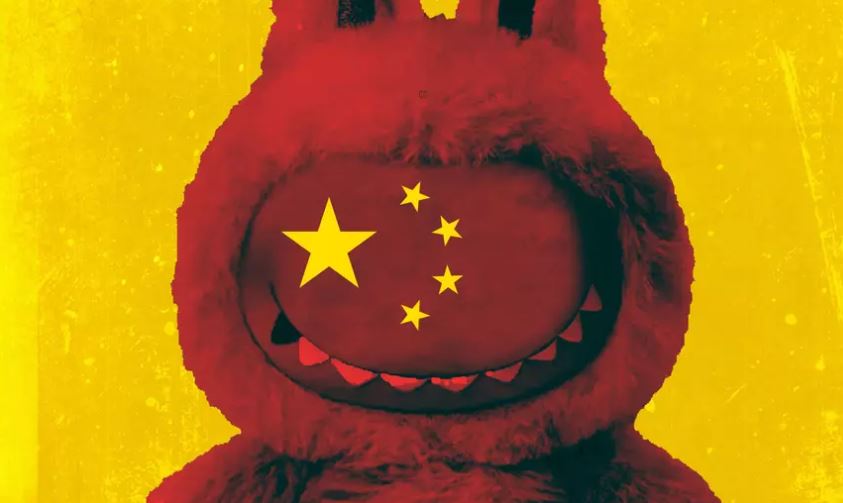
China and Labubu dolls illustration by Linas Garsys / The Washington Times
Some of the toys' cotton was handpicked by slaves
-
Riding the Washington Metro recently, I saw a Labubu doll dangling from a backpack.
An uneasy feeling grabbed my heart. To me, that doll represents modern slavery, and it’s personal.
An independent investigation by The New York Times recently confirmed that plush versions of Labubu dolls are made with cotton from my homeland, East Turkestan, now known by its colonial name, Xinjiang.
Uyghurs are coerced into labor transfers, indoctrinated and surveilled, and then shipped with the cotton they pick to provinces such as Guangdong, where 70% of Labubu maker Pop Mart’s dolls are made.
The Uyghur region is the Chinese Communist Party’s testing ground for its most extreme tools of control, including surveillance and state-imposed labor transfers. These are later exported across China, Central Asia, Africa and the rest of the Global South.
The Uyghur community has been subjected to genocidal policies targeting their ethnic and religious identity. More than 1 million children have been torn from their families and sent to state-run orphanages. Women have been forcibly sterilized or forced into marriage with Chinese men.
China’s recent “ethnic unity law” erases Uyghur identity by mandating Mandarin instruction and incentivizing forced marriages and Chinese migration while requiring CCP political indoctrination for all children.
The CCP has engineered a system of erasure and genocide that turns Uyghur suffering into profit, feeding global supply chains for apparel, agriculture, critical minerals, automobiles and more.
Beijing has mastered the art of distraction, dressing exploitation in the language of progress and culture. For example, it carefully orchestrates Potemkin-style tours of the Uyghur region. Princeton University Press staff joined one such tour and shamelessly praised the region’s “cultural diversity” despite overwhelming evidence that Uyghur culture, language and religion are being eradicated.
These tours showcase Uyghurs singing and dancing while their language is banned, their books are burned and their religion is criminalized. Phone data collection and facial recognition cameras feed predictive policing systems that monitor speech and behavior.
TikTok and state-backed media amplify the staged “happy” Uyghur images to whitewash atrocities, sow doubt and blunt accountability.
Still, no amount of propaganda can erase the truth lived by Uyghur families such as mine.
In 2018, I spoke at the Hudson Institute about China’s mass detention. Days later, the CCP abducted my sister, Dr. Gulshan Abbas. She has been imprisoned for nearly 3,000 days in retaliation for my advocacy. This is blatant transnational repression and a warning that my voice, even as an American citizen, carries a price.
My sister’s imprisonment is a stark reminder of what the regime fears most: the truth.
In 2021, the U.S. formally recognized the oppression of Uyghurs as genocide, and Congress passed the Uyghur Forced Labor Prevention Act that December.
The law requires importers to prove that their goods are free of Uyghur forced labor. Pop Mart has made no such attempts.
The Chinese toy maker even defended Xinjiang cotton, attacking Adidas China for “politicizing supply chains” after Adidas cut ties. Pop Mart has since expanded in the U.S., amassing nearly 2 million members — consumers who sign up to collect points with the manufacturer — and their data sits on Chinese servers.
Meanwhile, the tainted Labubu dolls are in stores and vending machines from Los Angeles to New York.
The CCP’s flagship newspaper hailed Pop Mart’s “Labubu 3.0” as proof that Chinese culture could captivate American consumers. The Pop Mart CEO sits on the Chinese People’s Political Consultative Conference, a party-run board used to project influence and propaganda worldwide.
This places the company firmly inside a state-backed ecosystem.
Pop Mart’s hunger-marketing model releases dolls in limited batches. TikTok amplifies this manufactured scarcity into a viral obsession, driving consumers to pay premium prices for toys made with Uyghur forced labor.
Labubu demonstrates how CCP soft power successfully integrates American consumers into an authoritarian economic system.
In July 2025, Campaign for Uyghurs submitted a formal allegation to U.S. Customs and Border Protection, urging an investigation of Pop Mart and its addition to the Uyghur Forced Labor Prevention Act Entity List. We have seen no action.
Still, the evidence is clear: Pop Mart should be investigated and banned from U.S. imports.
If you already own a Labubu doll, then keep it. Yet remember, it is made from cotton handpicked by Uyghur slaves who lost their families and livelihoods so the world could indulge in another disposable trend.
Staying silent on Uyghur persecution makes us all complicit.
• Rushan Abbas is executive director of Campaign for Uyghurs and author of “Unbroken: One Uyghur’s Fight for Freedom.”