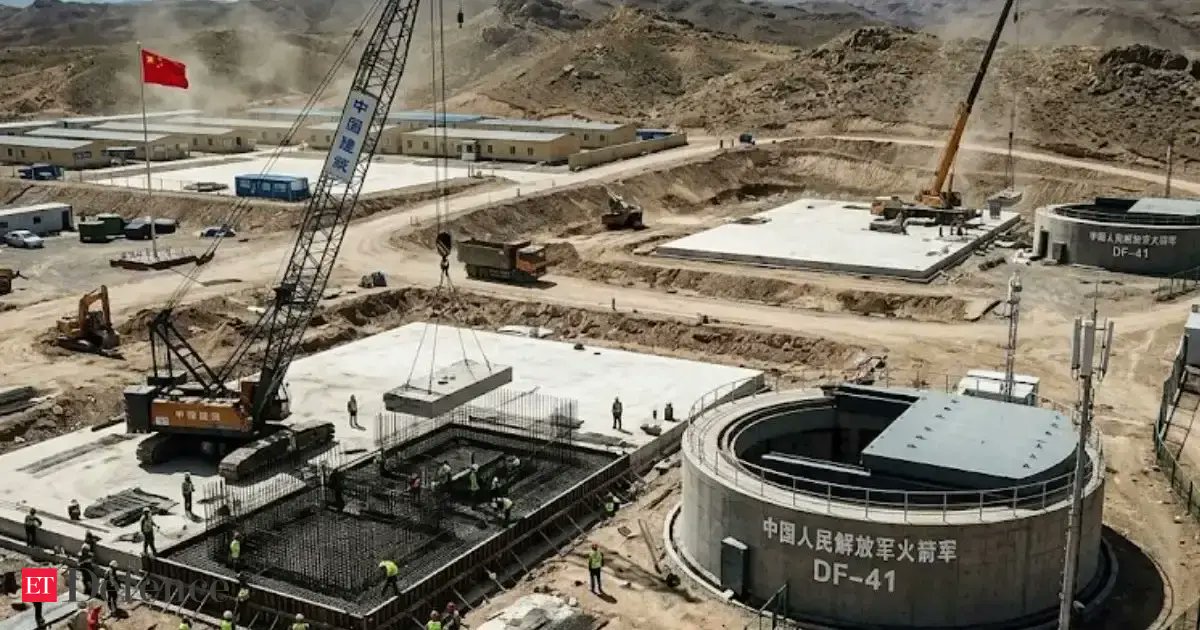
Turkistan Times, 31 May 2026 — A series of alarming satellite imagery investigations have revealed that Beijing is dramatically expanding its nuclear infrastructure across the occupied Uyghur homeland. These findings underscore a chilling reality: while millions of indigenous Uyghurs face systemic persecution, cultural erasure, and forced assimilation, their ancestral lands are being systematically converted into a sprawling, heavily fortified nuclear battleground.
According to separate investigative reports from Reuters and Nashaniva.com (citing data from Metro), commercial satellite images show that China has constructed more than 80 new missile launch pads and three massive, octagon-shaped military installations over the last six years. This sweeping infrastructure network covers thousands of square kilometers of the desert landscape in East Turkistan.
A Massive Network Built on Occupied Land
The newly discovered facilities are strategically situated near the Hami region, an area already notorious for harboring deep underground silos that hold the Chinese military’s longest-range intercontinental ballistic missiles. This unprecedented military buildup, which security analysts describe as nothing short of a sweeping expansion, features a vast web of hardened bunkers, concrete launch pads, transport infrastructure, and advanced communication nodes.
Experts believe these sites are designed to accommodate mobile anti-aircraft systems, advanced electronic warfare equipment, and mobile missile launchers. At the center of this rapid expansion are distinct, large octagonal structures. Satellite imagery reveals these complexes are engineered to house military personnel and heavy machinery, providing a permanent, fortified footprint for the People's Liberation Army (PLA) deep within East Turkistan.
Security scholars note that this network signals a significant upgrade in Beijing’s "second-strike" capability. Speaking to Reuters, Alexander Neill, an adjunct fellow at Hawaii’s Pacific Forum think tank, remarked:
“We can see this infrastructure is being built on a grand scale, covering thousands of square kilometers of desert... we’re looking at a very considerable enhancement and diversification of China’s strategic nuclear deterrent.”
Furthermore, Pentagon reports indicate that China is growing its nuclear arsenal faster than any other nation, with projections suggesting it could reach approximately 1,000 warheads by 2030.
A History of Radioactive Persecution
For the indigenous Uyghur population, the militarization of their homeland is a terrifying continuation of decades of exploitation. The choice of this region for nuclear operations is deeply tied to its historical oppression. The infamous Lop Nur base—located in what Chinese state media refers to as the "Xinjiang region"—has long been the epicenter of China’s nuclear weapons testing program, dating back to its first atomic blast, Project 596, in 1964.
While Chinese authorities have historically justified using the area by claiming it is a "desolate and isolated" desert, the broader East Turkistan region is the historic home of the Uyghurs, a predominantly Muslim ethnic group. For decades, the Uyghur people have persistently voiced grave concerns regarding the catastrophic health risks, environmental devastation, and radioactive fallout left in the wake of towering mushroom clouds.
Escalating Tensions and Lack of Transparency
This rapid escalation comes at a time of intensifying geopolitical friction. Western diplomats warn that despite China’s official "no first use" policy, Beijing could weaponize its expanding nuclear arsenal to exert coercion over international conflicts, such as the sovereignty of Taiwan. Human rights advocates argue that by turning the Uyghur homeland into a heavily fortified nuclear shield, the Chinese government is putting the local population at even greater risk, effectively using occupied territory as a geopolitical buffer zone.
As international scrutiny intensifies, Beijing continues to operate in total secrecy. China’s defense ministry refused to respond to questions regarding the developments, while the Pentagon declined to comment on the specific intelligence. For the people of East Turkistan, this silent, rapid nuclear expansion serves as a stark reminder of Beijing's disregard for their safety, their environment, and their fundamental human rights.