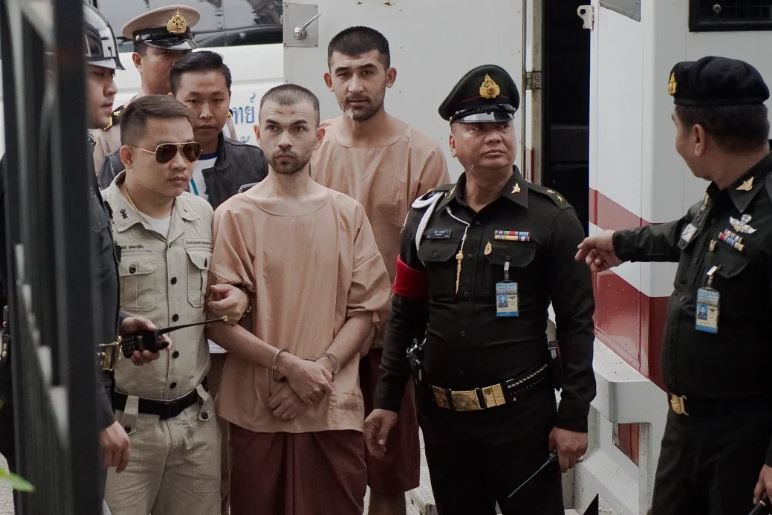
Bilal Mohammed (centre) and Yusufu Mieraili (back right), defendants in the 2015 Erawan shrine bombing case, arrive at a military court in Bangkok on February 16, 2016. File photo: Nicolas Asfouri/AFP.
Turkistan Times, 13 June 2026 — Two Uyghur men have been sentenced to death by a Thai court over the 2015 Erawan Shrine bombing, sparking intense international backlash from human rights groups and Uyghur advocates who condemn the verdict as a politically motivated miscarriage of justice following an eleven-year arbitrary detention.
On Thursday, June 11, 2026, the Bangkok South Criminal Court found Bilal Mohammed (also known as Adem Karadag) and Yusufu Mieraili guilty of carrying out the August 17, 2015 attack in central Bangkok, which tragically claimed 20 lives and injured more than 120 others. While the court cited testimonies from roughly ten key prosecution witnesses to justify the capital punishment, the defendants fiercely maintained their innocence, with Mieraili visibly shouting "Injustice!" in the courtroom. Human rights groups and East Turkistan advocates swiftly condemned the ruling, pointing out that the decade-long trial was severely flawed, marked by systemic violations of due process, and likely influenced by Beijing's heavy geopolitical leverage over Thailand.
According to a comprehensive press release issued by the International Federation for Human Rights (FIDH), the Paris-based global watchdog deeply regrets the court's decision, stating that the proceedings failed to meet international fair trial standards. FIDH Vice-President Teppei Ono strongly criticized the ruling, noting that after facing numerous fundamental rights violations for over a decade, the two men now face the ultimate violation of their right to life. The organization pointed out that the United Nations Working Group on Arbitrary Detention (WGAD) had officially declared the prolonged, nearly 11-year detention of Mohammed and Mieraili as "arbitrary" in an opinion adopted in August 2025. FIDH detailed a litany of serious violations under the International Covenant on Civil and Political Rights (ICCPR), including the denial of the right to a trial within a reasonable time and the failure to protect the men from torture. Both defendants testified between December 2025 and January 2026 that Thai authorities subjected them to physical ill-treatment in September 2015 to extract false confessions—allegations the Thai court dismissed as "insufficiently substantiated."
In a detailed report by Radio Free Asia (RFA), prominent Uyghur leader Rebiya Kadeer of the International Uyghur Human Rights and Democracy Foundation (IUHRDF) expressed profound skepticism over the legal process. While Kadeer acknowledged the immense tragedy of the 2015 bombing and stated that the victims' families deserve genuine justice, she firmly asserted that true justice cannot be built on a deeply compromised legal process. RFA highlighted that the defense lawyers, led by Choochat Kanpai, intend to appeal the verdict within the allowed 30-day window, arguing that the court failed to fully consider the systemic mistreatment the defendants endured. The RFA report, which drew upon on-the-ground reporting from journalists Pimuk Rakkanam in Bangkok and Tahir Hamut Izgil in Washington alongside dispatches from major international news agencies like Reuters and AFP, underscored how a severe lack of qualified translators and the pandemic crippled the defense's ability to cross-examine evidence effectively for a decade.
According to a report by BBC South East Asia correspondent Jonathan Head, who was present at the scene minutes after the 2015 blast, serious flaws have plagued the official investigation from its very inception. Head noted that the Thai government, deeply concerned about the impact on the crucial tourism industry, ordered the crime scene to be cleaned up and cemented over just two days later, effectively obliterating vital forensic evidence. Furthermore, the BBC report highlighted bizarre twists in the case, including Thai police awarding themselves an $80,000 bounty after detaining Mohammed and Mieraili, despite acknowledging that over a dozen other suspects remained at large. The broadcaster also shed light on the systematic delays that dragged the trial out for over a decade, revealing that the defendants spent years rejecting Mandarin-speaking translators provided by the Chinese Embassy, rightfully demanding independent, Uyghur-speaking translators instead.
The sudden finality of this death sentence raises major red flags, especially since Thai authorities held these men for 11 years without presenting ironclad, undeniable forensic proof, only to suddenly rush to a capital conviction now. Activists strongly suspect that Thailand’s sudden judicial resolve is the direct result of intense political and economic pressure from Beijing. This suspicion is heavily reinforced by Thailand's historical compliance with Chinese demands. Speculation has long surrounded the 2015 bombing itself, with many viewing it as a rogue retaliation after Thailand forcibly deported over 109 Uyghurs back to China in July 2015. Far from protecting these vulnerable refugees, Bangkok has repeatedly buckled under Beijing's influence. As reported by RFA, Bahtiyar Bora of the Australian Uyghur Association—who provided translation assistance during the trial—noted that Beijing welcomed the verdict with open arms. Chinese Foreign Ministry spokesman Lin Jian praised the death sentences, stating that China supports Thailand in "severely punishing the murderers," a move Bora warns allows China to continue labeling fleeing Uyghurs as international terrorists.
Furthermore, Thailand’s track record of violating international non-refoulement principles is glaring. Just recently, in February 2025, Thailand deported another 40 Uyghurs directly to China despite clear, urgent warnings from global human rights bodies that they would face severe persecution and abuse upon arrival—a move that drew immediate condemnation from the United Nations. Rebiya Kadeer told RFA that these recurring, deeply troubling actions by Bangkok reinforce fears that judicial decisions involving Uyghurs in Thailand are thoroughly compromised by political and commercial ties to Beijing rather than guided by international human rights laws. For the global East Turkistan community, this flawed verdict represents a dark day where geopolitical interests completely overrode the rule of law.