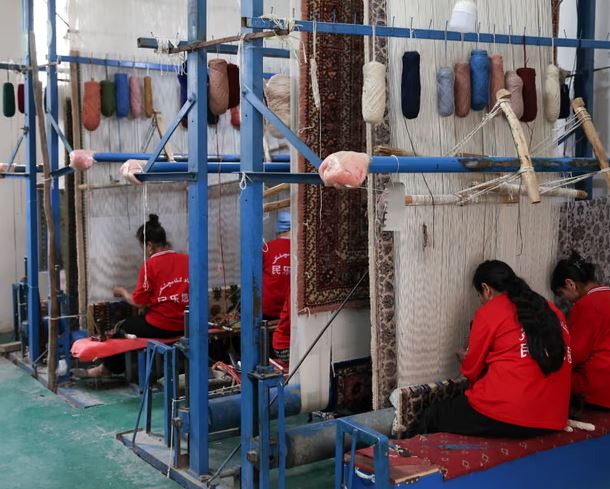
A general view of Minle handmade wool carpet factory on 28 May 2024 in Luopu County of Hotan, Xinjiang Uyghur Autonomous Regio, China. Photograph: Zhe Ji/Getty Images
Turkistan Times - June 16, 2026: The Canadian government has officially announced the elimination of the Canadian Ombudsperson for Responsible Enterprise (CORE), a federal human rights watchdog established in 2019 to oversee the overseas operations of Canadian companies. The decision, driven by Prime Minister Mark Carney as part of broader government austerity and efficiency measures, comes at a time when Canada is under intense pressure from the United States regarding its enforcement of anti-forced labour laws. Over its six-year existence, the watchdog faced significant criticism for its limited scope, having launched only five formal investigations, all of which specifically targeted corporate links to the state-sponsored forced labour of the Uyghurs in East Turkistan.
According to a report by the Guardian, the decision to dismantle the office was finalized a few months ago after Canadian officials concluded that the institution had not been sufficiently effective in enforcing supply chain laws. Although Canada possesses legislative frameworks such as the Fighting Against Forced Labour and Child Labour in Supply Chains Act, the government admitted that practical enforcement mechanism metrics have remained low. The Guardian highlighted that despite human rights groups publishing extensive evidence of modern-day slavery in northeastern China for years, Beijing continues to deny all allegations of abuses against the Uyghurs, creating a highly sensitive diplomatic environment for Canada's trade relations.
According to additional details published by RCI (Radio Canada International), the Canada Border Services Agency (CBSA) has intercepted and detained only 50 shipments over concerns about forced labour since 2020, with only two shipments—a 2024 textile shipment and a 2025 frozen seafood shipment—actually found to have used forced labour. This weak enforcement track record has drawn sharp criticism from Washington, especially given the strict enforcement of the U.S. Uyghur Forced Labor Prevention Act (UFLPA). The UFLPA establishes a rebuttable presumption that all goods manufactured even partially in the Xinjiang region are made with forced labour, a standard that American officials argue Canada has failed to match, leading U.S. Trade Representative Jamieson Greer to recommend a 10 per cent forced labour tariff on countries including Canada.
The dissolution of CORE has sparked widespread controversy because the watchdog’s entire operational history was deeply intertwined with the Uyghur human rights crisis. During its tenure, the body launched high-profile probes into major global brands operating in Canada—including Nike, Ralph Lauren, and Levi Strauss—as well as mining firms GobiMin and Dynasty Gold Corporation, over their alleged reliance on Uyghur forced labour. The watchdog specified that the allegations centered on the use of forced labour in the northeastern Xinjiang region of China. Additionally, a separate mediation process was initiated for fashion giant Hugo Boss regarding similar supply chain allegations. By abolishing the only dedicated watchdog that explicitly targeted these corporate human rights violations, critics argue that Ottawa is weakening its moral stance on global human rights.
The decision has also drawn sharp domestic political criticism from lawmakers who argue that the watchdog should have been empowered rather than eliminated entirely. Green Party leader Elizabeth May criticized the move, stating that CORE was never granted the true independence or legal powers required to compel evidence and hold powerful corporations accountable. Conservative foreign affairs critic Michael Chong also criticized the government for taking too long to act against forced labour, stating that it shouldn't have taken five-and-a-half years or direct prompting from the Donald Trump administration to address these gaps. The political rift underscores a deeper debate within Canada about whether the government is prioritizing fiscal austerity over its international humanitarian obligations to the people of East Turkistan.
In an effort to counter criticism and appease the U.S. administration, the Liberal government tabled Bill C-35 on Friday, a new piece of legislation aimed at tightening the ban on imports made with forced labour. Liberal MP Rob Oliphant introduced the bill, stating that it will create a public list of products linked to forced labour in specific global regions based on intelligence from embassies and other authorities, thereby shifting the burden of proof onto importers to certify that their goods are not manufactured through slavery. While the government hopes this "made-in-Canada solution" will satisfy Washington and align Canada with international rules being crafted by Mexico and the European Union, international observers remain skeptical about whether these trade-focused measures can replace the oversight potential of a dedicated human rights ombudsperson, leaving the future of Canada's scrutiny over forced labour in East Turkistan in a state of uncertainty.