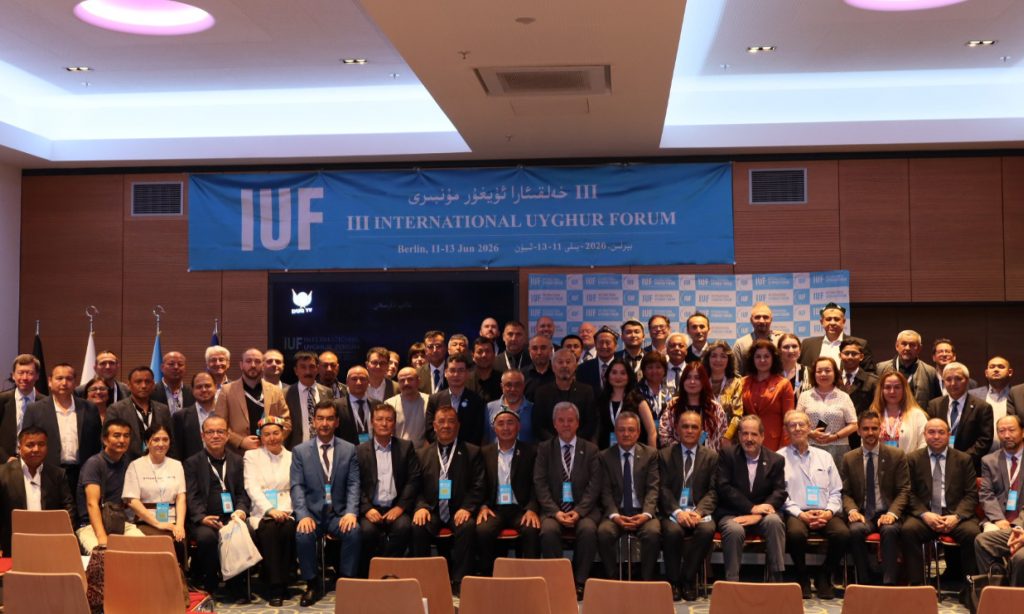
Politicians, experts, and civil society representatives from around the world gathered at the International Uyghur Forum held in Berlin to raise international awareness against the Uyghur genocide and demand accountability. The forum emphasized the need for concrete steps against the genocide and ongoing human rights violations targeting Uyghurs and insisted that those responsible must be held accountable.
June 15, 2026
The International Uyghur Forum 2026 was held in Berlin from June 11 to 13.
The rising international calls for accountability regarding China's policies against Uyghur Turks in East Turkestan were brought back to the agenda at the third International Uyghur Forum this year.
At the forum held in Berlin between June 11 and 13, parliamentarians, human rights defenders, lawyers, academics, and representatives of the Uyghur community from different countries met to discuss the steps the international community must take against the human rights violations targeting Uyghurs.
Co-organized by the World Uyghur Congress and the Uyghur Center for Democracy and Human Rights (UZDM), and supported by the Uyghur Friendship Group in the German Federal Parliament (Bundestag), this year’s forum convened under the title "Ten Years of the Camps: From Recognition to Accountability – What’s Next?". The primary objective of the forum was described as contributing to the development of accountability mechanisms that yield concrete political, diplomatic, and legal results, rather than keeping the international agenda regarding the Uyghur issue solely at the level of recognition and condemnation.
Why is the International Order Inadequate in Protecting Uyghurs?
Pointing out that a decade has passed since the Chinese government launched its mass detention campaign in 2016, the organizing committee emphasized that during this period, far from ending, oppressive policies against Uyghurs have gained a more institutional, systematic, and permanent character. Forced labor practices, transnational repression, the separation of families, restrictions on freedom of religion and belief, and cultural assimilation policies were among the primary topics discussed throughout the forum.
The photography exhibition titled "Lost Voices" organized within the scope of the program also attracted intense interest. The exhibition conveyed to the participants the hardships experienced by Uyghurs forced to work in China’s concentration camps, as well as the stories of Uyghur intellectuals who are still imprisoned or subjected to torture.
According to information shared by the forum organizers, the meeting in Berlin was attended by more than 200 participants and nearly 80 speakers from 25 countries. Within the framework of the three-day program, six panels, eight roundtables, and numerous side events were held.
During the panels, the red lines of the international order were debated using the examples of East Turkestan, Tibet, and Taiwan, and the relationship of global supply chains with human rights violations was discussed in the context of Uyghur forced labor. Furthermore, the extent to which the international and multilateral system has failed to protect Uyghurs, why existing mechanisms remain insufficient, and how international accountability can be strengthened were evaluated.
The roundtable meetings examined China's new ethnic unity policy, transnational repression targeting the Uyghur diaspora, and the current challenges faced by diaspora communities. Additionally, a special session conducted entirely in the Uyghur language was held to strengthen the resilience and endurance of the Uyghur community.
"Documenting Genocide Alone Does Not Bring Justice"
Dolkun Isa, Executive Committee Chairman of the World Uyghur Congress and one of the forum organizers, stated to Perspektif that the main goal of the forum is to keep the Uyghur issue on the international agenda. He emphasized that politicians, experts, and civil society representatives from various countries must develop a common stance against ongoing violations.
Noting that the attention of the global public is currently focused on war zones like Ukraine, Gaza, and Iran, Isa said, "At a time when the Uyghur genocide is being sidelined in the eyes of the global public, we met with people from different parts of the world to keep this horrific persecution on the agenda and stop the ongoing genocide. International silence must end!"
Stating that the forum was organized by the World Uyghur Congress and the Uyghur Center for Democracy and Human Rights (UZDM), with HASENE International being one of the largest sponsors among the 20 sponsors, Isa emphasized that concrete action plans for the future are also taking shape to support international accountability.
Mesud Gülbahar, Board Member of HASENE International—which was one of the main organizers of the first session of the International Uyghur Forum in 2022 and one of the main sponsors of this year’s forum—stated in his speech that the reports of United Nations special rapporteurs, independent investigative mechanisms, and testimonies of surviving victims over the last 10 years present a consistent and highly alarming picture: “Our reason for being here today is that documenting genocide alone does not mean justice. Recognition, no matter how important, is not a substitute for accountability.”
Gülbahar also argued for the implementation of supply chain legislation regarding products coming from camps where Uyghurs are subjected to forced labor, adding, “The European economy should not be complicit, even indirectly, in the oppression of any people.”
"Silence Leads to Normalization"
One of the important points highlighted by the forum was the international consensus that has formed in recent years regarding the violations against Uyghurs. As of 2026, the United States, the United Kingdom, Canada, France, Belgium, the Netherlands, the Czech Republic, Ireland, Lithuania, and Taiwan, as well as the European Parliament, have recognized the crimes committed against Uyghurs as "genocide" and/or "crimes against humanity."
The comprehensive report published by the Office of the United Nations High Commissioner for Human Rights on August 31, 2022, had concluded that China's practices in East Turkestan "may constitute crimes against humanity." The report included serious findings regarding arbitrary detentions, discriminatory practices, and the systematic restriction of fundamental rights.
Nevertheless, human rights organizations argue that international recognition has not translated into concrete outcomes. The World Uyghur Congress and other organizations state that following the UN's 2022 report, sufficient diplomatic pressure has not been exerted on China and accountability mechanisms have not been implemented.
One of the common concerns expressed at the Berlin forum was the gradual normalization of China's Uyghur policies at the international level. Participants argued that due to economic and diplomatic relations, many countries limit their criticism of the Beijing administration, which in turn deepens the international silence in the face of violations.
Various reports published in recent years also indicate that cultural oppression policies continue. Human rights organizations view the renaming of hundreds of Uyghur villages and settlements as a systematic policy to erase cultural identity, while independent research reveals that pressure on Uyghur-language songs and cultural products also persists.
What is the International Uyghur Forum?
The International Uyghur Forum was first held in 2022 in Brussels, where the Brussels Declaration was published, calling on governments to take stronger political and legal steps.
The second meeting of the forum was held in the Japanese Parliament in 2023. The third forum in Berlin became the venue where calls for the international community to transition from the "recognition" stage to the "accountability" stage were expressed in the strongest terms.
The Berlin Declaration, adopted at the end of the forum, includes several recommendations to end Uyghur forced labor and genocide and to strengthen Uyghur communities. Some prominent points from the declaration are as follows:
- Communities and peoples under the rule or threat of the People's Republic of China (including Uyghurs, Tibetans, Southern Mongols, as well as the peoples of Taiwan and Hong Kong) must increase cooperation and strengthen their relations with one another.
- States must provide safe haven for human rights defenders and diaspora communities facing serious threats; they should facilitate family reunification for individuals at high risk of transnational repression.
- Companies that benefit from the Uyghur forced labor system in their supply chains must be held genuinely accountable.
- For the purpose of accountability, in accordance with the "follow the money" principle, investments made in institutions and companies that use or encourage the Uyghur forced labor system must be sanctioned.
- Democratic countries must form a united front against the threat posed by the Chinese Communist Party and support the protection of Uyghurs' rights.
- The issue of Uyghur rights must not fall off the public agenda. Stories of individual victims and survivors must be made more visible. Particular attention must be drawn to the situation of Uyghur intellectuals who are disappeared or whose fates are unknown.
- Parliaments that have recognized the Uyghur genocide should adopt special resolutions on the occasion of the tenth anniversary of the genocide.
- The international community must continue its call for the release of millions of Uyghurs and members of other Turkic peoples held in camps.
- Chinese officials, especially those serving in the central government, must be sanctioned and held accountable for their roles in the Uyghur genocide.
- Democratic states must oppose China's new Ethnic Unity Law and the threats it poses to Uyghurs; if the Chinese government implements this law, sanctions must be imposed on the individuals responsible for drafting it.
- Democratic countries must protect Uyghur refugees and asylum seekers, provide them with asylum opportunities, and demand the implementation of the principle of non-refoulement in third countries.
- The international community must provide stronger support for cultural preservation initiatives, including efforts to protect language, history, and cultural heritage.
https://perspektif.eu/2026/06/15/berlinde-uygur-forumu-uluslararasi-suskunluk-sona-ermeli/