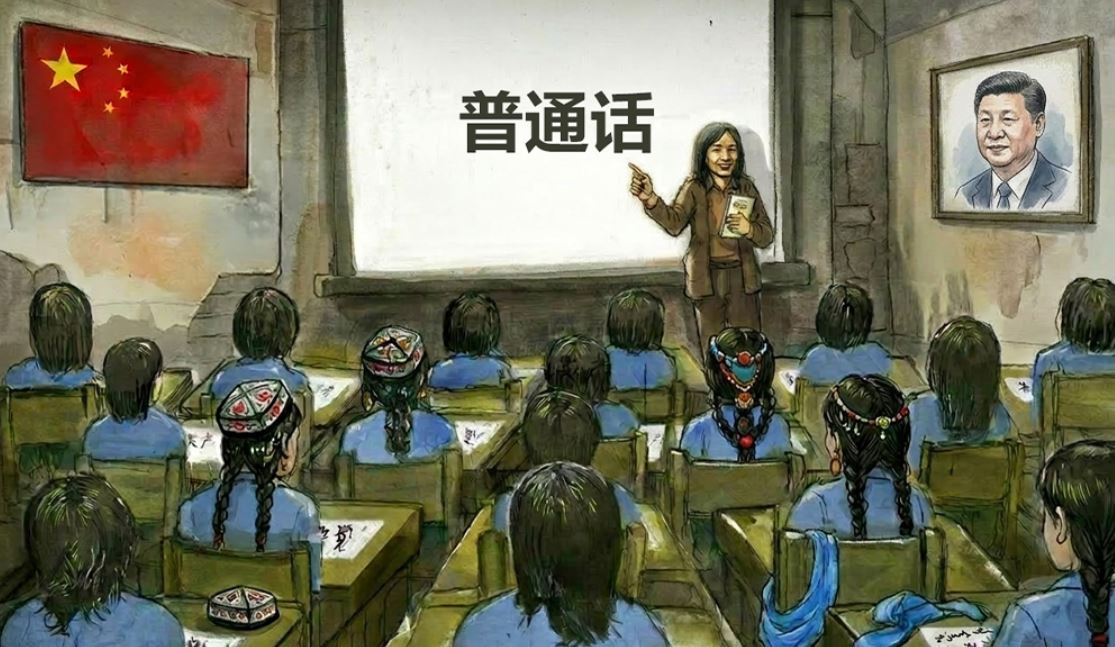
Since language is inseparable from cultural and religious identity to the Uyghur, Tibetan, and Mongolian communities, China’s requirement that they adopt Mandarin in school education and public institutions under its new law strikes at the very survival of these cultures, says Ashu Maan*, pointing out that international linguists and cultural preservation experts have repeatedly warned that state-driven language suppression of this scale constitutes a form of cultural erasure.
June 30, 2026 | Tibetan Review
China’s National People’s Congress passed the Law on Promoting Ethnic Unity and Progress on 12 March 2026, with the legislation set to take effect on 01 July 2026. It legally embeds Xi Jinping’s assimilationist agenda, folding the country’s 56 ethnic groups into a single Party-defined “Chinese nation,” mandating Mandarin as the standard language nationwide, and reaching beyond China’s borders to assert authority over diaspora critics.
The law builds on a troubling trajectory already visible over the past decade. In Inner Mongolia, Beijing has progressively replaced Mongolian-language instruction with Mandarin-medium education, triggering widespread protests in 2020 that were swiftly suppressed.
In Tibet, monastic education and Tibetan-language schooling have faced sustained restrictions, with many traditional institutions shut down or brought under tighter state control. In Xinjiang, the Uyghur language has been steadily pushed out of classrooms and administrative use, accompanied by the mass internment of Uyghurs in so-called “re-education” facilities.
The new law accelerates these trends by giving them explicit legal backing while wrapping them in the language of modernisation. It promises support for the “regulation, standardisation and digitalisation” of minority languages even as it makes Mandarin compulsory as the basic language of instruction nationwide.
This is presented by Beijing as part of a broader development agenda, citing improved access to education and rising living standards in minority regions, including the extension of free schooling in Tibet and parts of Xinjiang.
Such claims warrant scepticism: expanded access to education has been structured specifically around Mandarin-medium instruction, meaning the very institutions presented as developmental progress are simultaneously vehicles for linguistic displacement. Improved school access, in other words, has functioned as a delivery mechanism for assimilation rather than a neutral public good.
Language, for these communities, is inseparable from cultural and religious identity. The erosion of Uyghur, Tibetan, and Mongolian in schools and public institutions, therefore, represents more than a linguistic policy shift; it strikes at the survival of these cultures themselves.
Loss of language access disrupts the transmission of oral history, religious texts, traditional knowledge, and community cohesion across generations, regardless of whatever economic indicators accompany the change.
Even the law’s own claims to preserve linguistic diversity through “digitalisation” and “standardisation” should be read carefully. Standardisation efforts in China’s legal and administrative context have historically meant bringing minority-language content under centralised Party oversight rather than genuinely sustaining independent linguistic ecosystems. The net effect is a managed decline dressed in the language of preservation.
International linguists and cultural preservation experts have repeatedly warned that state-driven language suppression of this scale constitutes a form of cultural erasure.
With the Ethnic Unity and Progress Law now providing legal cover for Mandarin-only policies, and economic development serving as the public justification for institutions that simultaneously enforce linguistic conformity, the prospects for preserving these minority languages within China appear increasingly bleak.
This intensifies pressure on diaspora communities to become the last custodians of their own linguistic heritage, even as Beijing’s new law extends its reach to monitor and pressure those very communities abroad.
—
* Ashu Maan is an Associate Fellow at the Centre for Land Warfare Studies. He was awarded the Vice Chief of the Army Staff Commendation card on Army Day 2025. His research focuses include the India-China territorial dispute, great power rivalry, and Chinese foreign policy.