Caden Eldridge| July 12, 2026 | OWP
The Uyghur people, an Islamic minority group that lives primarily in China’s eastern Xinjiang (East Turkestan) region, have for the last decade been subjected to “counter-terrorism” campaigns from the Chinese government that attempt to eliminate Uyghur cultural identity and indoctrinate Uyghur people in Han (majority) Chinese customs. In doing so, reports allege that millions of Uyghurs and other Muslim minorities in the province have been detained in “re-education” camps, and have, according to the U.S. Department of Labor, been subjected to genocide, state-imposed forced labor, and crimes against humanity since 2016.
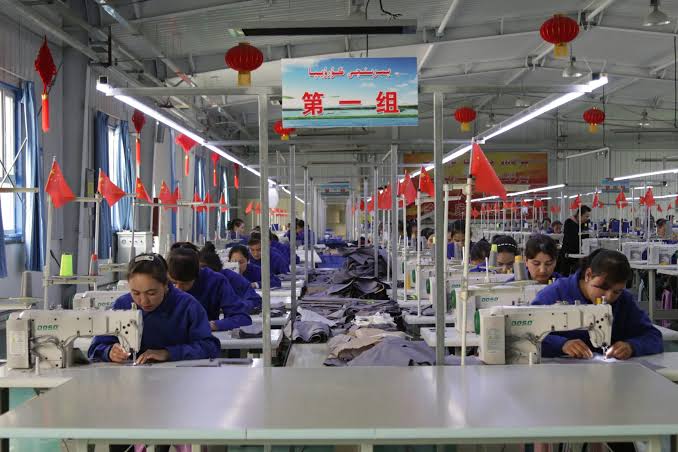
The Department of Labor also identified the Xinjiang Production and Construction Corps, under the state-mandated Chinese “poverty alleviation through labour transfer” program, as the central entity through which the Chinese government implements forced labor and cultural assimilation, and society-wide surveillance and control. Uyghur workers under the control of this program are forced to work in factories in Xinjiang, and are transferred to areas outside of Xinjiang where they are forced to work under intense surveillance and unequal conditions. The United Nations report on Uyghur forced labor, produced in 2022, claims that Xinjiang’s five-year plan (2021-2025) projected 13.75 million instances of labor transfers. The effects of this forcible labor program, according to that report, leads to “their language, chosen communities, ways of life, as well as cultural and religious practices […] eroded, which causes irreparable harm and loss.”
The conditions of these workers are also subject to serious concerns. The United Nations cited one internment camp in Kashgar, Xinjiang, where Uyghur detainees were forced to produce textiles. They received little pay, weren’t allowed to leave, and had limited or no contact with their families. In another case, reported by the Australian Strategic Policy Institute (A.S.P.I.), the Qingdao Taekwang Shoes Co. Ltd. (a South Korean parent company) employed 600 Uyghur and other minority workers. Photographs of the factory taken in 2020 showed the compound was equipped with inward-facing barbed wire fences, watchtowers, and an additional row of razor wires. Uyghur workers’ comings and goings were monitored by a police gate that used facial recognition software. Qingdao Taekwang Shoes Co. Ltd’s primary customer is Nike.
The products of Uyghur forced labor are almost unavoidable in many major industries. According to the Coalition to End Forced Labor in the Uyghur Regions, 1 in 5 cotton garments in the global apparel market, 35% of solar-grade polysilicon, 10 of the largest Information and Communication Technology companies, 10% of of polyvinyl chloride building materials, 100+ international auto parts and car manufacturers, and 14 of the largest aluminum, steel, and copper companies in the Xinjiang Region are all at high risk, or have been proven to use, Uyghur forced labor.
The A.S.P.I report identified 80,000 Uyghur forced laborers who produce goods for or are in the supply chain of 83 major international corporations. These laborers are often segregated from non-Islamic workers, subjected to “ideological training,” constant surveillance, and are forbidden from practicing their religion. The list of businesses identified by the A.S.P.I. are as follows:
Abercrombie & Fitch, Acer, Adidas, Alstom, Amazon, Apple, A.S.U.S., B.A.I.C. Motor, Bestway, B.M.W., Bombardier, Bosch, B.Y.D., Calvin Klein, Candy, Carter’s, Cerruti 1881, Changan Automobile, Cisco, C.R.R.C., Dell, Electrolux, Fila, Founder Group, G.A.C. Group (automobiles), Gap, Geely Auto, General Motors, Google, Goertek, H&M, Haier, Hart Schaffner Marx, Hisense, Hitachi, H.P., H.T.C., Huawei, iFlyTek, Jack & Jones, Jaguar, Japan Display Inc., L.L.Bean, Lacoste, Land Rover, Lenovo, L.G., Li-Ning, Mayor, Meizu, Mercedes-Benz, M.G., Microsoft, Mitsubishi, Mitsumi, Nike, Nintendo, Nokia, Oculus, Oppo, Panasonic, Polo Ralph Lauren, Puma, S.A.I.C. Motor, Samsung, S.G.M.W., Sharp, Siemens, Skechers, Sony, T.D.K., Tommy Hilfiger, Toshiba, Tsinghua Tongfang, Uniqlo, Victoria’s Secret, Vivo, Volkswagen, Xiaomi, Zara, Zegna, Z.T.E.
Some brands are linked with multiple factories. The companies that responded to this report and their responses are linked here.
To combat the influence of Uyghur forced labor in international supply chains, the United States and the European Union introduced legislation banning the sale of goods that used forced labor within their jurisdictions. The European Union’s Forced Labor Regulation, signed 2024, will require E.U. states to ban products or components that have been made with any forced labor, with specific focus placed on the Xinjiang Region. The United States’ Uyghur Forced Labor Prevention Act, approved 2021, is an explicit response to the Chinese government’s systemic use of Uyghur forced labor. The bill creates a Forced Labor Enforcement Taskforce to develop strategies to support the enforcement of the prohibition on the importation of goods into the United States manufactured wholly or in part with forced labor in China, especially from the Xinjiang Region. The bill led to the total prohibition of goods mined, produced, or manufactured wholly or in part in the Xinjiang Region. Since enforcement began, a total of 24,344 shipments have been denied from entering the country, comprising $950 million dollars in total value, $670 million of which comes from electronics. Canada and the United Kingdom followed suit, and are now pursuing similar bans on goods made with Uyghur forced labor.
While enforcement has been largely successful for the United States, the effect may be exacerbating the issue in mid-sized economies. As major markets such as the United States and the E.U. strengthen forced-labor laws and import controls, goods linked to forced labor may be redirected to other countries with weaker enforcement capabilities and limited investigative capacity. For example, a Uyghur Human Rights Project report found that Japan and Australia continue to import $6.71 billion and $4.82 billion dollars respectively from high-risk sectors associated with Uyghur forced labor. Enforcement in larger economies has created a supply chain bifurcation, with low-risk goods being directed towards the United States and Europe, and high-risk goods directed towards mid-sized economies that are unable or unwilling to enforce forced-labor bans. Without even enforcement across all importing economies, the risk of goods produced by forced laborers only shifts from one economy to another.
China stated that its “counter-terrorism” operations and “de-radicalization” campaigns in Xinjiang have been conducted according to “the rule of law,” and by no means add up to “suppression of ethnic minorities.” One Chinese statement on Uyghur forced labor reads, “The lawful rights and interests of workers of all ethnic groups in Xinjiang are protected and there is no such thing as ‘forced labour,’” adding that there had been no “massive violation of rights.” However unlikely, international pressure for China to ratify the International Labour Organization’s Convention on Forced Labour, 1930 (No. 29) and Protocol of 2014 to the Forced Labour Convention, could go a long way towards the protection of Islamic minorities in Xinjiang and the liberation of Uyghur people in forced labor camps. Until that time, the best practice urged by U.N. experts is for investors and businesses operating and sourcing from China to conduct due human rights diligence in line with the U.N. Guiding Principles on Business and Human Rights by taking the risks of forced-labor within production supply chains into consideration. For individuals or leaders of civil institutions, membership of the Coalition to End Forced Labor, a coalition of trade unions and civil society organizations dedicated to end state-sponsored forced labor and human rights abuses against the Uyghur people in China, may be a good start. The coalition includes but is not limited to the A.F.L.-C.I.O., Human Trafficking Legal Center, Human Rights Watch, Human Rights Foundation, Worker’s Rights Consortium, Global Student Forum, Public Citizen Global Trade Watch, Uyghur-American Association, and Freedom Collaborative. An interest form is linked here.
While the plight of Uyghur people continues, economic and social pressure both on businesses associated with Uyghur forced labor and on the Chinese government can go a long way to stopping the practice altogether. Public outcry and boycott of businesses that refuse to make efforts to distance themselves from the practice gives those businesses a monetary motivation to do so. The Chinese government may be a harder target, but seeing real economic incentives to stop the practice, or at least to prove its absence from goods being exported, could lead to the amount of Uyghur forced laborers steadily decreasing. The most important strategy for stopping the practice is to make its use unprofitable, which even individuals can have a part in by taking into account a business’s connection to forced labor before patronizing it.
- Author