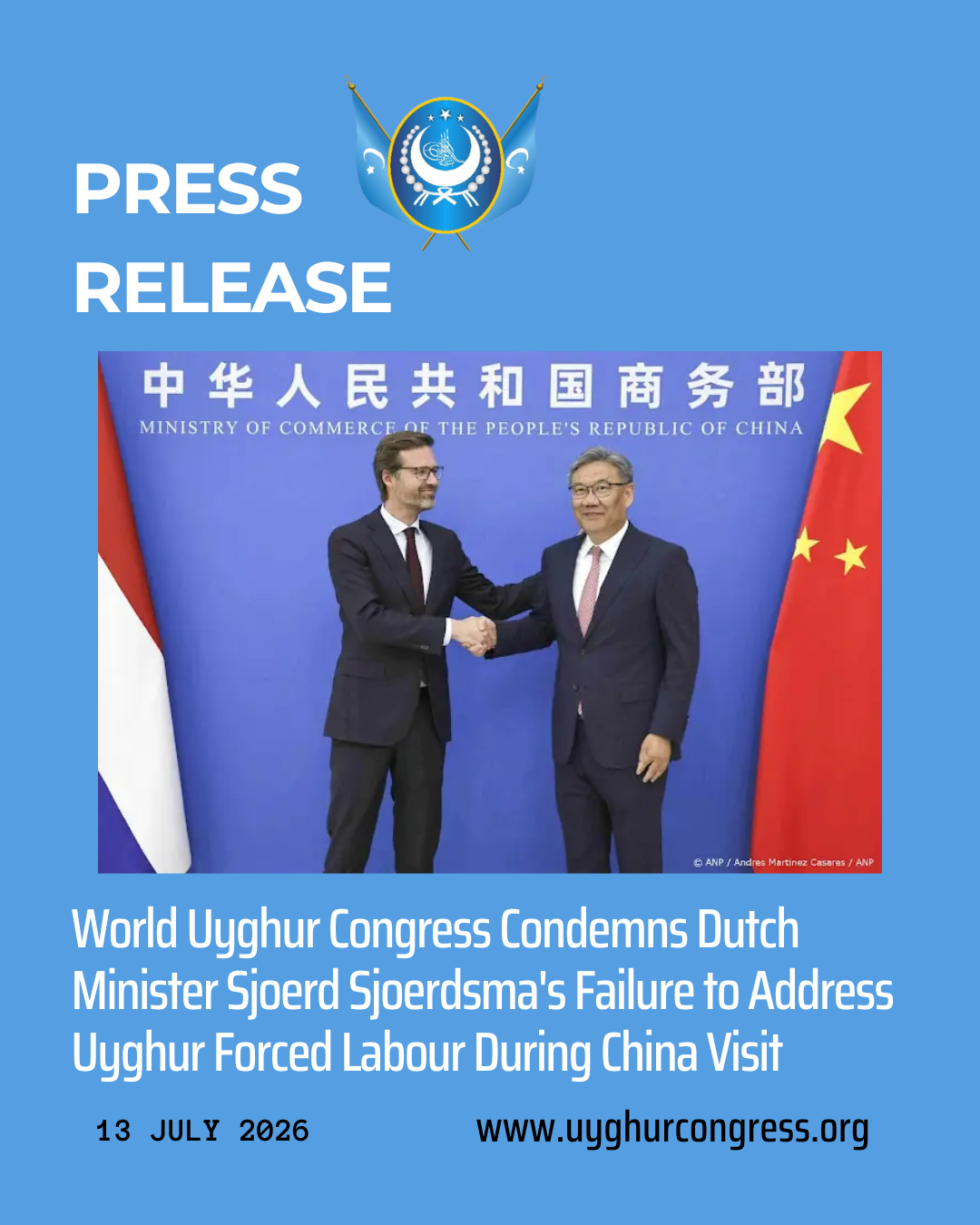
Press Release – For immediate Release
13 July 2026
On 7 July, Dutch Minister for Foreign Trade and Development Cooperation Sjoerd Sjoerdsma visited Beijing as part of a trade mission to China, with the stated objective of strengthening bilateral relations between the Netherlands and China. This was the first ministerial-level physical trade mission to China since April 2018. The World Uyghur Congress (WUC) regrets Minister Sjoerdsma’s uncritical approach to trade with Chinese companies and the Chinese government, as well as the absence of any reference to the widespread use of state-imposed forced labour in the Chinese market, particularly Uyghur forced labour.
The WUC also regrets that Minister Sjoerdsma, who has long been a strong ally of the Uyghur community, failed to uphold his previous commitments. In 2021, while serving as a Member of Parliament, he introduced a motion in the Dutch House of Representatives recognizing the atrocities committed against the Uyghurs as a genocide, a move that led to him being sanctioned by the Chinese government. Moreover, in 2024, Sjoerdsma also submitted a parliamentary question calling on the government to clarify its position on Uyghur forced labour.
What’s more worrisome, after the trade mission to China was announced, the Dutch Parliament overwhelmingly adopted a motion introduced by DENK MP Stephen van Baarle requiring that the human rights situation of the Uyghurs be explicitly raised during the mission. This requirement was not fulfilled.
“When former allies fail to uphold their own principles after assuming positions of power, it is always disappointing,” said WUC President Turgunjan Alawdun. “We hope Minister Sjoerdsma will live up to his own example and take concrete steps to limit imports of products originating from East Turkistan.“
Unfortunately, since Minister Sjoerdsma assumed office, Dutch trade with East Turkistanhas actually increased, according to China’s Customs database. This is concerning not only for the Uyghur people but also for Dutch consumers, who may unknowingly be purchasing products that have been tainted by forced labour somewhere in their supply chains.
Moreover, following the publication of the implementation guidelines for the EU Forced Labour Regulation, the European Commission will investigate state-imposed forced labour on a broad scale, including by geographic region. As a result, products suspected of containing Uyghur forced labour in their supply chains are likely to be prohibited from entering the EU market. Unless action is taken, the Netherlands risks being unprepared for the economic consequences of its growing dependence on imports from East Turkistan.
In light of these developments, the World Uyghur Congress asks Minister Sjoerdsma and the government of the Netherlands to:
Publicly condemn the widespread human rights violations against Uyghurs in East Turkistan, and to raise this issue with their Chinese counterparts bilaterally;
Take concrete steps to ensure Dutch companies are diverting their supply chains from the use of Uyghur forced labour, under the presumption that all products coming from the region are expected to be produced with forced labour in any moment of their supply chains;
Take concrete steps to implement and comply with the EU Forced Labour ban regulation and its Guidelines;
Advance the discussion and approval of its mandatory human rights due diligence legislation for businesses through the approval of the Responsible and Sustainable International Business Conduct Act.