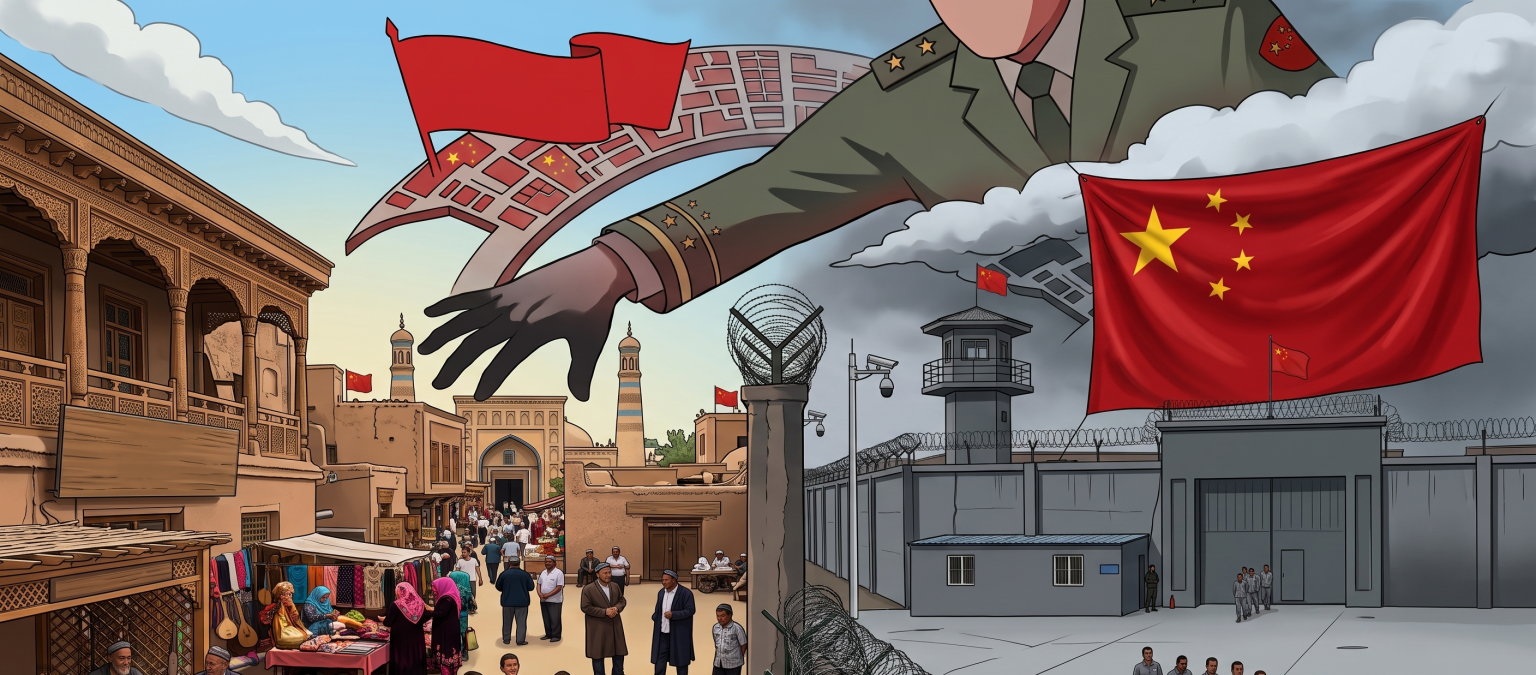
The "Law on Promoting Ethnic Unity and Progress," signed by Chinese President Xi Jinping and officially coming into effect on July 1, 2026, marks a historic turning point in China's ethnic policies and signals the beginning of a new, aggressive phase [1, 2]. Officially approved on March 12, 2026, by the National People's Congress, the highest legislative body in the Chinese system, this law was drafted under the direct supervision of the Central Committee of the Chinese Communist Party [1, 3]. Although the Chinese government promotes this law as a guarantee of so-called "inter-ethnic unity, social stability, and common prosperity," it is in reality an instrument of forced assimilation that stifles basic human rights and Sinicizes ethnic identities [2].
This new legal framework indicates that the Chinese government has completely abandoned its previous promise to safeguard the system of regional ethnic autonomy [3]. When the People's Republic of China was founded in 1949, minority nationalities within China's borders were granted the right to self-governance in their own territories through constitutional-level promises [3]. However, in the new orientation, the policy of recognizing ethnic interests and differences has been abolished; instead, "one language, one culture, and one political ideology" is forcibly imposed [1].
From the perspective of political and national security, the Chinese leadership views the total eradication of the ethnic and cultural identities of the peoples in strategically important border regions like East Turkestan and Tibet as the only way to protect geopolitical security [2]. Because East Turkestan is the overland gateway to the west for China's "Belt and Road" strategic development plan, the Chinese government has aimed to tolerate no ethnic resistance or identity orientation during its westward expansion [2]. Therefore, this law does not remain merely symbolic; rather, it is a framework of systematic aggression that lays the legal groundwork for treating local nationalities as a security threat [1, 4].
The drafting process of the law in question is the highest-level manifestation of the Chinese Communist Party's plan to reshape ethnic groups into a single mold [1]. Chinese authorities have now formalized the unprecedented atrocities they have committed over the past decade—such as the camp system, forced labor, the destruction of national languages, and birth restrictions—through a new national law, granting it "full executive power" [2, 3]. In this way, China's "path with Chinese characteristics" in handling ethnic issues has been systematically transformed into a matter of political security [2, 5].
In the international arena, institutions led by the United Nations High Commissioner for Human Rights, Volker Türk, and Amnesty International immediately issued statements condemning this law by the Chinese government as a "grave violation of fundamental human rights declarations" [6, 7]. These organizations warned that the law in question would bring about an even more severe and systematic tragedy of genocide targeting the languages, religious beliefs, and cultural freedoms of local peoples [6, 7]. Furthermore, it was stated that this new orientation would further strengthen transnational intimidation and repression policies [7].
This analytical article aims to examine the nature of China's relevant ethnic policies from a multi-layered academic perspective. In the following sections of the article, the ideological concepts behind this new law, domestic and foreign administrative control mechanisms, social consequences for Uyghurs and other Muslims, and transnational punitive measures will be explained in detail through multi-source scientific evidence [2].
Political and Ideological Objectives Behind the "Ethnic Unity Law"
The political and ideological focal point that has become the essence of the "Law on Promoting Ethnic Unity and Progress" is the concept of "Forging a Strong Sense of Community for the Chinese Nation," introduced by Chinese leader Xi Jinping [1, 2]. While this concept may superficially appear as civic nationalism, it actually aims to dissolve and destroy all authentic ethnic characteristics within China's core political identity [1, 2]. The Chinese Communist Party views ethnic characteristics and values as a threat to the state's stability and the party's governance capacity [2, 8].
This ideological shift proves that the "Second Generation Ethnic Policies" theory, proposed in Chinese academic circles, has become official state law [1]. Statist policymakers, such as Peking University professor Ma Rong, examining the dissolution process of the Soviet Union, argued that the limited autonomy and ethnic statuses granted to local peoples under the Soviet model paved the way for separatism within the country [5, 9]. Pointing out that the Soviet Union splintered along the borders of national republics, these individuals argued that differences between ethnic groups must be dissolved and eradicated so that China does not share the same fate [3, 5].
The new assimilation system completely strips local peoples of their political statuses. Mongolian scholar Uradyn Bulag has termed this situation "political genocide," which refers to the destruction by the party system of a nation's ability to recognize itself as a distinct political entity, to act upon it, and to pass it down from generation to generation [3]. The Chinese political institutions aim to completely stifle the historical and geographical identity claims of East Turkestanis, restricting their national mission solely to serving the common Chinese narrative created by Beijing [1, 2].
The use of the word "forging (smelting and casting)" in this process is extremely important; in Chinese, this signifies creating an unbreakable, monolithic steel chain through the smelting of ore [1]. Contrary to the will of ethnic groups to preserve their own identities, the Chinese Communist Party wants to construct a state image consisting solely of a "uniform populace completely subjugated to socialist values" desired by the party [2, 10]. In this process, national language, religion, and historical collective memories are viewed as potential roots threatening the security of the Chinese state structure and are severely punished [2, 3].
In such a situation, all historical promises and pledges regarding ethnic autonomy turn into empty talk [11, 12]. Although the regional ethnic autonomy clauses in the Chinese constitution have ostensibly not been repealed, the new "Ethnic Unity Law" has completely restricted autonomy rights, turning it into an empty framework [1]. Thus, Chinese ethnic policy has completely abandoned its stance of acknowledging historical diversity, stepping into a framework of absolute punishment subjugated to a single center [2, 3].
The "Twelve Musts" support system proposed by Chinese policymakers ties all state guarantees to a single point: accepting the absolute leadership of the party [2, 3]. All ethnic interests must unconditionally serve the political interests of the Chinese state [1, 2]. In the party's new ideological system, if local nationalities demand to live with their own identities, they are automatically viewed as "separatists," "terrorists," or "religious extremists" and punished accordingly [5, 8].
At the same time, Beijing authorities announce the process of fully assimilating local nationalities to the world by calling it the "common development of ethnic groups" [2, 8]. However, this so-called development only creates favorable conditions for Chinese companies to plunder local resources and for Chinese immigrants to settle massively in the region [2, 8]. The development of local peoples is solely measured through indicators of Sinicization [1, 2].
This process aims, on the one hand, to establish absolute party dominance internally by destroying the demographic structure in China's border regions, and on the other hand, to systematically demonstrate "Chinese-style state governance power" against human rights pressures from Western countries [2, 13]. Built upon the aforementioned political foundation, this law is a ruthless legal trap that leaves no path of salvation for local nationalities [2, 10].
Method of Implementation on Nationalities through Legal and Administrative Mechanisms
The "Law on Promoting Ethnic Unity and Progress" is not merely composed of empty theoretical slogans; on the contrary, it is equipped with highly concrete legal and administrative mechanisms that control every layer of society [2, 5]. This law has transformed the political objectives of the Chinese Communist Party into legal articles with direct executive power [2, 3]. The mechanism for controlling local nationalities consists of an administrative chain that penetrates the veins of society [2, 8].
The first administrative feature of this law is that it begins with a preamble of a historical narrative nature exceeding eight hundred characters [2, 3]. In Chinese legislation, a preamble writing system is only found in a very limited number of major, strategic laws [3]. Here, by putting forth the myth of five thousand years of Chinese civilization, the necessity of binding all nationalities to a common bloodline and a common future is forcibly imposed from a legal perspective [2, 5]. This preamble mobilizes all the administrative power of the state toward a single goal: formally protecting the "Community of the Chinese Nation" [2, 3].
Chapters 1 and 5 of the law establish a system to punish and administratively manage the entire society [2, 5]. This law imposes a common administrative task on all state and societal forces [2, 5]. Civil servants, the media system, social organizations, commercial companies, neighborhood committees, the Chinese military, and families will have a direct administrative obligation in implementing the new ethnic law [2, 5, 9]. Here, the state has established a systematic surveillance network, and any institution or individual will be held legally responsible if they hinder or remain indifferent to the assimilation of local nationalities [2, 9].
From an administrative standpoint, this new ethnic policy will be directly managed and supervised by the United Front Work Department of the Chinese Communist Party and its affiliated State Ethnic Affairs Commission [2, 5]. These two institutions will oversee the ethnic work of all administrative ministries, schools, and local governments, and will evaluate or punish local cadres based on the implementation status of the new policies [2, 3].
Local governments at the county level and above will be obligatorily forced to establish an "interwoven neighborhood environment (mixed communities)" in new urban construction plans and social systems [2, 5]. Such regulations mean that local governments must implement systems that force Uyghurs and Chinese to live together by disbanding ethnic settlement areas [2, 3]. Population transfers, housing allocation, employment, and school plans will all be adapted to this systematic eradication plan through administrative pressures [2, 3].
On the other hand, the law in question has also imposed administrative obligations on network administrators and internet service providers, determining the task of immediately blocking, deleting, and reporting to police institutions any information or criticism in the cyber world that contradicts China's ethnic policies [2, 9]. Through this mechanism, information technology and artificial intelligence have been transformed into an administrative punishing machine that destroys the freedom of thought and expression of local nationalities [5, 14].
This law also brings clear administrative pressure on the internal social structure of the family [2, 3]. According to the law, parents will be compelled to educate their children to love the Chinese Communist Party and the Chinese people [2, 5]. If parents instill historical, cultural, and ethnic understandings in their children that do not comply with the state's assimilation plan, these actions will be investigated as a violation of the law, and severe administrative penalties such as removing children from the family will be given [2, 3].
There are previously tested provincial-level versions of this new national-level system, and the "Regulations on the Construction of a Model Area for Ethnic Unity and Progress in the Tibet Autonomous Region" prepared in the Tibet Autonomous Region is the most typical example of this [3, 9]. Such local regulations serve as the daily implementation tool of the new national ethnic law in those regions [1, 3].
In summary, this new law has integrated China's administrative and legal punishment system at an even more aggressive level, leaving no legal loopholes for local nationalities to resist [2, 12]. All organs of the state have officially put into effect the plan to completely control ethnic groups through a system tied to a single center [2, 3].
Strong Impact on the Identity of Uyghurs, Tibetans, and Other Muslim Nationalities
The systematic blow that the "Law on Promoting Ethnic Unity and Progress" will deal to the languages, religions, and cultural identities of Uyghurs, Tibetans, and other local Muslim peoples is extremely heavy and has a long-term destructive nature [2, 12]. International human rights organizations define this situation as a kind of systematic "cultural genocide" [8]. Through this law, the Chinese government has legalized the total exclusion of the national languages of local peoples from education and daily social life [2, 12].
In the field of education, the plan to destroy national languages has been made the primary goal, and Article 15 of the law in question places China's state language, Mandarin (Putonghua), in the absolute first place in education and all official affairs [5]. Although it is written in the law that local languages will also be "protected," it is stipulated that in any public space where two languages are used together, Chinese script must be written more prominently, larger, and in a prioritized order compared to local scripts [5]. This is actually a new orientation of the policy to completely ban local languages [5].
Local Uyghur and Tibetan textbooks have been completely banned in the education system, and many devoted local intellectuals who wrote or edited these textbooks have been sentenced to death or life imprisonment on fabricated charges such as "inciting separatism" [12]. In line with the system implemented under the guise of "bilingual education," classes are taught entirely in Chinese, while only a few hours a week are allocated to local literature classes [12].
The most ruthless administrative tool for alienating local children from their own language and cultural environment is the domestic closed-type "boarding schools" system [1, 2]. The Chinese government has separated more than one million children living in East Turkestan and Tibet, even three-year-old toddlers, from their families, confining them in these closed spaces where only Chinese is spoken and their brains are washed with Chinese ideology [1, 8]. In this way, the chain of natural intergenerational transmission of the national language is completely severed [1].
The policy of destroying religious identity continues ruthlessly under the slogan of "Sinicizing Islam" [2, 5]. Chinese state institutions have implemented a plan to redefine Islamic teachings by adapting translations of the Holy Quran in local languages to Chinese socialist values and rewriting them [8]. Possessing or reading religious books not approved by the state is considered a severe terrorism crime in East Turkestan today [8].
Clerics and imams are under strict police surveillance and can only receive education in ten religious institutes approved by the Chinese state [8]. The educational programs of these schools are filled with Marxism and party ideology [8]. Since 2014, more than a thousand well-known clerics and imams in East Turkestan have been locked up in camps and prisons simply for organizing daily religious activities in the community or opposing the party's order to burn religious books [8].
Religious traditions and customs in local society and family life have also been completely banned [4]. Women wearing headscarves in public spaces, men growing beards, and giving young children names bearing Islamic or local characteristics (e.g., Saddam, Medina) have been completely determined as administrative offenses [8, 12]. Even individuals fasting in their homes has been banned, and state civil servants have been forced to eat during the days of Eid al-Fitr [8].
In addition, to erase the local national and historical identity from the geography, thousands of ancient place names in East Turkestan are being replaced with new Chinese names [12]. From 2009 to 2023, the historical Uyghur names of a total of 3,652 towns and villages were completely destroyed and replaced with Chinese political slogan names (e.g., "Red Flag Village," "Unity Village") [12]. This is a psychological pressure planned to increase the feeling among local peoples of being refugees even while living in their own homeland [15].
On the other hand, the Chinese government has turned the cultural wealth of local peoples into merely a visual tourism propaganda tool [1, 2]. The identities, clothing, and dances of local nationalities are nothing more than a show exhibited to Chinese tourists, and they have no right to be used in claiming any political or social status [1]. Such systematic oppression is part of the plan to completely destroy the spiritual identities of local peoples [1].
The Connection Between Forced Labor and the Assimilation Policy
In its new strategy currently being executed in East Turkestan, the Chinese government does not only view the forced labor mechanism as an economic indicator; on the contrary, it uses it as a powerful tool to drive local nationalities away from their own lands to distant regions and assimilate them [2]. The so-called "poverty alleviation" and "labor transfer" projects of the Chinese administrative authorities actually aim to dismantle the social demographic structure where local Uyghurs are heavily concentrated [2, 5].
Through this system, local youth from East Turkestan, especially young girls between the ages of 15 and 20, are forcibly torn from their families and transferred as cheap labor to closed factories in China's inland provinces [2]. In these factories, kept under strict police surveillance, the youth are strictly forbidden from speaking in local languages, and even during their rest times, they are compulsorily forced to listen to lessons on Chinese and party ideology [5]. This is actually a systematic brainwashing process [4].
In parallel with this, the Chinese government also supports the policy of migrating the Chinese population in the inland provinces to East Turkestan with extremely strong economic incentive regulations [8]. Through the Xinjiang Production and Construction Corps (Bingtuan) system, millions of Chinese immigrants settled in the region are offered free land, housing, tax exemptions, and job opportunities [3, 8]. This system is a ruthless demographic engineering established to usurp the lands of local Uyghurs and change the demographic ratio in favor of the Chinese [5, 8].
To disrupt the demographic balance, ruthless birth control and torture regimes are simultaneously applied to local women [4, 10]. East Turkestani women are forced to have intrauterine devices inserted or undergo sterilization surgeries, and those who reject these cruel orders are arrested and thrown into camps [8, 12]. As a result of such systematic intimidation, the local birth rate in densely populated local regions such as Hotan and Kashgar dropped by more than 60% between 2015 and 2018 [12].
The Chinese government has also transformed the policy of "encouraging inter-ethnic marriage" into an official administrative order to eliminate ethnic differences within the family [2, 5]. By forcing local girls to marry Chinese men, and giving married couples ten thousand yuan in cash and other social benefits, it attempts to biologically dissolve national identity among future generations [12]. Local families who reject this marriage are immediately sent to camps under the label of "harboring extremist thoughts" [12].
This kind of systematic suppression mechanism aims to completely eradicate local nationalities and turn them merely into cheap labor at the lowest stratum of the monolithic Chinese state structure [2, 12]. In this way, the power of local peoples to make political demands in their own homelands is completely destroyed, and the enormous underground wealth in the border regions is handed over to Beijing's monopoly [2].
The Role of "Article 63" in Applying Political Pressure on East Turkestanis in the International Arena
The most serious and threatening orientation in the "Law on Promoting Ethnic Unity and Progress" is its being endowed with transnational punitive power [2, 12]. Article 63 of the law in question stipulates that "any foreign organization or individual who harms the ethnic unity of the People's Republic of China or engages in separatism," even if they are outside the borders of China, will be held criminally responsible [2, 3]. This is a clear and distinct legal basis for the transnational repression policy [4, 5].
East Turkestani human rights activists, intellectuals, media workers, and aid organizations operating abroad, regardless of what country's citizens they are, have today been made targets of Beijing [2, 3]. Through this law, the Chinese government has declared it its legal right to take various administrative, economic, and systematic punitive measures against activists abroad [1, 2]. This situation is planned to create a serious level of psychological pressure and a hidden atmosphere of fear among the Uyghur diaspora community [2, 12].
The most commonly used administrative mechanism to silence activists in the diaspora is to hold their relatives and family members remaining in East Turkestan hostage [2, 5]. The family members in their hometowns of those who criticize China's ethnic policies from abroad are rapidly thrown into camps or subjected to economic hardships [2, 5]. Such systematic punitive measures aim to leave activists abroad completely silent even in the countries where they live [2, 5].
Technology and cyber attacks are another tool for surveilling local communities abroad [2, 7]. Chinese-backed hackers continue to target the leaders of Uyghur and Tibetan human rights organizations abroad, installing hidden spyware on their mobile phones and launching various cyber attacks [2, 7]. This systematic surveillance network has been established to fully control activities abroad [2, 12].
Apart from this, the Chinese government, using its economic and political relations with foreign countries, applies strong political pressure on third countries to extradite East Turkestani refugees to China [2, 5]. As a result of some erroneous administrative pressures that occurred in Germany, Thailand, and other countries, the risk of Uyghur refugees being handed over to Chinese authorities is still very high [2, 7, 16]. This is an administrative aggression that puts the lives of East Turkestanis in grave danger before the eyes of international powers [7, 16].
In a statement published by the Taiwan Mainland Affairs Council, it was emphasized that China would use this new so-called ethnic law against Taiwanese activists or other pro-democracy figures abroad, linking them to separatism and accusing them of fabricated crimes [2, 7]. This shows that China's judicial power has turned into a political weapon worldwide against those demanding political independence [2, 12].
Therefore, Article 63 of this law is a complete political trap for East Turkestanis, no matter where they live in the world [2, 7]. By silencing all democratic voices abroad through this regulation, the Chinese government aims to completely exempt its brutal domestic assimilation oppression from international criticism [2, 8].
"Community of the Chinese Nation," Internal Security, and Nation Building
The long-term strategic goal of the Chinese government in enacting its new ethnic law is closely linked to the state's future 2035 modernization goal and the "Chinese Dream," namely the "Great Rejuvenation of the Chinese Nation" plan proposed by Xi Jinping [2, 8]. The Chinese leadership believes that the long-term peace and stability of the state cannot be maintained without constructing a common national identity [1, 2].
The lands of East Turkestan are of absolute importance for China's energy and underground resource security [2]. The Chinese state extracts more than 60% of its daily oil consumption, as well as massive amounts of coal, natural gas, and rare earth elements—which are very scarce in the world—from East Turkestan [2]. Therefore, completely Sinicizing the region and destroying the land claims of local peoples is a political matter of life and death for Beijing [2].
This strategic plan is also based on the objective of turning East Turkestan into an absolute security zone completely purged of political turmoil in China's geopolitical competition with the West [2]. China's hierarchical system in history, based on the distinction of "Hua-Yi" (civilized Chinese and barbarian foreign tribes), is being reconstructed today with police force and modern information technology, and is used to Sinicize and subjugate local peoples [13].
Since this law was drafted and came into effect, China's relationship with local nationalities has turned entirely into a national security issue [2, 5]. Moderate intellectuals like Ilham Tohti, who in the past demanded the establishment of cooperation between local peoples and China, have today been completely erased from society, condemned to silence with life sentences [1, 15]. This situation shows that the Chinese government has officially closed the path of peaceful coexistence with local nationalities [1, 2].
In summary, this new ethnic policy is an aggressive security system that will make local nationalities completely submit to the closed Chinese identity, not only politically but also by melting the soul and national existence of local peoples [1, 2]. The Chinese government views this goal as the systematic administrative will of the state [2, 3].
Evaluation and Future Trends from the Perspective of International Law and Human Rights
Viewed from the perspective of international human rights, China's new ethnic law clearly violates the United Nations' multilateral human rights treaties, especially the 1948 "Convention on the Prevention and Punishment of the Crime of Genocide" [2, 5]. Separating the future generations of a nation from their families and locking them in schools, and reducing the birth rate by 60% through the state's administrative pressures, fully meet the conditions for the crime of genocide according to international court jurisprudence [2, 5].
Furthermore, in the official reports published by the United Nations Human Rights Committee on the situation in East Turkestan, it was clearly determined that China's atrocities there constitute "crimes against humanity" [4, 5]. Although the United Nations has tried to soften the name of the crime with euphemistic words in its official statements due to political pressures, the history of persecution faced by local peoples goes far beyond such hesitation [4, 5].
Looking at future trends, the Chinese government is trying to completely cover up its human rights violations on international platforms by using its economic power abroad and its alliance system with some Muslim countries [2, 5]. Some developing countries, for the sake of China's massive investment projects, vote to support China in UN voting sessions [5]. This is an extremely terrifying moral crisis for the future of the international human rights system [5].
However, this law of China aiming to completely subjugate ethnic groups will, in the long run, cultivate a stronger historical and political resistance force against itself [2, 5]. Many local witnesses held in the camps have proven that after confronting the state's ruthless plan, they became attached to their own identities and beliefs with a much stronger loyalty [5]. A system based on ethnic persecution can never bring long-term stability to a state [2, 5].
As a warning, it should be noted that China's new "Ethnic Unity Law" has pushed the existence of the local Uyghur and Tibetan peoples to a dangerous precipice where they cannot be protected even beyond international borders [2, 16]. If the international community does not immediately unite and implement actual political and economic sanctions against this aggression by China, world history will once again witness a complete tragedy of ethnic genocide unfolding before our eyes [2, 7].
References:
- Wei, Changhao. (2026). NPC 2026: China Enshrines Xi-Era Ethnic Policy in New Law. Beijing: NPC Observer. https://npcobserver.com/2026/03/05/china-npc-2026-ethnic-assimilation-unity-law/
- Stratejik Düşünce Enstitüsü. (2026). Çin Halk Cumhuriyeti’nin Etnik Birlik ve İlerlemeyi Teşvik Yasası: Küresel Kaynaklar Işığında Zorunlu Asimilasyon, Güvenlik Doktrini ve Ulusötesi Yargı Yetkisi. Ankara: SDE Asya Masası. https://www.sde.org.tr/asya/cin-de-etnik-birlik-yasasi-yururluge-girdi-uygur-turkleri-ve-tibetliler-tepkili-haberi-65663
- NPC Standing Committee Legislative Affairs Commission. (2025). Law on Promoting Ethnic Unity and Progress Comparison Chart (1st, 2nd, and Final Drafts). Beijing: NPC Observer. https://npcobserver.com/wp-content/uploads/2025/12/Law-on-Promoting-Ethnic-Unity-and-Progress_Comparison_1st2nd.pdf
- Ludwig, Jessica. (2026). China's 'ethnic unity' law threatens human rights around the world. Dallas: George W. Bush Institute. https://www.bushcenter.org/publications/chinas-ethnic-unity-law-threatens-human-rights-around-the-world
- Tatlı, İrfan & Kurban, Ayşe. (2022). Doğu Türkistan'daki Hak İhlalleri ve BM'nin Uygur Raporunun Değerlendirilmesi. İstanbul: İNSAMER. https://www.insamer.com/tr/dogu-turkistandaki-hak-ihlalleri-ve-bmnin-uygur-raporunun-degerlendirilmesi.html
- Dickyi, Tenzin & Dolma, Nordhey. (2026). Explained: China's 'ethnic unity and progress promotion' law. Washington: Radio Free Asia Tibetan Service. https://www.rfa.org/english/tibet/2026/07/24/explainer-china-ethnic-unity-law-tibet-uyghur/
- Wasl News Agency. (2026). الأويغور الأرشيف. Istanbul: Wasl News. https://wasl.news/tag/%D0%B7%D9%84%D8%A3%D9%8وزلأويغور/
- Human Rights Foundation Center for Law and Democracy. (2021). 100 Years of Suppression: The CCP's Strategies in Tibet, the Uyghur Region, and Hong Kong. New York: Human Rights Foundation. https://archive.hrf.org/wp-content/uploads/2021/12/CCP-100-Years-of-Suppression-FINAL-VERSION.pdf
- Wikipedia Contributors. (2026). Law on Promoting Ethnic Unity and Progress. Wikipedia, The Free Encyclopedia. https://en.wikipedia.org/wiki/Law_on_Promoting_Ethnic_Unity_and_Progress
- Xinhua News Agency. (2026). China adopts law to promote ethnic unity and development. Beijing: Supreme People's Procuratorate Media Center. https://en.spp.gov.cn/2026-03/12/c_1167964.htm
- Wei, Changhao. (2026). Law on Promoting Ethnic Unity and Progress. Beijing: NPC Observer. https://npcobserver.com/legislation/law-on-promoting-ethnic-unity-and-progress/
- Eruygur, Adilcan. (2024). Çin Devletinin Uygur Türklerine Yönelik Bölgesel Milliyet Özerklik Söylemi. İzmir: Türk Dünyası İncelemeleri Dergisi, 24(2), 439-465. https://dergipark.org.tr/tr/download/article-file/4121395
- Xinhua News Agency. (2026). China's law on ethnic affairs takes effect, bolsters legal basis for ethnic unity. Beijing: Ministry of Justice of the People's Republic of China. https://en.moj.gov.cn/2026-07/02/c_1194614.htm
- Amnesty International Australia. (2026). China: New 'ethnic unity' law set to entrench assimilation of minority groups. Sydney: Amnesty International Australia. https://www.amnesty.org.au/china-new-ethnic-unity-law-set-to-entrench-assimilation-of-minority-groups/
- Ergenç, Selinay & Rehemutula, Abudurexiti. (2025). Çin’in Doğu Türkistan Politikaları: Yeni İpek Yolu Projesi ve Asimilasyon. Ankara: Uluslararası Uygur Araştırmaları Dergisi, Sayı: 2025/26, 49-62. https://dergipark.org.tr/tr/download/article-file/5386027
- Amnesty International. (2026). China: New 'ethnic unity' law set to entrench assimilation of minority groups. London: Amnesty International Press Office. https://www.amnesty.org/en/latest/news/2026/06/china-new-ethnic-unity-law-set-to-entrench-assimilation-of-minority-groups/