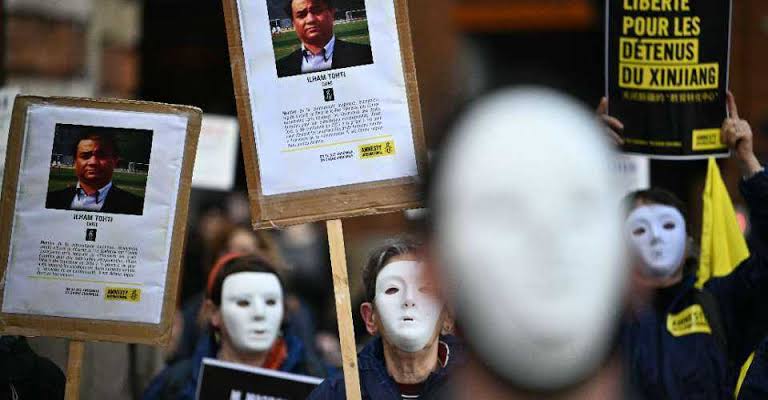
Activists from Amnesty International hold placards as they march during a demonstration in support of the Uyghurs, on the sidelines of the Chinese President's two-day state visit in France, in Toulouse, south-western France, on May 6, 2024. (Photo by Lionel Bonaventure/AFP)
25 years after 9/11, activists say Beijing has used counterterrorism policies to suppress their faith, culture and identity
UCA News, August 20, 2026
While the world commemorates the 25th anniversary of the Sept. 11 terrorist attacks, Muslims in many countries continue to face sweeping accusations of terrorism.
Uyghurs and other Muslim minorities in China's Xinjiang Uyghur Autonomous Region are often labeled terrorists, while some Christians and other religious believers have been branded subversive elements.
Over the years, China has enacted a number of laws and regulations to combat what it calls terrorism. With vague definitions and an overly broad range of offenses, these measures have left Uyghurs and other Muslim populations in China under suspicion of engaging in separatist or terrorist activities. In some cases, practicing Islam and identifying as Uyghur can be treated as evidence of terrorism or separatism.
Tibetans and Mongolians have raised similar concerns. Members of both communities have complained about forced assimilation by China's atheist authorities, the sidelining of their languages and cultures, and policies that compel children to learn Mandarin while discouraging them from learning their native languages and practicing their religions.
China recently passed the Law on Promoting Ethnic Unity and Progress, which took effect July 1, 2026. The U.S.-based Chinese Human Rights Defenders said that, rather than promoting unity as Chinese authorities claim, the law reinforces restrictions on freedoms of language, education, practice of religion, culture, expression and assembly, citing Volker Türk, the United Nations high commissioner for human rights, who raised similar concerns at the U.N. Human Rights Council on June 15.
China passed its Counter-Terrorism Law in 2015 and then promulgated a series of regulations on counterterrorism, anti-separatism and religious extremism. Questions remain over how broadly these offenses are defined
The Chinese government also issued a white paper on the fight against terrorism and extremism and human rights protection in Xinjiang. Critics say the document imposes more restrictions than protections on human rights. Religious and cultural practices are sometimes characterized as extremist and labeled separatist or even terrorist. In 2019, U.N. special procedures raised concerns about the repressive implications of China's Counter-Terrorism Law.
Prominent Uyghur economics professor Ilham Tohti was sentenced to life in prison in September 2014. Twelve years later, his case remains emblematic of the debate over how China defines terrorism and separatism.
Tohti ran a website called Uyghur Online, which promoted dialogue and better relations between Uyghurs and Han Chinese in the region. Despite his advocacy for ethnic dialogue, he was convicted of separatism and sentenced to life in prison.
His case, critics say, illustrates the contradiction between China's stated goal of ethnic unity and its treatment of those who advocate for greater understanding between ethnic groups.
'Terrorism' with Chinese characteristics
Uyghurs and Tibetans can be accused of terrorism or separatism because of religious and cultural activities and the practice of traditional customs, critics say.
Seven years after the Sept. 11 attacks, violent resistance erupted in the predominantly Muslim Xinjiang region in northwestern China, a vast area historically inhabited by Uyghurs and other Turkic peoples. Critics say the Chinese government has imposed repressive policies and forced cultural assimilation since the Communist Party took power in 1949.
Abdurehim Gheni Uyghur, a Uyghur activist and writer based in the Netherlands, shared his views on an attack in Kashgar in 2008, shortly before the Beijing Olympics.
Two young men, 33-year-old Abdurakhman Azad and 29-year-old Kurbanjan Himit, attacked a Kashgar border defense armed police unit near the Baris (Shadlik) Hotel on Semen Road. The attack killed 17 soldiers and seriously injured 15 others.
Chinese authorities quickly described the incident as an extremist terrorist attack. Gheni argues that the attack should also be understood in the context of decades of repression of Uyghur religious practices and cultural traditions.
The attack specifically targeted soldiers, and no civilians were killed. Gheni said that while conflicts between dominant powers and marginalized groups have historically been described as colonization and anti-colonization resistance, the Chinese government characterized the Kashgar attack as terrorism.
The two men were tried behind closed doors at the Kashgar Sports Center in April 2009. They were sentenced to death and executed the same day.
Rushan Abbas, executive director of Campaign for Uyghurs in the United States, said the Sept. 11 attacks profoundly reshaped global security policy.
In the years that followed, the Chinese Communist Party (CCP) exploited the world's focus on counterterrorism to justify its long-standing persecution of the Uyghur people while criminalizing normal religious activities, Abbas said. Beijing labeled an entire ethnic and religious community as a security threat, turning ordinary expressions of Uyghur faith, culture and identity into alleged signs of extremism.
Under the banner of counterterrorism, she said, China created political cover for mass internment, forced labor, family separation, religious persecution and cultural destruction.
For Uyghurs, the CCP's so-called counterterrorism campaign has never been about preventing terrorism; it has been about collective punishment, Abbas said. Millions have been targeted simply because they are Uyghur.
My own sister, Dr. Gulshan Abbas, a retired physician, remains imprisoned after eight years, not for any crime she committed but in apparent retaliation for my peaceful human rights advocacy in the U.S. as a Uyghur American, she said. Her case exposes the truth: Beijing's campaign is about silencing dissent and eliminating Uyghur identity.
Abbas said China's new Law on Promoting Ethnic Unity and Progress further codifies a policy of forced assimilation while intensifying censorship and transnational repression against people who expose alleged abuses.
Twenty-five years after 9/11, the Uyghur experience should serve as a warning to the world: Counterterrorism must never become a pretext for crimes against humanity, she said. When governments weaponize security, 'unity' and 'stability' to strip people of their rights and erase their identity, the international community has a responsibility to speak out and act.
Gulchehra Hoja, a Uyghur journalist in the United States, said: I hope that people will pay attention not to who is being accused, but to who is doing the accusing. My name is on China's terrorist list. Even my 85-year-old father's name is also on China's terrorist list. My father is an archaeologist who has been paralyzed and bedridden for 11 years.
Our only 'crime' is that we are Uyghurs and that our spirit has never surrendered to China. Our desire is for independence.
Hoja said she recently learned that her younger brother had suddenly died. She said his heart stopped unexpectedly and alleged that he had been killed after surviving imprisonment and detention camps.
Am I a terrorist? Was my brother a terrorist? she asked.
If, because of your work, 25 of your relatives were arrested in a single day and tortured in camps; if your brother or sister were killed; if your daughter or sister were raped; if your children were taken away from you; if their organs were taken and they were killed; if your homes and lives were destroyed and your property was confiscated — and then, on top of all that, you were publicly branded a terrorist before the entire world — what would you do?
Despite what she described as severe oppression, Hoja said Uyghurs have not sought to harm innocent Chinese citizens.
Those who carry out China's state policies and those who support and enable those policies are the real terrorists, she said.
Abduweli Ayup, a Uyghur linguist and poet and founder of Uyghur Hjelp in Norway, said accusations against Uyghurs should not be equated with terrorism or extremism.
There are social issues and violent acts committed by people from the Uyghur community, but they don't represent Uyghur reactions to atrocities, Ayup said. Such events have also happened within Chinese communities and were committed by ethnic Han people. Of course, they don't represent all Han people.
He said the 2014 Kunming attack and other violent incidents involving Uyghurs were horrible violent crimes, but added that whether they constitute terrorism depends on the definition.
Aziz Isa Elkun, a Uyghur author, poet and researcher at the School of Oriental and African Studies at the University of London, said the Uyghur struggle should not be reduced to accusations of separatism or terrorism.
The Uyghur struggle cannot be reduced to the labels of 'separatism' or 'terrorism' repeatedly imposed by the Chinese government, Elkun said. At its core, it is a struggle for identity, dignity, rights and the preservation of a distinct cultural, linguistic, religious and social way of life.
For decades, Uyghurs have resisted what Elkun described as policies aimed at suppressing and eroding their identity. After Sept. 11, 2001, he said, Beijing increasingly adopted the global war on terror narrative and applied it to the Uyghur issue, portraying political, cultural and social grievances as security threats.
The consequences have been devastating, he said. The July 2009 events in Ürümqi and subsequent crackdowns marked a major escalation. Since 2017, repression has expanded into mass detention, forced labor, coercive assimilation, restrictions on religious practice, and systematic interference in Uyghur cultural and family life.
But repression cannot erase a people's identity. Imprisonment, cultural suppression, religious restrictions and forced assimilation cannot create genuine unity; they only deepen historical grievances.
Elkun said the Uyghur issue is fundamentally about the Uyghur homeland, human rights, dignity, cultural survival and the right of Uyghurs to determine their own future.
We aspire to an independent Uyghur homeland in which Uyghurs can safeguard their distinct historical, cultural, linguistic and religious identity and live with dignity and freedom, he said.
No slogan, law or campaign of 'ethnic unity' can resolve this fundamental issue. A lasting solution requires an end to repression and coercive assimilation, protection of Uyghur rights and culture, accountability for abuses, and genuine recognition of the Uyghur people's right to determine their political future.
Repression may silence people temporarily, but it cannot erase their identity or extinguish their aspirations. The future of the Uyghur homeland must ultimately be determined by the Uyghur people themselves — not through coercion, but through their freely expressed will.
Yalkun Uluyol, a China researcher at Human Rights Watch, said the Chinese government uses counterterrorism and counter-extremism rhetoric to justify what he described as the persecution of peaceful expressions of Uyghur identity, culture and traditional ways of life.
The Xinjiang Implementing Measures on the Counterterrorism Law and the Xinjiang Counter-Extremism Regulations prohibit a wide range of activities related to ethnic, religious and political expression, Uluyol said.
Over the past decade, he said, Beijing has committed crimes against humanity in Xinjiang, subjecting Uyghurs to mass arbitrary detention, unjust imprisonment, state-imposed forced labor and other widespread and systematic human rights violations.
These policies aim to assimilate Uyghurs into Han Chinese culture and eradicate their traditional way of life, including by criminalizing peaceful religious practices such as attending mosques or studying the Quran, he said.
Patrick Poon is a freelance journalist and human rights consultant based in Tokyo, Japan. He's a board member of Tokyo-based Asian Lawyers Network (ALN) and East Asia Lead of New Zealand-based Human Rights Measurement Initiative (HRMI).
*The views expressed in this article are those of the author and do not necessarily reflect the official editorial position of UCA News.