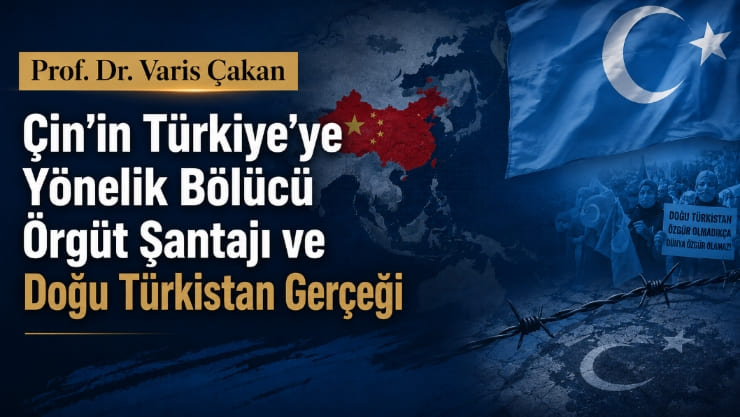
The People's Republic of China is exerting diplomatic pressure on Türkiye by comparing the Uyghur issue in East Turkistan with Türkiye's terrorism problem. Prof. Dr. Varis Çakan argues that the two cases are entirely different historically and sociologically, and that China is using this narrative as an instrument of blackmail.
Author: Prof. Dr. Varis Çakan
Whenever the Republic of Türkiye seeks to defend the human rights of the people of East Turkistan under Chinese occupation in international forums, the People's Republic of China places separatist organizations such as the PKK, which seeks to divide Türkiye, in the same category as the Uyghurs, who are waging a struggle for independence against Chinese oppression, and labels the Uyghurs “terrorist organizations” seeking to divide China. Beijing blackmails Türkiye by saying, “If Türkiye supports the (so-called) Uyghur terrorists who want to divide Chinese territory, China will support PKK members who want to divide Türkiye,” thereby treating the Uyghur issue in China and the Kurdish issue in Türkiye as equivalent.
So what is the truth? Are the so-called “Kurdish question,” which was artificially created in Türkiye, and the question of the Uyghurs, who have maintained a national resistance against China since their land was occupied in 1949, issues of the same character? Let us examine this from a historical perspective.
As is well known, the Republic of Türkiye was founded through a war of liberation following the disintegration of the Ottoman Empire. Historical sources clearly show that the Turks are a nation that has maintained its presence in the Middle East for more than ten centuries. Anatolia's status as the homeland of the Turks was established by the Battle of Manzikert in 1071. Moreover, the Turks lost more than 70% of Ottoman territory after the First World War.
When the Turks began to rule Anatolia, the powerful Karakhanid State governed East Turkistan, where the Uyghurs live today, as well as West Turkistan. Throughout history, East Turkistan lay within the domains of the Hun, Göktürk, Uyghur and Karakhanid states. Today, the flags of these four great Turkic states appear on the emblem of the Presidency of the Republic of Türkiye.
According to independent sources, the Uyghurs were among the founding elements of the four great Turkic states mentioned above. In addition, Mahmud al-Kashgari, the author of Dīwān Lughāt al-Turk—the first encyclopedic dictionary of the Turkic languages—and the author of Kutadgu Bilig lived in Kashgar, an ancient city in present-day East Turkistan, and produced their works there.
After the collapse of the Karakhanid State, East Turkistan came under Khitan, Naiman and Mongol invasions. Nevertheless, the Uyghurs absorbed these nomadic groups and Turkified them.
As a result, Turco-Mongol states such as the Chagatai Khanate and the Timurid State were established in East and West Turkistan. After the Eastern Chagatai Khanate, also known as the Moghulistan Khanate, the Yarkand Saidiya State was founded in East Turkistan in 1514 (1514–1678). In 1678, the state was destroyed by the Mongol Dzungar tribe because of the betrayal of Hidayatullah Ishan, the leader of the İşkiye order who was popularly known as Afaq Khoja.
A puppet Khoja administration was subsequently established in East Turkistan under the patronage of the Mongol Dzungars (1678–1755). East Turkistan suffered a major catastrophe during the Khoja era, which is known as the country's age of ignorance and darkness. The sense of statehood and national consciousness suffered a severe blow. From that point onward, the history of East Turkistan began to be written in blood and tears.
By 1755, struggles for the throne had broken out among the Dzungar aristocracy, the patrons of the Khojas of the İşkiye sect. The Manchu Empire—then ruling China as the Qing dynasty (清朝, 1644–1911)—seized the opportunity and invaded East Turkistan for the first time.
Between 1755 and 1762, a war began between the people of East Turkistan and the occupying Manchus and continued for nearly a century. Eventually, by the 1860s, the Manchu occupiers were driven out of East Turkistan, and local governments established in five regions began to administer the country.
Yaqub Beg of Kokand united the five local governments established in East Turkistan and founded the State of Kashgaria in 1865, taking the title “Ataliq Ghazi.” Britain, Tsarist Russia and the Ottoman Empire initially recognized the state and established diplomatic relations with it. After the State of Kashgaria pledged allegiance to the Ottoman Empire, Ottoman Sultan Abdulaziz Khan granted Yaqub Khan the title of “Emir.”
Later, following Yaqub Khan's death by poisoning, Britain and Tsarist Russia withdrew their support for the State of Kashgaria and reached an agreement with China's Manchu Empire. Consequently, the Manchu Empire occupied Kashgaria again in 1878.
Following the 1881 Treaty of Ili between Tsarist Russia and the Manchu Empire, East Turkistan was left under Manchu rule in accordance with the agreement. After occupying East Turkistan for the second time, the Manchu Empire renamed the region the so-called “Xinjiang”—meaning “New Frontier”—in 1884.
After the Manchu Empire collapsed in 1911, East Turkistan was ruled by three rogue militarist warlords—Yang Zengxin (楊增新, 1911–1928), Jin Shuren (金樹仁, 1928–1933) and Sheng Shicai (盛世才, 1933–1944)—without being effectively subordinate to Zhonghua Minguo (中华民国), the Republic of China established in 1912. Following a national struggle that began in the early 1930s, the people of East Turkistan founded the East Turkistan Islamic Republic (November 12, 1933–February 1934) and gained independence.
However, the Soviet Union under Stalin provided military support to the warlord Sheng Shicai, whose sphere of control was then limited to the Urumqi area, and dismantled the East Turkistan Islamic Republic.
Sheng Shicai, who ruled East Turkistan from 1933 to 1944 with Stalin's support, turned away from Stalin after Nazi Germany attacked the Soviet Union. In exchange for tonnes of gold collected from East Turkistan by various means, he sought refuge with Chiang Kai-shek (蔣介石), the leader of the Nationalist Chinese Government.
East Turkistan thus became formally attached to Zhonghua Minguo—the Nationalist Chinese state—from 1944 onward. After turning away from the Soviet Union, Sheng Shicai provoked widespread anger by killing thousands of people, Turkic and Chinese alike, under the banner of “Fighting Communism.” Chiang Kai-shek removed him from his post in East Turkistan in 1944 and sent Wu Zhongxin (吴忠信) to replace him as the head of so-called “Xinjiang.”
Unable to accept Sheng Shicai's betrayal, Stalin provided political and military support to the national struggle that erupted in northern East Turkistan. At the end of this struggle, the East Turkistan Republic was established in Ghulja on November 12, 1944.
However, the Soviet Union—which had divided West Turkistan and created five so-called Soviet Socialist Republics consisting of Uzbekistan, Kyrgyzstan, Tajikistan, Kazakhstan and Turkmenistan—considered the independent East Turkistan Republic established next to West Turkistan a danger to itself and once again supported the Nationalist Chinese state. The East Turkistan Republic was therefore forced, under Soviet pressure, to conclude a peace agreement with the Nationalist Chinese Government in 1946.
Ultimately, with the contribution of pro-Soviet figures serving in the East Turkistan Republic's administration, an 11-article agreement was signed in October 1946 and a Provisional Government was formed in Urumqi. The authority of the East Turkistan Republic was restricted to the Ili, Altay and Chöchek provinces in northern East Turkistan. The East Turkistan National Army, which was advancing toward the capital, Urumqi, after a major victory, was halted on the banks of the Manas River through Stalin's personal intervention.
Japan's surrender brought the Second World War in the Asia-Pacific region to an end, while a civil war lasting approximately three years began in China. After the Chinese Communist Party (CCP) won the civil war, the present-day People's Republic of China was established on October 1, 1949. The Soviet Union under Stalin enabled the Red Army of the People's Republic of China, led by Mao Zedong (毛泽东), to occupy East Turkistan. Since that date, East Turkistan, an ancient Turkic homeland, has remained under Chinese occupation.
Since October 1949, the Uyghurs and other Turkic peoples—the indigenous owners of East Turkistan—have struggled against China to liberate their occupied land. The Uyghurs and other fraternal Turkic communities in East Turkistan are not trying to separate from China a region that historically belonged to China. On the contrary, they are fighting to liberate their occupied homeland.
The Uyghurs and other Turkic peoples who share their fate have lived on this land since time immemorial and are East Turkistan's indigenous peoples. East Turkistan, which China calls the so-called “Xinjiang Uyghur Autonomous Region,” is a historic Turkic homeland that was occupied in October 1949 because of the betrayal of a very small number of collaborators and capitulationists.
In conclusion, placing the Uyghurs, who are struggling to liberate their occupied homeland, in the same category as separatist organizations such as the PKK, which seeks to divide Anatolia—a Turkic homeland for more than a millennium—is incompatible with historical realities. History must not be turned into an instrument of the expansionist policies of imperialist countries.
Source: Haber Nida | August 29, 2026
Original article: Turkistan Times