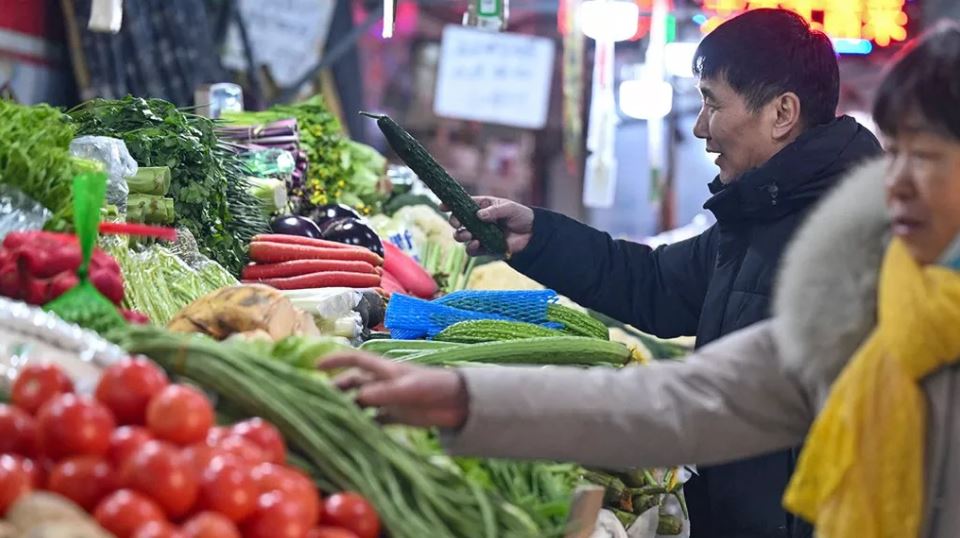
The Jiuding market in Urumqi, in the Xinjiang Uyghur Autonomous Region, a major agricultural granary. Photo: Ding Lei/Xinhua/AFP.
Thanks to its logistics infrastructure, China has turned Xinjiang into a base for exporting agricultural products across Central Asia and beyond. Beijing has nevertheless lost some Western customers because of its repression of Uyghurs in the region.
Author: Raphaël Balenieri
Published: September 27, 2026 at 09:25
Translated by Turkistan Times
Original source: Les Echos
Covering almost 667,000 square metres, shipping 300,000 tonnes of fruit a year and hosting more than 1,300 traders, the Agricultural Products Trading Centre in Aksu is a city within a city. Aksu is a small city of half a million people in China’s far west, in the Xinjiang Uyghur Autonomous Region. Resembling a local version of the Rungis wholesale market, the state-owned site stores, processes and then transports all agricultural production from the surrounding area to the rest of China, nearby Central Asia, the Middle East and beyond.
Business appears to be going rather well, judging by the gigantic dashboard installed at the entrance, where data are displayed in real time. «Four years ago, 4 percent of our walnut production was exported. Today, the figure is 39 percent», said Wang Xiaoming, one of the centre’s managers, during a recent trip organised by the regional authorities and financed entirely by Les Echos. «Our apples, potatoes, onions… Potentially, we can export everything. This trend will continue», he predicted.
Trade Surplus in Vegetables
China is no longer exporting only electric vehicles, batteries and wind turbines. Although the volumes and sums involved are smaller, Beijing is exporting an increasing share of its agricultural production.
The development is not new, but recent infrastructure improvements, combined with the modernisation of Chinese agriculture, have greatly expanded the possibilities. In 2025, the value of China’s vegetable exports, both fresh and processed, rose by 7.2 percent year on year to nearly 19 billion US dollars, according to Chinese customs data.
China even recorded a trade surplus of more than 17 billion dollars in this segment last year. For the first time, processed and prepared vegetables, which generate more added value, accounted for more than 45 percent. Tomatoes from Xinjiang, for example, are exported to Italy in the form of pasta sauce.
In fruit, by contrast, China imports more than it exports. Even so, Chinese fruit exports increased by 5 percent to more than 6 billion dollars, or 8.6 billion dollars when processed fruit is included. Some categories, including grapes and citrus fruit, posted double-digit growth.
Xinjiang alone symbolises this trend. Three times the size of France and bordering eight countries, the region lies a five-hour flight from Shanghai and is one of China’s orchards. Its grapes, melons, walnuts and pomegranates are known throughout the country. Aksu is the city of apples, a fruit that has become its mascot and appears throughout the city’s street furniture.
Drones and Cotton Fields
China is capitalising on the variety of its climates and the extent of its farmland, two advantages that allow it to cultivate almost every agricultural product in large quantities. The world’s second-largest economy is also benefiting from the modernisation of its agriculture, which has accelerated yields. In Kumuyila, a small village near Aksu specialising in cotton cultivation, the use of drones to plant seeds has made the work easier.
«Previously, planting one mu of cotton [a traditional Chinese unit equivalent to 670 square metres] took one or two days of work. A drone does it in five hours», said Youssef, a 36-year-old Uyghur who grows cotton with his family in the agricultural cooperative. Production there is said to have almost doubled, reaching 400 kilograms per mu, thanks to machinery.
Infrastructure improvements then enabled China to export at lower cost. In 2016, under the Belt and Road Initiative, Beijing launched a China-Europe rail link that now connects 129 Chinese cities with 236 European cities, according to the operator China Railway. In Urumqi, Xinjiang’s regional capital, the international airport surpassed London Heathrow in surface area after a new terminal opened last year.
A Reputational Problem
In Xinjiang, however, China faces a reputational problem that has cost it customers in the West. The violent policy of Sinicisation targeting Uyghurs for roughly a decade has prompted some European and American buyers to sever ties. «Many companies no longer want to use Xinjiang cotton. This has affected the local economy», said Darren Byler, a Xinjiang specialist at Simon Fraser University in Canada.
In Aksu, a textile giant that sold its cotton yarn to numerous brands, including Nike and Adidas, was forced to turn back to the domestic market after being sanctioned by the United States in 2025. Washington accused the company of using Uyghur forced labour, an allegation the company disputes.
«Exports now account for only 20 percent of our business, compared with 70 percent previously. We mainly export to Southeast Asia. Europe now accounts for only 3 to 5 percent of enquiries», acknowledged a company representative who opened the factory to a group of journalists on condition that its name not be disclosed. All around him, machines spin cotton amid deafening noise until the spools are packed into boxes, at a rate of 30 to 50 tonnes a day.
«Not long ago, representatives of Hugo Boss came to inspect our factories, but they told us they were not the decision-makers», he said. Contacted by Les Echos, the German group categorically denied this.