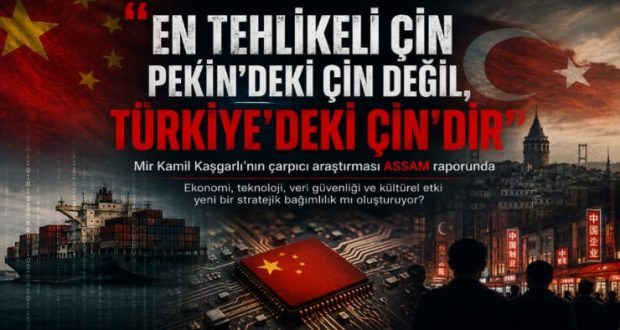
(The original language of this article is Turkish. Translated by ASSAM.)
Mir Kamil Kaşgarlı, Journalist-Author
ABSTRACT
This study examines China's influence on Türkiye not just in economic relations, but within a multifaceted framework encompassing daily life, technology, industry, security, and social structure. The study analyses dependency relationships across various sectors, from food and pharmaceuticals to e-commerce platforms, digital infrastructure, and strategic investments, highlighting the potential for long-term economic fragility, data security risks, and strategic dependency. The study's significance lies in its observation that while China's influence often manifests in a fragmented and indirect manner, it can create cumulative effects across different areas, leading to structural consequences. Therefore, the study considers this influence not as a one-dimensional economic relationship, but as a multi-layered process. The findings indicate that Türkiye needs to develop policies that protect its strategic independence while maintaining its integration with the global system. Accordingly, strengthening domestic production, reducing dependence on foreign sources in critical sectors, securing digital infrastructure, and protecting data sovereignty stand out as key policy priorities.
KEYWORDS: China's Influence in Türkiye, Strategic Dependence, Digital and Economic Security
INTRODUCTION
At a time when global power balances undergo profound transformation, interstate competition is no longer restricted to traditional military and economic domains; rather, it increasingly encompasses technology, data security, supply chains, and societal impact. Accordingly, China’s growing global influence in recent times is giving rise to multi-faceted implications, particularly for developing countries. Türkiye is not immune to this process; the economic, technological and commercial relations with China are venturing into an increasingly broad range of areas.
This study aims to examine China’s influence on Türkiye not merely against the backdrop of traditional foreign trade or investment relations, but from a broad perspective spanning everything from everyday life to digital infrastructure, and from industrial production to security policies. Its significance lies in the fact that, although this influence often manifests itself in a fragmented and indirect manner, it points out to a structure that could have significant long-term consequences in terms of economic dependence, data security and strategic vulnerabilities.
In light of the foregoing, the study examines China’s influence on Türkiye under six main headings. Firstly, it analyzes the systemic interdependencies reshaping daily life and consumption patterns, contextualizing them through empirical evidence from the food, pharmaceutical, and digital commerce industries. This is followed by an exploration of topics, including data security, surveillance and algorithmic steering under the heading of technology and digital infrastructure. Thirdly, the impacts on the economy, industry and strategic sectors are examined, while the fourth section addresses the security and cyber dimensions. Subsequently, strategic dependency relationships against the backdrop of state policies and international projects are analysed. And finally, the study focuses on cultural and social spheres of influence.
Accordingly, the study assesses China’s presence in Türkiye not as a one-dimensional economic relationship, but as a multi-layered sphere of influence with mutually complementary elements, and brings into focus the risks that this process may entail.
CHINA’S MULTIDIMENSIONAL SPHERE OF INFLUENCE IN TÜRKİYE
1.1. Daily Life and Consumption: ‘The Reach of Dependency: From Our Kitchens to Our Pharmacies”
China’s influence in Türkiye is directly reflected in daily life through the food sector. This influence is not limited to imported garlic but is also evident in the use of monosodium glutamate (MSG), various preservatives and genetically modified agricultural products, which are key components of the food industry. The increasing replacement of indigenous seeds and natural (organic) production processes with industrial additives of Chinese origin poses a potential long-term risk to public health. This development exacerbates Türkiye’s external dependence within the domain of food security, rendering its agricultural production vulnerable to fluctuations in imported inputs.
China’s influence is likewise expanding into the health sector by way of the pharmaceutical industry. The fact that Türkiye has become heavily reliant on China for active pharmaceutical ingredients (APIs) used in drug manufacture creates a significant vulnerability for the healthcare system. The fact that the supply of raw materials—ranging from the simplest antibiotics to the most critical medicines—is anchored on China increases external dependency. This carries the risk of supply chain disruptions in the event of a potential crisis or political tension, creating a structure that could have severe consequences for the healthcare system.
China’s influence also demonstrates itself through consumption habits and e-commerce. The increasing “micro-import” process through platforms such as Temu, Alibaba and Shein facilitates access to low-cost products while creating significant competitive pressure on domestic tradesmen and SMEs. Furthermore, this flow of products occurring duty-free or with limited inspection creates negative effects on the economic structure and can contribute to an increase in the current account deficit.
China’s growing footprint is likewise manifest in the digital economy, particularly across logistics channels and data flows. The relationship between Trendyol, one of Türkiye’s largest e-commerce platforms, and the Alibaba Group is an issue that requires evaluation not only from a commercial standpoint but also from a data security perspective. This process results in the collection of data about user identities, addresses, payment details and consumption habits within big data systems. The processing and storage of this data by multi-nationals is an issue that must be addressed with utmost care in terms of data security and digital sovereignty.
China’s influence on global supply chains is also apparent in the textile sector. Production processes known as ‘Xinjiang cotton’ have been the subject of debate in the international public sphere due to their production conditions. The inclusion of this raw material in the global textile market is viewed as an issue with not only economic but also ethical implications. This poses a risk that must be taken into account for the Turkish textile sector’s reputation in international markets and the high quality of its exports.
China’s impact also extends to the toy industry, with major implications for child health standards and domestic manufacturing. The widespread availability of toys of Chinese origin is notable due to their low-cost production. However, the substandard production conditions of some products and the possibility that they may contain harmful chemicals may pose a risk to children’s health. Also, these products create price-driven competitive pressure on domestic toy manufacturers.
China’s influence is evident in the furniture sector through production inputs. The fact that a significant proportion of the fabrics, mechanisms, foam and accessories used in furniture production are of Chinese origin increasingly renders the sector dependent on imports. This can constrain domestic value addition and push local manufacturers toward an assembly-oriented production model.
Finally, China’s influence extends through home technologies into the more private spheres of daily life. Robot vacuum cleaners, smart bulbs and IoT (Internet of Things) devices, admittedly provide comfort in daily life but they have the capacity to collect data via cameras, microphones and sensors. The storage and processing of this data via cloud systems is a matter that requires careful consideration when it comes to user privacy and data security.
1.2. Technology, Surveillance and Digital Influence: ‘The Spread of Techno-Authoritarianism”
Mobile devices serve as a direct channel through which China’s influence is experienced at the individual level in Türkiye. The prevalence of brands such as Huawei, Xiaomi, Oppo and Vivo in the market is assessed not only as a commercial choice but also from the perspective of data security. Potential security vulnerabilities or the possibility of ‘backdoors’ at the hardware (chipset) and software (kernel) levels of these devices create vulnerabilities regarding user data surveillance, interception, and leakage.
China’s influence has also become an integral part of daily life through mobile applications. Platforms such as TikTok and CapCut reach large audiences while becoming subjects of debate regarding data collection and processing. The fact that such applications are under data sharing obligations with the state under China’s ‘National Intelligence Law’ brings along various concerns regarding the security of user data.
China’s digital influence is also evident through algorithmic steering mechanisms. It is frequently stated that there are differences in content policies between application versions used in China (e.g. Douyin) and versions used in other countries. This leads to algorithms being evaluated not merely as tools for delivering content, but as mechanisms capable of steering user behavior.
China’s influence gains a strategic dimension through internet infrastructure. The effectiveness of Chinese companies in 5G technology, base stations and modem infrastructures brings to the agenda the risk of main systems through which data traffic passes becoming dependent on external sources. This is a development that must be carefully evaluated in terms of data security and digital sovereignty.
China’s influence is also felt in public spaces through surveillance technologies. Face recognition, license plate reading and behavior analysis systems provided by companies such as Hikvision and Dahua, while used for security purposes, become subjects of debate due to their large-scale data collection capacity. The use of biometric data obtained through these systems stands out as an important topic regarding data security.
China’s influence also impacts the young population through digital entertainment and the gaming industry. Platforms like Tencent and PUBG, while reaching large audiences, can generate cultural and behavioral effects through in-game interactions, digital purchases and content flows. This causes digital platforms to be evaluated not merely as entertainment tools, but as spaces for social interaction.
China’s influence is also seen in cryptocurrency and digital finance. Transactions carried out through mining hardware (ASIC) and cryptocurrency exchanges create new risk areas within the financial system. In particular, Certain systems that enable anonymous transactions may hinder the detection of illicit financial activities and therefore they give rise to new debates regarding regulatory mechanisms.
China’s influence is also taking on a strategic dimension through energy and transport technologies. The concentration of supply in lithium batteries and rare-earth elements used in EV production fuels the global dependency in this sector. Türkiye’s reliance on foreign battery technologies in the automotive sector’s transformation process stands out as an element to be evaluated in terms of energy and transport security.
China’s influence is also expanding into space and satellite technologies. While projects developed in satellite systems and navigation infrastructures proceed within inter-state cooperation, they create an area that must be handled with care regarding data sharing and strategic information flow. China’s development of alternative technologies, such as the Beidou navigation system, creates a new area of competition on a global scale.
Finally, China’s influence is also evident in advanced technology and intelligence. Developments in quantum computing and quantum key distribution (QKD) technologies raise the possibility that current encryption systems may become breakable in the future. In this context, the approach expressed as “store now, decrypt later” points to the risk that encrypted data collected today may be decrypted in the future.
1.3. Economy, Industry and Strategic Ownership: ‘New Colonialism Debates”
China’s economic footprint in Türkiye is particularly pronounced within the trade balance. Relations with China—one of the countries with which Türkiye records the largest trade deficit—put pressure on domestic production. The flooding of state-subsidised, low-cost products into the market is challenging for domestic manufacturers in terms of their competitiveness; this carries the risk of a decline in production capacity and increased external dependency.
China’s influence also finds its way into the industrial structure through the automotive sector. The rapid and supported flood of brands such as Chery, BYD and MG into Turkish market creates not only commercial competition but also a new balance in terms of the automotive supply industry and supply chain. This process stands out as a development that requires careful assessment in terms of Türkiye’s production infrastructure and integration into international trade.
China’s influence is also felt in economic decision-making processes through financial relations. While swap agreements and credit mechanisms may provide short-term financial relief, they create a structure that could strengthen economic dependency relationships in the long term. Therefore, financial partnerships should be handled not merely in an economic but also in a strategic framework.
China’s influence manifests in less transparent areas, such as shadow banking and alternative financing mechanisms. Certain financing models outside official regulatory oversight complicate corporate debt structures and may exert indirect influences on management processes. This stands out as an area requiring careful assessment in terms of financial sustainability and corporate structure.
China’s influence extends deep into the financial system via the banking sector. While the operations of institutions such as ICBC Turkey and the Bank of China are significant in terms of fostering robust financial relations, they also give rise to new debates regarding the analysis of corporate data and the flow of financial information.
China’s influence is now more integrated than ever into global trade networks via logistics infrastructure and ports. The transfer of strategic ports such as Kumport to Chinese companies is evaluated within the framework of “Maritime Silk Road” projects. This requires ports to be addressed not only from a commercial standpoint but also in terms of their strategic importance.
China’s influence is also evident in the natural resources and mining sectors. Exporting low-value-added resources—such as marble, boron, thorium, and rare earth elements—has fueled controversy over exporting raw materials without domestic processing. This stands out as an issue that must be assessed in terms of resource management and economic value creation.
China’s influence in the energy sector manifests itself through technological dependence. Solar panel manufacture and large-scale energy projects play a significant role in Türkiye’s energy transition journey. That said, the continued reliance on foreign technology, equipment and software components in the industry is viewed as a factor that must be taken into account when it comes to energy security.
China’s influence also extends to the property market. Land acquisitions in strategic regions, agricultural lands and in the vicinity of major projects fuel the debate in terms of long-term ownership structures although they are viewed as economic investments.
China’s influence is also evident on corporate structures via the capital markets. While foreign equity inflows into specific Borsa İstanbul-listed firms are an expected byproduct of cross-border capital mobility, it is a development that requires close monitoring in terms of changes to the ownership structure of companies in critical sectors.
China’s influence can also be found through public tenders and infrastructure projects. Although the involvement of Chinese firms in the financing and implementation phases of large-scale projects may provide short-term cost advantages, one should also look at its long-term impact on debt obligations and domestic capacity.
Finally, China’s influence is linked to regional balances through international partnerships and technology transfers. China’s technology investments in various countries and its presence in strategic projects can create indirect effects through the relationships established with these nations. This is also an aspect that must be addressed in terms of regional geopolitical balances.
1.4. Security, Intelligence and the Cyberspace: ‘Transboundary Risks”
China’s influence in Türkiye is also a hot topic of debate in terms of security, particularly through its intelligence activities and spheres of influence. The alleged existence of “illegal overseas Chinese police stations” based within Türkiye’s borders draws attention as assessment suggest that they were established to monitor, interrogate and exert pressure on their own citizens, particularly Uyghur Turks. Alleged existence of such structures stand out as an issue that must be carefully addressed in terms of sovereignty rights and the “rule of law” principles.
China’s influence is also closely watched in the defence industry. The global recognition gained by Türkiye’s advancements in unmanned aerial vehicles (UAVs), smart munitions, and missile technologies underscores the critical necessity of safeguarding its technological know-how. Collaborations such as “joint production” and “technology transfer”, must also be carefully assessed from the perspective of protecting intellectual property rights, regardless of whether or not they offer excellent opportunities.
China’s influence is also striking in operational activities and international security practices. It is known that surveillance and tracking of Chinese diaspora are carried out under certain operations such as ‘Sky Net’ and ‘Fox Hunt’. Accordingly, allegations of physical and digital surveillance targeting the Uyghur diaspora in Türkiye have sparked critical debates regarding diaspora mobilization and freedom of expression.
China’s influence is also felt at the individual level through communication tools. Allegations that pressure is put on some Uyghur Turks living in Türkiye via their family members in China stem from practices such as forcing individuals to share information about their social circles and activities. This stands out as an issue that must be approached in terms of individual security and fundamental rights.
China’s influence is also evident in the field of cyber security. Cyber-attacks reportedly carried out by ‘APT’ groups targeting Turkish public institutions, local authorities, energy infrastructure and universities pose significant risks to critical data security. Such activities are addressed as potential threats to the state’s decision-making mechanisms.
China’s influence is also seen in the research and development (R&D) operations and technology ecosystem. Models of certain investment and partnerships operating in technology parks and the start-up ecosystem give rise to the risk that patents, algorithms and technologies developed by domestic start-ups may be transferred at low cost. This constitutes a significant area of debate regarding the protection of intellectual property rights.
China’s influence is also discussed in relation to agriculture and biological resources. While Anatolia’s endemic flora, landraces, and rich biodiversity regularly feature in international scientific collaborations, the international use and protection of this data has subsequently emerged as a key issue. This must be diligently addressed from the perspective of the management and protection of biological resources.
Finally, China’s influence is also a major topic of debate in the fields of biotechnology and genetic data. It is suggested that genetic data collected through biotechnology companies and various data collection processes may be used for different purposes in future. Accordingly, genetic data security has emerged as one of the new and key areas of national security.
1.5. State and Strategy: ‘Political and Economic Dependence”
China’s influence in Türkiye also manifests in state policy and strategic posture through mega-projects and multilateral initiatives. Türkiye’s position in the “Belt and Road” (BRI) initiative is largely assessed in the context of a transit corridor. This is viewed as a structure that could entail risks such as limited added value in logistics and an increase in financial obligations in the long term.
China’s influence is also reflected in strategic areas through transport infrastructure. The presence of Chinese partners at critical junctures such as Yavuz Sultan Selim Bridge and the Northern Marmara Highway, though regarded as an economic cooperation, should be examined from various perspectives thanks to its strategic importance. It is at the times of crises, in particular, that the control and management of such infrastructure turn out to be a strategic issue.
China’s influence is also felt in the spheres of diplomatic relations and foreign policy. The diplomatic alignment governed by the 'One China' principle remains a key strategic variable requiring careful assessment relative to Türkiye’s foreign policy orientation and global diplomatic posture. Accordingly, Türkiye’s relations with regions with which it shares historical and cultural ties are also among the factors that may be affected from it.
China’s influence also manifests itself in various ways through local authorities. Partnerships driven by ‘sister city’ relationships and ‘smart city’ projects lead to local councils working with Chinese firms in certain areas, including transport, waste management, water systems and data infrastructure. This process stands out as an area requiring careful assessment regarding data management and digital infrastructure security at the local level.
China’s influence is also debated in the legal and judicial domains. In particular, arrangements such as "Extradition Treaties" are subject to varying assessments under international law, human rights, and domestic law. The scope and implementation of such treaties are addressed in both their legal and political dimensions.
China’s influence is also observed through citizenship and investment processes. The presence of foreign investors acquiring citizenship in exchange for real estate investments, while evaluated economically, also gives rise to debates regarding these individuals' activities in economic and social spheres. This constitutes a topic requiring assessment within the framework of investment policies and national interests.
Finally, China’s influence is also evident through the environment and natural resources. The enforcement of environmental standards in mining and heavy industry investments is of great importance in terms of water resources, soil fertility and ecological balance. The environmental impacts of such investments are a key issue that must be assessed within the framework of sustainable development and environmental policies.
1.6. Mind, Ideology and Social Impact: ‘Cultural and Perceptual Transformation”
China’s influence in Türkiye is also debated through the field of education. Some observers view the educational and cultural programs run by Confucius Institutes as more than just educational programs, but also as channels used to convey China's official viewpoints. Accordingly, the question of how the academic environment and academic freedom at universities are affected within the framework of international cooperation has become a subject of debate.
China’s influence also emerges as a key issue in the course of academic output and research activities. While research projects and academic studies funded by China are generally viewed as part of scientific collaboration, there are criticisms for the restriction or disregard of critical studies, particularly those concerning developments in East Turkestan.
China’s influence is also felt in the media sector. In addition to media institutions with direct links to China (e.g CRI Türk), assessments suggest that advertising and content partnerships have become channels through which indirect influence is exerted on local media. Accordingly, the public dissemination of news regarding events in East Turkestan has become a subject of critical debate concerning editorial autonomy and press freedom.
China’s influence is also evident through digital content creators and social media influencers. It is argued that content produced as part of visits and promotional activities organised by China reflects a specific perspective and may influence public perception. This constitutes a significant area of debate in terms of digital media and the flow of information.
The extent of China’s influence is increasingly being evaluated within and through the scope of the publishing industry. It is suggested that certain economic and political narratives are being disseminated through China-backed publishing projects and works translated into Turkish. This is examined in terms of intellectual production and ideological orientations.
China’s influence is also felt in the arts. The support given or refused, to, certain content in film festivals, exhibitions and cultural events is a subject of debate, particularly with regard to works focusing on human rights themes. Accordingly, Restricting cultural and theatrical works that deal with developments in East Turkestan raises fundamental questions regarding the boundaries of artistic freedom.
China’s influence is also examined as a means of exerting economic pressure through the tourism sector. Linking tourist activity to specific political issues suggests that tourism revenues could be indirectly affected. This raises questions about the relationship between economic dependence and social and political attitudes.
China’s influence also manifests itself in the sports sector through sponsorship arrangements. The financial support from Chinese firms to sports clubs has an impact on fan bases and the sports economy. At the same time, the reactions faced by athletes who make statements regarding East Turkestan also bring the political dimension of sport to the fore.
China’s influence is also assessed through ideological debates and intellectual orientations. In discussions concerning Türkiye’s foreign policy axis, the nature and scope of relations with China are approached from various perspectives.
China’s influence is also the subject of various assessments in the political realm. The handling of relations with China at the political level is discussed with reference to foreign policy preferences and national interests. Accordingly, positions on the East Turkestan issue serve as key indicators of broader political alignments and ideological leanings.
Finally, China’s influence is also looked at the social and moral levels. Whether certain issues are overlooked or reinterpreted for economic and political gain is actively debated through the lens of social value. Accordingly, social sensitivity towards developments in East Turkestan, in particular, is regarded as a matter of conscience and ethics.
From a holistic approach, China’s influence in Türkiye emerges not merely as an external factor, but as a multi-layered process that extends across various fields and deepens over time. The analysis carried out under this scope intends to increase awareness of Turkey’s sovereignty, social structure, and future trajectory.
CONCLUSION AND ASSESSMENT
This study has examined China’s influence on Türkiye not merely against the backdrop of economic relations, but from a multidimensional perspective spanning from everyday life to technology to industrial and financial structures to the fields of security, intelligence and society. The main goal is to demonstrate that this influence—frequently manifesting in a subtle and piecemeal fashion—may build up significant long-term consequences.
The findings point out that China’s presence in Türkiye forms a sphere of influence that cannot be reduced to a single area, but rather comprises complementary elements that deepen over time. Supply chain dependencies in the food and pharmaceutical sectors, security risks through digital infrastructure and data flows, structural vulnerabilities in the industrial and financial sectors, and interactions at the cultural and social levels stand out as key components of this multi-layered structure. In this respect, according to the study, the process extends beyond economic integration and entails transformation at both the strategic and structural levels.
In light of these findings, the fundamental challenge that Turkey faces is to strike a balance that allows it to maintain its strategic independence without compromising its integration with the global economic system. Accordingly, top priority emergency areas include strengthening domestic production capacity, reducing external dependence in critical sectors, securing digital infrastructure and safeguarding data sovereignty. Moreover, other key components of this process include maintaining transparent and sustainable financial relations, controlling strategic infrastructure and protecting intellectual property rights. Ultimately, this study assesses China’s influence in Türkiye not as a one-dimensional relationship, but as a multi-layered process in which economic, technological and social dimensions are intertwined; it therefore underscores the need to manage this process through comprehensive policies grounded in a long-term perspective. In this respect, it provides a framework designed to make sense of the current state of affairs while addressing prospective risks.